Friday, July 07, 2006

OFF TANGENT | A Lyrical Life

I've been playing a lot of Sarah McLachlan recently. You know how sometimes, like a miracle, a song just seems to be about your life?

Actually, it's quite sad - because life is larger than a song, or a book for that matter. But I can admit sometimes - it feels like it's all about you.

A friend once pointed out hoobastank's Reason is the "Story of My Life." For the reason mentioned above, I disagree. My life is larger than that song. My friend got it wrong; my Ex is NOT The Reason I want to change my life.

Rather, I realised the choices I had made were making me unhappy. I chose to change because I believe I deserve to be happier.

But I concede there are still songs that echoed the little unhappy chapters in my life. I set these songs on "Repeat" mode on my mpeg player sometimes, when the mood hits me.

This is one of them (and it's not Sarah McLachlan):

Change
Tracy Chapman

If you knew that you would die today
If you saw the face of God and love
Would you change?
Would you change?

If you knew that love can't break your heart
When you're down so low you cannot fall
Would you change would you change?

How bad how good does it need to get?
How many losses how much regret?
What chain reaction
What cause and effect
Makes you turn around
Makes you try to explain
Makes you forgive and forget
Makes you change
Makes you change

If you knew that you couldn't be alone
Knowing right being wrong
Would you change?
Would you change?
If you knew that you would find a truth
That brings a pain that can't be soothed
Would you change would you change?

How bad how good does it need to get?
How many losses how much regret?
What chain reaction
What cause and effect
Makes you turn around
Makes you try to explain
Makes you forgive and forget
Makes you change
Makes you change

Are you so upright you can't be bent
if it comes to blows
Are you so sure you won't be crawling
If not for the good why risk falling
Why risk falling

If everything you think you know
Makes your life unbearable
Would you change?
Would you change?
If you'd broken every rule and vow
And hard times come to bring you down
Would you change?
Would you change?

If you knew that you would die today
If you saw the face of God and love
Would you change?
Would you change?
Wednesday, July 05, 2006

MUSIC | Evanescence's New Album

Evanescence, one of my favourite band, will have a new album out this year. It's currently slated for October 2006 release.

Album entitled The Open Door.

Tuesday, July 04, 2006

Fallen by Sarah McLachlan

Fallen

Heaven Bend to take my hand
And lead me through the fire
Be the long awaited answer
To a long and painful fight
Truth be told I tried my best
But somewhere long the way
I got caught up in all there was to offer
But the cost was so much more than I could bear

Though I've tried I've fallen
I have sunk so low
I messed up
Better I should know
So don't come round here and
Tell me I told you so

We all begin out with good intent
When love is raw and young
We believe that we can change ourselves
The past can be undone
But we carry on our back the burdens time always reveals
In the lonely light of morning
In the wound that would not heal
It's the bitter taste of losing everything
I've held so dear

Though I've tried I've fallen
I have sunk so low
I messed up
Better I should know
So don't come round here and
Tell me I told you so

Heaven bend to take my hand
I've nowhere left to turn
I'm lost to these I thought were friends
To everyone I know
Oh they turn their heads embarrassed
Pretend that they don't see
That it's one wrong step one slip before you know it
And there doesn't seem away to be redeemed

Though I've tried I've fallen
I have sunk so low
I messed up
Better I should know
So don't come round here and
Tell me I told you so
I messed up
Better I should know
So don't come round here and
Tell me I told you so

Monday, July 03, 2006

Smelly Cheese

A has returned. She was in Germany for the World Cup with her husband. After that, they toured Europe.

A has returned with smelly cheese for yours truly. Gourmet cheesiness that is currently stinking up the office.

Ahhh...the thought that counts.

Wednesday, June 28, 2006

World Hum's Top 30 Travel Books

"To read and to travel: that should be for anyone among the finest of vocations."
~ Gregorio Brillantes


World Hum - an excellent travel weblog - has finally put up their list of Top 30 Travel Books. Out of Which, I've only read 4, shown in Orange.

No. 1: Arabian Sands by Wilfred Thesiger
No. 2: The Road to Oxiana by Robert Byron
No. 3: The Great Railway Bazaar by Paul Theroux
No. 4: The Soccer War by Ryszard Kapuściński
No. 5: No Mercy by Redmond O’Hanlon
No. 6: North of South by Shiva Naipaul
No. 7: Golden Earth by Norman Lewis
No. 8: Video Night in Kathmandu by Pico Iyer
No. 9: The Innocents Abroad by Mark Twain
No. 10: In A Sunburned Country by Bill Bryson
No. 11: The Snow Leopard by Peter Matthiessen
No. 12: The Songlines by Bruce Chatwin
No. 13: Travels with Charley by John Steinbeck
No. 14: Riding to the Tigris by Freya Stark
No. 15: Europe, Europe by Hans Magnus Enzensberger
No. 16: City of Djinns by William Dalrymple
No. 17: A Short Walk in the Hindu Kush by Eric Newby
No. 18: All the Wrong Places by James Fenton
No. 19: Hunting Mister Heartbreak by Jonathan Raban
No. 20: River Town by Peter Hessler
No. 21: Road Fever by Tim Cahill
No. 22: When the Going was Good by Evelyn Waugh
No. 23: Behind the Wall by Colin Thubron
No. 24: Trieste and the Meaning of Nowhere by Jan Morris
No. 25: A Time of Gifts by Patrick Leigh Fermor
No. 26: Baghdad Without a Map by Tony Horwitz
No. 27: The Size of the World by Jeff Greenwald
No. 28: Facing the Congo by Jeffrey Tayler
No. 29: Venture to the Interior by Laurens van der Post
No. 30: A Turn in the South by V.S. Naipaul

Full Link

Tuesday, June 27, 2006

Observer: Jeanette Winterson

Observer interview with Jeanette Winterson for her new Children's Book, Tanglewreck.

Don't get me started. Yes, another one. ;p

'If I was a dog, I'd be a terrier. I suppose I was brought up in quite a tough culture and used to speaking out. I get angry when people behave stupidly or brutally to each other or to animals or to the planet. It seems to me a debasement of humanity when you can't be bothered to think how your actions will hurt someone else. It drives me mad. You know if there is a fight on the street, I am always in there. I have been knocked about so many times because I can't stand back.'

Thursday, June 22, 2006

Tuesday, June 13, 2006

Times Online: Malapropism

From Times Online
by Jeanette Winterson

Mrs Winterson used to talk about an interfering madam she disliked as a "proper Cleopatra". On further inquiry I discovered she had "a rod up her asp". When I asked what this meant, Mrs Winterson replied: "She won’t let sleeping snakes lie."


Full article.

Tuesday, June 06, 2006

QUOTE: Flaubert on Reading

"Do not read, as children do, to amuse yourself, or like the ambitious, for the purpose of instruction. No, read in order to live."
~ Gustave Flaubert


Now, it sounds all grand and romantic. But - keep in mind that Flaubert never married and lived with his mother his whole life.

Monday, June 05, 2006

When I have a little money, I buy books

I am currently reading The Praise of Folly (along with too many other books). This little quote seems appropriate.

"When I have a little money, I buy books. And if any is left, I buy food and clothings."

~ Desiderius Erasmus

Quotes For Your Notebook: Jeanette Winterson

Nine Wave Design is one of the moleskine-associated sites I visit regularly.

One of my favourite section of this blog is the Quotes For Your Notebook feature.

This is taken from Winterson's Weight: The Myth of Atlas and Heracles:
"I believe there is always exposure, vulnerability, in the writing process, which is not to say it is either confessional or memoir. Simply, it is real."

Yes. Anyone who quotes Jeanette Winterson is fine by my book.

Full entry.

Guardian Interview with Pink!

The Guardian's Barbara Ellen interviews Pink.

It's here because I like her kick-ass honesty. She's opinionated, she's brash and occasionally funny. But she's definitely more centered and self-aware than a lot of the people I know.
Does she ever feel pressured to sit down and shut up? 'Sometimes.' She chuckles throatily. 'And you know what? I'm a lot to take. I know that better than anyone.'


Did I mention I have ALL her CDs? Heh. ;)

Full interview

Backward Narrative

I have been thinking about narrative techniques recently. Sarah Waters' Night Watch works powerfully by telling the story backwards. This is not exactly revolutionary and Waters herself admits she was partly inspired by Harold Pinter's Betrayal.

The poignancy of the unravelled lives, and then moving back in time to where it all began. Knowing we are fated to disappointment and loss, yet yearning desperately to love.

As an explanation for this train of thought: I'm currently working on the story that I first began when I was supposed to be working on my thesis. That was more than 6 years ago. Back then I was watching too many Buffy the Vampire Slayer episodes. The tormented vampire/Slayer love story flooded my consciousness like a cheesy stew.

The story that first sprouted 6~7 years ago was supposed to be a pastiche of all the vampire stories I've imbibed my entire life. But as my computer crashed on me after graduation, and with my life consumed by an adult working life - the story went into hiatus. I stopped writing. Period.

Two years ago I picked up the thread of that lost tale. My notes and drafts were lost and I had to tell the story from scratch; I was also learning to live some aspects of my life anew.

As I begun to write, I realise another story was pushing itself into the foreground. Many of the original characters were altered, some were abandoned. My vampire pastiche became an existential meditation.

I wanted to begin the story with the broken lives of my heroes. (They are heroes because these characters bear the Promethean burden in the story.) And I wanted to trace everything back to the start of it all, 5 years ago.

Intertextuality in Fingersmith

From The Guardian

John Mullan on intertextuality in Fingersmith by Sarah Waters.

What I liked about Fingersmith was the whole Wilkie Collins feel about.

Full article.

Friday, June 02, 2006

Friday, May 26, 2006

Dogs and a Bush

Arundhati RoyAmy Goodman Interviews Arundhati Roy. On AlterNet

AR: ... Across the street from them, in a five-star hotel were Bush's 16 sniffer dogs who were staying in this five-star hotel, and we were all told that you can't call them dogs, because they are actually officers of the American Army, you know. I don't know what the names were. Sergeant Pepper and Corporal Whatever. So, it wasn't even possible to be satirical or write black comedy, because it was all real.

AG: Didn't President Bush visit Gandhi's grave?

AR: He visited Gandhi's grave, and first his dogs visited Gandhi's grave. Then, you know, Gandhians were, like, wanting to purify it. And I said, "Look, I don't mind the dogs. I mind Bush much [more] than the dogs."


Full interview here.

Thursday, May 25, 2006

Tautou and Da Vinci Code

Audrey Tautou
One the French actress of The Da Vinci Code movie, Anthony Lane wrote:
"as for Audrey Tautou, it is surely no coincidence that Howard sought out and hired almost the only young French actress who emits not a hint of sexual radiation."

I don't think Lane got it. The point of Audrey Tautou is not her sexual appeal - but the fact she looks like a potential psycho-stalker. Hence she should have been offered the Silas role instead.
Full New Yorker review of The Da Vinci Code.

Da Vinci and BAD BAD Dialogue

From Anthony Lane's New Yorker review of The Da Vinci Code:
The task of the Bishop and his hit man is to thwart the unveiling of what Teabing modestly calls “the greatest secret in modern history,” so powerful that, "if revealed, it would devastate the very foundations of Christianity." Later, realizing that this sounds a little meek and mild, he stretches it to "the greatest coverup in human history." As a rule, you should beware of any movie in which characters utter lines of dialogue whose proper place is on the advertising poster. (Just imagine Sigourney Weaver, halfway through "Alien," turning to John Hurt and explaining, "In space, no one can hear you scream.")

Sound advice really. And so, so true.

Wednesday, May 24, 2006

Which Classic Female Literary Character Are you?

Another Russian. It's my karma, I swear.


Which Classic Female Literary Character Are you?


You're Anna Karenina of Anna Karenina by Leo Tolstoy!
Take this quiz!


Quizilla |
Join


| Make A Quiz | More Quizzes | Grab Code

Monday, May 22, 2006

THE ENGLISH PATIENT: Words

"She had always wanted words, she loved them, grew up on them. Words gave her clarity, brought reason, shape. Where as I thought words bent emotions like sticks in water."

~ From The English Patient by Michael Ondaatje.

Saturday, May 20, 2006

"All atoms must jump in one direction..."

From The English Patient:
"I believe this. When we meet those we fall in love with, there is an aspect of our spirit that is historian, a bit of a pendant, who imagines or remembers a meeting when the other had passed by innocently...But all parts of the body must be ready for the other, all atoms must jump in one direction for desire to occur."

A long time ago, I was at a play by The Necessary Stage. It was an invitation from BMH, who brought her friends. I sat next to the girl who would captivate me a year later.

But at that moment, we were unknown to one another. She sat next to me, telling lame jokes throughout the play. Trying to get a laugh. Trying to break the ice. She spent the night sitting next to a sombre, silent stranger.

I did not recall much of her about that night. This anecdote was passed on to me through her narrative.

A year later, quite by accident, some antics of hers finally made me laugh. Then I fell in love.

Friday, May 19, 2006

Irene Jacob

Irene Jacob from 'Rouge'
After watching Kieslowski's Rouge, I wrote this about Irene Jacob:

"...you cannot imagine her capable of evil with that beauty"

New Yorker Story

From The New Yorker
CINDERELLA SCHOOL
by LARA VAPNYAR
Issue of 2006-05-22
Posted 2006-05-15


... He asked if I had seen "Red" and "Blue."

"Yes, I’ve seen them," I said.

"Who is more beautiful, Juliette Binoche or Irène Jacob?"

I turned my head to the right, then to the left.

"Juliette Binoche," I said.

"Why?"

"Because Irène Jacob is pure soul. Pure soul cannot be beautiful."

Read story here

Thursday, May 18, 2006

Brain on Toast

I'm just that tad bit burnt-out with the serious books I've been reading recently. So I've putting aside Maximum City, the absorbing biopic of Bombay City.

I'm now reading H. Rider Haggard's She - the same author who wrote boyish trash like King Solomon's Mine. Basically I'm regressing back to sensationalistic gothic trash. Yea.

Brain fever.

Excuse Me, I'm Looking for a Book

People have come in asking for these titles. Seriously.


  1. To Mock a Killing Bird

  2. Catcher in the Wheatfield

  3. The Little Prince by Machiavelli

  4. Who Moved My Tree


Frequently Asked Idiotic Questions:

Customer: "Hello, you work here?"
Me: "No."
I swear. This happens to me even when I'm in T-shirt and jeans in other bookstores or at the supermarket.

Idiot: "You must read lots of books."
Me: "No."

And far too many times, people coming in with, "I'm looking for a book. I don't know the title or the author or what is it about. Can you help me?"

FILM: The Da Vinci Code

Caught The Da Vinci Code movie last night. It would be an over-statement to tell it a thriller. I was not thrilled. Or excited or even intrigued by the plot.

In fact, it insults the intelligence of the audience. But if The Da Vinci Code does become the biggest box-office hit of the year, then to paraphrase JM, the people are getting what they deserve.

The movie opens on what is obviously lazy plotting and no research. A murder has occurred in the Louvre. We see the man, Jacques Sauniere, shot in the stomache by Silas (Paul Bettany playing a tortured, spaced-out albino psychopath). The police detective Bezu Fache (Jean Reno) asks for Professor Robert Langdon's (Tom Hanks in a bad haircut) assistance in the investigation. Jean Reno, who is so cool in Leon, just walks around, breathes a little and talk a bit in this movie.

When we see the naked body of Sauniere laid out in the pattern of Da Vinci's Vitruvian Man, a pentagram drawn in blood on his chest. Langdon asks, who did it to him? Fair question, I would think.

"He did it to himself," answered Fache.

Huh?

We are the generation brought up on CSI: Crime Scene Investigation. And first rule of a murder investigation: preserve the crime scene.

Query: Are we to believe that Fache can just bring in a stranger (and a murder suspect at that) into the crime scene with a dead body?

Bezu Fache supposedly cleared off some of the text Sauniere wrote in ultraviolet marker before his death.

Query: Is Fache allowed to tamper with a crime scene before the body has been removed?

Also, we are supposed to suspend our disbelief that:

1. Sauniere, after being shot in the stomache - has the time and strength to walk around the Louvre writing cryptic anagrams with a ultra-violet marker?
2. Sauniere is the kind of man who just happens to carry a ultra-violet marker with him everywhere he goes?
3. After his ultra-violet graffiti, Sauniere proceeds to strip naked, use his own blood to draw a pentagram on his chest, before lying down to die.
4. Sophie Neveu, having never met Robert Langdon or Fache, knows Fache is trying to frame Langdon for the murder of Sauniere.
5. Sophie Neveu never once suspect Langdon of the murder of her grandfather


A critic wrote that Akiva Goldman actually improved on Dan Brown's novel. This scares me and re-affirms my decision to stop reading after the first page. I gave away my copy of The Da Vinci Code and Angels and Demons to a colleague and left her these parting words, "I don't want them to come back."

25 Sexiest Novels Ever Written

Playboy compiles their list of the 25 Sexiest Novels Ever Written.

Don't judge me. ;p

BOOKS: Istanbul by Pamuk

Istanbul: Memories and the City
By Orhan Pamuk
Translated by Maureen Freely
New York: Alfred A. Knopf, 2005
[05/05/2006 ~ 09/05/2006]

Pamuk wrote Istanbul not just as a portrait of the city of his birth. It is also the portrait of Orhan Pamuk the writer - from his childhood amidst his large Turkish family, to his younger days as aspiring artist and when he finally decided to be a writer.

In his book, there is love and joy – but also a grievance against the city of his birth. He identifies a perennial sadness that possesses the entire city. Istanbul is a fallen city. The gem of the former Ottoman Empire that is no more.

Pamuk opens his book with an epigraph from Ahmet Rasim:
"The beauty of a landscape resides in its melancholy."

It encapsulates the poetry of the city.

Ahmet Rasim is a columnist of the city in the late 19th century. He is praised for his love of love, his wit and the joy in his craft. Rasim spent 50 years writing about Istanbul. Some of the best portraits of Istanbul are drawn from the ink of her journalists.

Random picks from the journalism over the years:

The celebrated French author Victor Hugo was in the habit of riding from one side of Paris to the other on top of a horse drawn omnibus, just to see what his fellow citizens were doing. Yesterday we did the same, and we were able to establish that a large number of Istanul residents take little notice of what they’re doing when they’re walking down the street and forever bumping into each other and throwing tickets, ice-cream wrappers, and corn husks on the ground; everywhere there are pedestrians walking in the roads and cars mounting the pavements, and – not from poverty but from laziness and ignorance – everyone in the city is very badly dressed. [1952]

It is only by giving up on our old way of comporting ourselves in the streets and in the city’s public places, and only by complying with traffic regulations as they do in the West, that we can hope to deliver ourselves from the traffic chaos. But if you asked how many people in this city even know what the traffic regulations are – well, that’s a different matter altogether. [1949]

Thursday, May 11, 2006

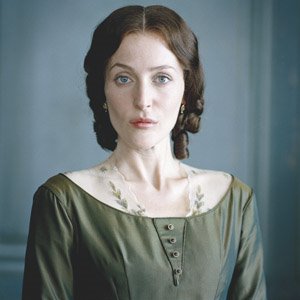
INTERVIEW: Gillian Anderson

From The Guardian, Sunday May 7, 2006
Interview with Gillian Anderson

Anderson from Bleak House
She was the intelligent, sardonic FBI agent from The X-Files. And the real star of the show, if you ask me.

The Senior Ms H once watched an interview with Gillian Anderson on David Letterman. She was indignant, and griped that Anderson "sounded like a bimbo!"

Which led to my rebuttal, a little tongue-in-cheek, but with genuine admiration, "That means Gillian Anderson is a really good actress. She actually makes you believe Scully's intelligent when she's [Anderson herself] not!"

The Guardian interview linked here is fun, with Anderson coming through as a slightly unglam actress who is actually approachable. The interviewer wrote this about her:
She's a funny creature, Gillian Anderson. I warm to her for various reasons. She's got a nice line in non sequiturs. She's un-grand. She's wearing an eccentric pair of white patent leather heels, a tatty old pair of combat trousers and a violet jersey. She swears brilliantly. She gets excited when a waiter carries a tray of puddings past, and races off to feed the parking meter so she can have the lemon tart brulee ('and please get the sticky toffee pudding'). She doesn't have a watch. She's capable, even on a day like today, of moments of almost painful candour. Last but not least, I like her because when the interview is over, she will say goodbye and attempt to leave the restaurant not through the door, but through one of the plate-glass windows. She is, I think, not altogether cool.

Remember: Anderson was the poster-girl for geeks 10 years back. (Do I still have my X-Files t-shirt? Hmm.) I believe Anderson is a geek at heart.

Other bitties from the interview. Anderson on a happiness roll:
Four years ago, she went through a really good stage, she was 'really, really happy', and there's a long, dreamy pause while she drifts off, remembering this happy time, and then she comes to and says, briskly, 'Yeah, but I was doing loads of yoga and meditation. I was going to say I was eating wholefoods a lot, but I think I was living off frozen yogurt.'

How can you not like a woman who eats? She had two desserts during the interview. (She went off to feed the parking meter - then came back for seconds.) Then she tells the interviewer:
'... Please don't write that I scoffed two desserts. You can be honest about it and say that I ate all of mine and half of yours. Well, I'm going to have one more bite before I go.'

It's the kind of remark that endears someone to you, because they come off so raw and real.

Wednesday, May 10, 2006

Barnes on Flaubert

Taken from The New York Review of Books

Julian Barnes, writing about Bouvard and Pécuchet and Flaubert: A Biography by Frederick Brown - things Flaubert.

Full article here.

Holland's shameful treatment of Ayaan Hirsi Ali.

The Caged Virgin
Holland's shameful treatment of Ayaan Hirsi Ali.
By Christopher Hitchens

Hitchens on one example of how over-apologetic attitudes of "liberal" Western countries in fact lack conviction in their policies. Ayaan Hirsi Ali was born in Somalia, and had been a refugee in several African countries. She was circumcised against her will at a young age, and then given in marriage to a distant male relative she had never met. Now a prominent activist in Holland, she has received death threats, but the Dutch government is embarrassed to have her.
Entering politics to try to alert the European left to this danger, she was first elected as a deputy for the Labor Party, but after 9/11 she changed her allegiance to the Liberals. This, she explained, was because many Labor spokesmen preferred to think of immigrants as possessing "group rights." They had become so infatuated by their own "multi-culti" style that they had ignored the rights of individuals—especially women and girls—who were imprisoned within their own ghetto.


Full article.

Also, pick up Ayaan Hirsi Ali's The Caged Virgin.

Tuesday, May 09, 2006

BOOKS: Reading "Madame Bovary"

Emma Bovary is getting on my nerves. She is the sort of protagonist that I dislike in real life - self-absorbed, deluded and vain. (But then we see too many of these women these days, so there's probably a lot of people I don't like)

The adulterous cad, Monsieur Rodolphe however, reminded me of something:
But with that critical superiority vested in the man who, in every relationship, holds back something of himself, Rodolphe sensed that in this love there lay further pleasures to be exploited. He reckoned all delicacy irksome. He used her brutishly. He made of her a creature docile and corrupt. Hers was a sort of idiot attachment, full of admiration for him, of pleasure for herself; a beatific drowsiness,; and her soul sank deep into this fuddle, drowning there, shrivelling up...

Madame Bovary's weakness was she deluded herself with literary romances. But then again, so many of us fall in love through the books we read - and suffer for it.

Perhaps Flaubert's book irritates me so much because his characters are so utterly human. It's not a romance, definitely.

Salon Archive: Madame Bovary

Taken from Salon article, by Erica Jong

"A book lives longer than a girl," Vladimir Nabokov said, lecturing to his Cornell students about Flaubert's "Madame Bovary" in the 1950s. He went on to praise the master's clinical style, the way he transformed the sordid materials of pulp fiction -- adultery, suicide -- into a poetic masterpiece by his painstaking description of bourgeois life in mid-19th century France.

"Madame Bovary" can be approached in many ways: as a notable banned book (like "Ulysses" or "Lolita"), as a book that delineates the confinement of the 19th century wife, as a book that influences subsequent development of the novel, even as a book that betrays the foot fetishism of the author. In "The Perpetual Orgy," Mario Vargas-Llosa's book about his passion for "Madame Bovary," Flaubert's erotic attachment to shoes and feet is detailed.

But what interests me most in "Madame Bovary" is the heroine's fondness for reading. She dies because she has attempted to make her life into a novel -- and it is the foolishness of that quest that Flaubert's clinical style mocks.

A novelist mocking a heroine besotted by novels? Then this must be a writer mocking himself! And indeed, Flaubert memorably said that he had drawn Madame Bovary from life -- and after himself. "I have dissected myself to the quick," he wrote.

Emma Bovary is deluded by literature. Because she is in search of ecstasy and transcendence, she falls madly in love with a cad, then with a coward, ignoring the plodding husband and child who both adore her. She is looking for a higher, more spiritual life than the one available to her as the wife of a bourgeois country doctor, and in this quest she finds only self-destruction. We identify with her because we too look to fantasy for salvation. If Emma Bovary, with all her self-delusion, still stirs our hearts, it is because she wants something authentic and important: for her life to have meaning, for her life to bring transcendence.

"In 'Madame Bovary,'" says Vargas-Llosa, "we see the first signs of alienation that a century later will take hold of men and women in industrial societies (the women above all, owing to the life they are obliged to live): consumption as an outlet for anxiety, the attempt to people with objects the emptiness that modern life has made a permanent feature of the existence of the individual. Emma's drama is the gap between illusion and reality, the distance between desire and its fulfillment. On two occasions she is persuaded that adultery can give her the splendid life that her imagination strains toward, and both times she is left feeling 'bitterly disappointed.'"

Perhaps we identify with Emma because we too feel an emptiness at the center of things -- an emptiness we try to fill with books, with fantasies, with sex, with things. Her yearning is nothing more or less than the human condition in the modern world. Her search for ecstasy is ours. "One way of tolerating existence is to lose oneself in literature as in a perpetual orgy," Flaubert wrote in 1858. If "Madame Bovary" can still move us all these years later, it is because she was both Flaubert's refuge -- and his self-portrait.

Sept. 15, 1997

Monday, May 08, 2006

READINGS: John Kenneth Galbraith

Economist John Kenneth Galbraith died recently. The Globe and Mail ran a story on what the man read.
Rather late in life, he was introduced to the work of Robertson Davies, which he thereafter avidly consumed. No doubt one reason was that Davies set his Deptford Trilogy -- Fifth Business (1970), The Manticore (1972) and World of Wonders (1975; all three published by Macmillan Canada) -- in rural and small-town southwestern Ontario, not far from where Galbraith had grown up; this, however, was more likely a co-ordinate attraction. Far more powerful, Galbraith insisted, was "the ring of truth" in Davies, embedded in his richly imagined physical, social and moral landscape, and ornamented with what Galbraith found to be "an extraordinary range of wholly unpredictable information."

In case you're tempted, The Deptford Trilogy is truly worth the effort.

Among Galbraith's works are The Affluent Society and The Good Society.

BOOKS: Lost Guide

The Guardian reviews Rebecca Solnit's A Field Guide to Getting Lost.

I brought the book to a Phuket trip last year, and I enjoyed it. It was a stronger collection than her previous book, Wanderlust. The Guardian reviewer puts it in a nutshell:
De Vaca stands at the heart of this book, not just as a symbol of the plucky adventurers and mingling nationalities that created modern America, but as an exemplar of Solnit's strongest theme: getting lost means accepting change. "The things we want are transformative, and we don't know or only think we know what is on the other side of that transformation.

Reading Baby

A 28 month old Vietnamese baby can read
The child could correctly and fluently read a Vietnamese-language newspaper though his pronunciation sounded like a foreigner’s.

Shame on us then.

Link via Bookninja

Friday, May 05, 2006

Get a Life

I'm catching up with Season 5 of CSI: Crime Scene Investigation. I'm also barely 1/4 into Natasha's Dance - an interesting book (to me at least) on the cultural history of Russia.

Now, I should be reading more, but really, I prefer to spend my time watching Grissom and his team solving crimes.

But what I really like to do is to have a life.

Excuse me, what to do huh?

NOT A POLITICAL POST

Overheard at the office:
"I hate reading the newspapers these days. The whole thing is just about the PAP."

BOOKS: Winterson in The Times

From The Times
29 April 2006

Winterson's Her Word. She's writing on the PEN World Voices Festival of International Literature. On why literature is important.
Books must now compete against films, against television, against the internet — the noisy new media. Books are quieter, but we must still listen.

Literature is a place where you can always go and always be welcome. No one is shut out. It is truly global, in that it crosses all boundaries but does not seek to make everything and everyone the same.

Literature is about discovering difference. That is why it is so important, in our world now, that it be available. The internet is no substitute for a good bookshop where a real-life browser will always find something unexpected, and come away the better for it.

The story goes, there were only 6 books in the house Winterson grew up in. One was the Bible - and 5 other books on the Bible. So she bought books and hid them under her mattress. Her mother peered in one day and found a DH Lawrence. Mrs Winterson proceeded to set the books on fire.

What she learnt that day from her mother was how some people burnt books - because you never know what you will find in books until it was too late. She also started to memorize passages from books - because they can't take away what you take from the books.

WINTERSON: Column May 2006

From Jeanette Winterson's website. The Column for May 2006

I like this bit:
As I get older I get more concerned about excess - which is not the same as indulgence or luxury, I can do both of those. But excess? Why? I don't want to carry too many pounds, too much luggage, have too much stuff, or even, know too many people.

Ever felt this way?

ESSAY: Iranian Lost Epic

From The New York Times

An essay by Reza Aslan: The Epic of Iran. He writes about Iran's national epic, the "Shahnameh."
Written more than a thousand years ago by Abolqasem Ferdowsi, the "Shahnameh," or "Book of Kings," recounts the mythological history of Iran from the first fitful moments of creation to the Arab conquest of the Persian Empire in the seventh century A.D. Ferdowsi was a member of Iran's aristocratic class, which maintained a strong attachment to the heritage of pre-Islamic Iran. According to legend, he composed the "Shahnameh" under the patronage of Sultan Mahmud of Ghazna, who promised him one dinar for every couplet. But when Ferdowsi presented the sultan with nearly 60,000 couplets, a flustered Mahmud offered him a fraction of his promised reward. Insulted, Ferdowsi rejected the money and returned home to the city of Tus, where he died impoverished and embittered. But his poem endured.

A verse from the Shahnameh:
Where are your valiant warriors and your priests,
Where are your hunting parties and your feasts?
Where is that warlike mien, and where are those
Great armies that destroyed our country's foes? . . .
Count Persia as a ruin, as the lair
Of lions and leopards. Look now and despair.


Reza Aslan is the author of No God But God.

Thursday, May 04, 2006

CULTURE VULTURE: World Literature Tour May 2006

Culture Vulture World Literature Tour goes to Japan.

Something wanky happened with the Culture Vulture page. It does not allow me to sign-in.

So I will not be adding my 25 cents worth on Japanese Literature people should read.

No, not Haruki Murakami. I think we over-dosed on him already.

Jose Saramago and Democracy

From The Observer
Interview with Jose Saramago

Jose Saramago is probably the most famous (if not the only) Nobel Prize winner Portugal can lay claim to. Ironically, Saramago left his homeland of Portugal 14 years ago in protest of the government censorship of his novel, The Gospel According to Jesus Christ. It was the sentiment of the authorities that his book offended religious sensiblities.

At 84, Saramago is still actively serving the political role of the author. He is a writer of conviction - one of the dying breed. He is also the kind of writer who ends up talking about the problem of democracy during book discussions. In light of our forthcoming election, I'm inclined to highlight something he mentioned in the interview:
'I answered that I didn't have a solution, except that we, as citizens, do have the power of the vote, but we always use it to vote for one or other of the parties on off er. But there is another possibility, which is to cast a blank vote.' He leans forward and points a stern finger. 'And this is not at all the same as abstention. Abstention means you stayed at home or went to the beach. By casting a blank vote, you're saying that you understand your responsibility, you have a political conscience and you came to vote, but you don't agree with any of the existing parties and this is the only way you have of saying so.

'Then I thought about what would happen if the blank votes went up to 50 or more per cent. It would be a way of saying society has to change but the political powers we have at the moment are not enough to effect this change. The whole democratic system would have to be rethought.'

Not that I'm advocating anything political, of course. I'm hardly political. I don't even have to vote. I live with a country where I am 30 and have never casted a single vote for my democratically elected government.

Is voting really compulsory by the way?


Read the latest title by Jose Saramago, Seeing, translation by Margaret Jull Costa. Saramago is published by Harvill Press in the UK, the original English publisher for Haruki Murakami.

Wednesday, May 03, 2006

Bayley and Iris Murdoch

John Bayley wrote his 3 part memoir on his wife Muriel Spark?

So says my jack-ass boss - Store Director of one of the biggest bookstore in the country.

I work for ignorant people.

Friday, April 28, 2006

The Easter Story

Almost missed out this little piece from The Times. Jeanette Winterson on the Easter story. A reminder that one can be queerly irreligious - yet spiritual.
It is significant that the first person to find the miracle is a woman, and a woman who was a prostitute. Christianity, in its earliest force, was not a religion of power; it was a religion of love.


Taken from The Times, April 15, 2006

Thursday, April 27, 2006

SAMUEL BECKETT: Lost Play

Scholars discover lost play by Samuel Beckett

The 23 blank pages, which literary experts presume is a two-act play composed sometime between 1973 and 1975, are already being heralded as one of the most ambitious works by the Nobel Prize-winning author of Waiting For Godot, and a natural progression from his earlier works, including 1969's Breath, a 30-second play with no characters, and 1972's Not I, in which the only illuminated part of the stage is a floating mouth.


Full Story.

AUTHOR: Ali Smith

The Guardian on Ali Smith

Wednesday, April 26, 2006

BOOKS: Orange Prize 2006 Shortlist

The shortlist is finally out for this year's Orange Prize award. The Orange Prize is one of the few book awards for fiction written by women. Why do we need it? Because it's still a predominantly male-centred literary world.

The Shortlist:

The History Of Love by Nicole Krauss
Viking
It is 60 years since Leo fell in love with a girl called Alma in the Polish village where he was born and wrote a book in her honour. He assumes that the book, and his dreams, are lost, until they return to him in a brown envelope.


Beyond Black by Hilary Mantel
Harper Perennial
Alison, a medium, tours London's dormitory towns with flint-hearted Colette. But behind her smile is desperation: the next life holds terrors she must conceal from her clients, and she is plagued by the spirits of men from her past.


The Accidental by Ali Smith
Hamish Hamilton
The mundane summer holiday of 12-year-old Astrid and her family - mother Eve, stepfather Michael and elder brother Magnus - is interrupted by the arrival of Amber, who turns up on the doorstep and ends up staying. Who is she and what does she want?

Everyman's Rules For Scientific Living by Carrie Tiffany
Picador
In 1934, the Better Farming Train slides through Australia's fields and small towns, bringing advice to those living on the land. In its carriages, an love affair develops between idealists Robert and Jean.

The Night Watch by Sarah Waters
Virago
Moving back through the 1940s through air raids, black-outs and illicit liaisons to end with its beginning in 1941, The Night Watch is the story of four Londoners - three women and a young man with a past.


From The Guardian

Monday, April 24, 2006

DATE: 21 October 2006

I was just noting an entry in my diary, when I noticed that 21st October 2006 is Deepavali.

Will be there. In T-shirt and jeans hor. ;)

BOOKS: Reading Meme

Via Ed

Look at the list of books below. Bold the ones you’ve read, italicize the ones you might read, cross out the ones you won’t, underline the ones on your book shelf, and place parentheses around the ones you’ve never even heard of.

The Da Vinci Code - Dan Brown
The Catcher in the Rye - J.D. Salinger
The Hitchhiker’s Guide To The Galaxy - Douglas Adams
The Great Gatsby - F. Scott Fitzgerald
To Kill a Mockingbird - Harper Lee
The Time Traveler’s Wife - Audrey Niffenegger
His Dark Materials - Philip Pullman
Harry Potter and the Half-Blood Prince - J. K. Rowling
The Life of Pi - Yann Martel
Animal Farm: A Fairy Story - George Orwell
Catch 22 - Joseph Heller
The Hobbit - J. R. R. Tolkien
The Curious Incident of the Dog in the Night-time - Mark Haddon
Lord of the Flies - William Golding
Pride and Prejudice - Jane Austen
1984 - George Orwell
Harry Potter and the Prisoner of Azkaban - J. K. Rowling
One Hundred Years of Solitude - Gabriel Garcia Marquez
Memoirs of a Geisha - Arthur Golden
The Kite Runner - Khaled Hosseini
The Lovely Bones - Alice Sebold
Slaughterhouse 5 - Kurt Vonnegut
The Secret History - Donna Tartt
Wuthering Heights - Emily Bronte
The Lion, the Witch and the Wardrobe - C.S. Lewis
Middlesex - Jeffrey Eugenides
Cloud Atlas - David Mitchell
Jane Eyre - Charlotte Bronte
Atonement - Ian McEwan
The Shadow of The Wind - Carlos Ruiz Zafon
The Old Man and the Sea - Ernest Hemingway
The Handmaid’s Tale - Margaret Atwood
The Bell Jar - Sylvia Plath
Dune - Frank Herbert
Sula by Toni Morrison
Cold Mountain by Charles Frazier
The Alchemist by Paulo Coehlo
White Teeth by Zadie Smith
The House of Mirth by Edith Wharton


What titles would you add to this list, because you love them or think they are worthy of note?


The End of the Affair by Graham Greene
Notice by Heather Lewis
The End of Alice by A. M. Homes
Fall On your Knees by Ann Marie MacDonald
The Passion by Jeanette Winterson

BOOKS: Saramago's "Seeing"

Ursula K. Le Guin on reading Jose Saramago's Seeing.

I have to read Blindness before I start on Seeing. Especially since I'm holding onto PW's copy!

Saturday, April 08, 2006

Gone To Tibet


Back on 24th April 2006.


Lonely Planet Destination: Tibet

I Love ME Soooooooo Much

Spidey Love

It's just the kind of picture I HAD to put up.


Via Warren Ellis

Friday, April 07, 2006

J K Rowling Can't Find Paper

So, the next Harry Potter will be late because J K Rowling can't find paper to write.

Like dat also can ah?
"What is a writer who likes to write longhand supposed to do when she hits her stride and then realizes, to her horror, that she has covered every bit of blank paper in her bag? Forty-five minutes it took me, this morning, to find somewhere that would sell me some normal, lined paper. And there's a university here! What do the students use? Don't tell me laptops, it makes me feel like something out of the eighteenth century."


Full story.

TIBET: What to Pack Again

I've re-packed my backpack for Tibet too many times to count. Out of sheer paranoia, I've purchase a heavy duty fleece jacket from Campus Corner. It's a nice bright blue that I like.

I am such a slut for blue.

So for cold wear I'm packing:

1) Heavy duty fleece jacket
2) The fleece vest that WW lent me.
- It's light-weight so it's more suitable for when I am on the move, and I can wear my water-proof Nike jacket over when it snows.
3) Black Nike jacket
- I rarely travel without it

And because I have enough space, I have increased my underwear from 3 to 5. This is partly due to grossed-out protest from friends who cannot believe 3 pairs of underwear should be made to last 2 weeks.

READINGS: Men vs WOMEN Part 2

Follow-up.

If you've taken the time to read The Guardian article on "what do men read to get them through life?" - you will know the title chosen by the men surveyed is Albert Camus'L'Etranger. This, against Jane Eyre, chosen by the ladies. Hmm.

Once more we are reminded that Men and Women are different.

But did we need a survey to tell us that?
They use fiction almost topographically, as a map. Many of our women respondents last year explained that they used novels metaphorically - the build-up to an emotional crisis and subsequent denouement in a novel such as Jane Eyre might have helped negotiate an emotional progress through a difficult divorce, or provided support during a difficult period at work, or provided solace when things seemed generally dull.

This did not seem ever to be the case for men, though some men admitted to having made a sound investment in an author - such as Orwell - whom they used as a guide throughout their adult life on the basis of a first encounter in adolescence.

Thursday, April 06, 2006

READINGS: Men vs WOMEN

The Guardian
This year, we tackled the obvious next question: what do men read to get them through life? If polling women's reading habits had thrown up such an astonishing variety of reading, surely men's reading would be equally revealing. After all, as two female researchers, we might have been prepared for women's reading choices; in the case of men, we admitted we really hadn't a clue.


Full article.

BOOKS: Chess by Stefan Zweig


Recently discovered Stefan Zweig's Chess: A Novella. Read it in one sitting.

The story takes place on a cruise-ship, where introduces a chess prodigy is challenged by a prideful Scotsman, McConnor. The chess prodigy a brutish, thick-browed imbecile with no intellectual faculty whatever - except in chess.

During a chess match, as McConnor was slowly losing to the chess prodigy, a mysterious stranger steps up to offer advice. His predictions and steps are all brilliant, and the game ends in a draw.

To everyone's surprise, the mysterious stranger claims to have not touched a chess set for twenty-five years. Yet he is obviously a genius.

How this stranger come to be the chess genius that he is lies at the heart of this tale.

About Zweig:
Austrian biographer, essayist, short story writer, and cosmopolitan, who advocated the idea of an united Europe under one government. Zweig achieved fame with his vivid and psychoanalytically-oriented biographies of historical characters. Among his best-known works is BAUMEISTER DER WELT (1936, translated as Master Builders), a collection of his biographical studies. Zweig was a prolific writer. In the 1930s he was one of the most widely translated authors in the world. His extensive travels led him to India, Africa, North and Central America, and Russia. Among his friends were Maksim Gorky, Rainer Maria Rilke, Auguste Rodin, and Arturo Toscanini.


Full write-up.

Pushkin Press is currently in the progress of making Zweig more available to the English reading market. That's a good thing. He's relatively unknown and unread by English readers - in spite of his cult status among the German readers.

SPAM: Dying Childless Widow

I received this in my email this morning. As usual, the absurdity of the message is laughable, so I thought I just needed to share this with everyone.

I like the premise set up for this story: Christian widow, dying, child-less, trying to do good for some god-fearing person out there.

Who comes up with this?

From: Mrs. Julian David julivid_1962@yahoo.com
26 Kesington Court,
London, England.


Attn: MY FRIEND,

I am the above named person but now undergoing medical treatment in London, England. I am married to Mr. Jim Walter David who worked with British Railway Commission in Chelsea England for over a decade before he died on 5th of July in the year 2003. We were married for fifteen years without a child. He died after a brief illness that lasted for two weeks. Before his death he made a vow to use his wealth for the down trodden and the less privileged in the society. Since his death I decided not to re-marry or get a child outside my matrimonial home. When my late husband was alive he deposited the sum of 10 Million (Ten Million Pounds) in a Vault with a Security/Finance House in SA. Presently, this money is still there. Recently, my Doctor told me that I would not last for the next 150days due to cancer problem. Though what disturbs me most is my stroke.

Having known my condition I decided to donate this fund to an individual or better still a God fearing person who will utilize this money the way I am going to instruct here in. I want an individual that will use this to fund and provide succour to poor and indigent persons, orphanages, and above all those affected in hurricane wilma. I understand that blessed is the hand that giveth. I took this decision because I do not have any child that will inherit this money and my husband relatives are not inclined to helping poor persons and I do not want my husbands hard earned money to be misused or spent in the manner in which my late husband did not specify. I do not want a situation where this money will be used in an unGodly manner, hence the reason for taking this bold decision. I am not afraid of death hence I know where I am going. I know that I am going to be in the bosom of the Almighty. I do not need any telephone communication in this regard because of my health, and because of the presence of my husbands relatives around me always. I do not want them to know about thisdevelopment. With God all things are possible.

As soon as I receive your reply I shall give you the contact of the Security/Finance House in SA. I will also issue you a letter of authority that will empower you as the original beneficiary of this fund,through my Lawyer. I want you to always pray for me. My happiness is that I lived a life worthy of emulation. Whosoever that wants to serve the Almighty must serve him with all his heart and mind and soul and also in truth. Please always be prayerful all through your life. Any delay in your reply will give me room in sourcing for an individual for this same purpose. Please assure me that you will act according to my specification herein. Hoping to hear from you.pls reply through this box.

(julivid_1962@yahoo.com )

Thank you and may the Almighty bless you.
Yours sincerely,

Mrs. Julian David(Benefactor)

Wednesday, April 05, 2006

TIBET: What to Pack

My dad has packed for Tibet. It's a compact backpack two-third of my own. He's perplexed at what his little girl (I'll always be Daddy's Little Girl) is bringing to Tibet.

Right now I'm still considering what book to bring to Tibet.

Dhammapada perhaps.

Tuesday, April 04, 2006

Pink on the furore over her 'Stupid Girls' video

From The Observer

Pink talks:
The media would have us believe that they are only giving us what we want but a recent ICM poll found that 83 per cent of us thought the media coverage of celebrity excessive. So who exactly is interested in the Stupid Girls? Psychologist Lynn E McCutcheon of DeVry University in Orlando examined fans of the famous. According to him, people who worship celebrity are not as intelligent as those who don't. Ouch!

She’s my favourite bitch of the moment. Hee.

I'm Not Dead
Her new album, "I'm Not Dead" is out today.

BOOKS: This Book Will Save Your Life

I'm finally reading the proof for this book, coming out this month actually.

A. M Homes is often described with adjective such as "transgressive," "dark" and "funny." This new book is oddly a play on transformation, almost a tale of a man coming to a crisis of his life and learning from it - something that seems more out of Oprah Winfrey than what fans are used to.

But it is funny. Homes always had a tendency towards humour of the absurd. Human life is absurd afterall.

Will update as I progress in my reading.

Friday, March 31, 2006

BOOKS: Pevear Translation of The Three Musketeers


Richard Pevear, one-half of my favourite Russian translators, has a translation of Alexandre Dumas' Three Musketeers coming out.

It's published by Viking (an imprint of Penguin Books) and slated for August 2006 release.

I really like this nice cover. But I already have a copy of The Three Musketeers! How many copies of the same book can one possibly have?

Canadian Authors to Check Out

The World Literature Tour: Canada over at The Guardian's culture culture Blog is still on. Remember to nominate your favourite Canadian authors if you have any.

These are some of the Canadian authors I intend to check out:
  1. Timothy Findley

  2. Mordecai Richler

  3. Alice Munro

  4. Mavis Gallant


I've also wanted to check out By Grand Central Station I Sat Down and Wept, by Elizabeth Smart

More Michael Ondaatje.

Thursday, March 30, 2006

San Francisco 1906 Earthquake

This timeline is taken from http://www.sfmuseum.org/hist10/06timeline.html

San Francisco, April 18, 1906.

  1. The earthquake struck at 5:13 AM.

  2. By 7 AM federal troops had reported to the mayor.

  3. By 8 AM they were patrolling the entire downtown area and searching for survivors.

  4. The second quake struck at 8:14 AM.

  5. By 10:05 AM the USS Chicago was on its way from San Diego to San Francisco; by 10:30 the USS Preble had landed a medical team and set up an emergency hospital.

  6. By 11 AM large parts of the city were on fire; troops continued to arrive throughout the day, evacuating people from the areas threatened by fire to emergency shelters and Golden Gate Park.

  7. St. Mary's hospital was destroyed by the fire at 1 PM, with no loss of life, the staff and patients having already been evacuated across the bay to Oakland.
  8. By 3 PM troops had shot several looters, and dynamited buildings to make a firebreak; by five they had buried dozens of corpses, the morgue and the police pistol range being unable to hold any more.

  9. At 8:40 PM General Funston requested emergency housing - tents and shelters - from the War Department in Washington; all of the tents in the U.S. Army were on their way to San Francisco by 4:55 AM the next morning.

  10. Prisoners were evacuated to Alcatraz, and by April 20 (two days after the earthquake) the USS Chicago had reached San Francisco, where it evacuated 20,000 refugees.

Go Away!

Dorothy called me at work yesterday - I was about to leave the office. She needed to look for a book. So she decided to just call me on my handphone - at work.
"Why don't you call the store number?" I asked.

"I did. Not one pick up the phone."

Annoyed, but I decided to help. But her presumption was that I was willing to walk around the store looking for her books - when she is too lazy to make a trip down herself. I told her later to just call the store herself. I went home.

Why this attitude?

I have no problem helping out a friend for books - in fact I usually make an effort.

But Dorothy, you have no right to call yourself my friend.

Three years of silence, no "Happy Birthday," no "Happy New Year," no "Merry Christmas" - and suddenly you call me out of the blue when you needed help over something so trivial.

Love dies from neglect. Our friendship died years ago.

You crush my heart, you manipulated me - and let's not mention the mindfuck.

You knew what you were doing. But you were right, it happened because I allowed it.

But I promised myself, it will NEVER happen again.

You call us "deviants" - but you loathe yourself. You think of yourself as a freak. I do not think of myself like that.

I cherish myself. A pity you never did.

But I agree on this point - you are sado-masochistic. You are grotesque.

You are a vampire. You drained me but I survived.

Go away.

PS: I usually use initials to protect the innocent - but you are not innocent. Fuck you.

Naipaul Rants

He's an angry, bitter man.

The BBC New reports:
The author slates Dickens for his "repetitiveness" and cites the experience of reading Jane Austen's Northanger Abbey as a revelatory one.

"I thought halfway through the book, 'Here am I, a grown man reading about this terrible vapid woman and her so-called love life.'

You don't like Dickens and Austen - writers both more enduring and vastly more readable than you?

I spit on you.

BOOKS: Kiriyama Book Prize 2006

For Fiction
The Hummingbird's Daughterby Luis Alberto Urrea

For Non-Fiction:
The Reindeer People: Living With Animals and Spirits in Siberia by Piers Vitebsky's

The prize is given to authors whose works contribute to a better understanding of the peoples and nations of the Pacific Rim and South Asia. Each writer receives $15,000 US.


Full story.

Wednesday, March 29, 2006

QUIZ: I am Riot Grrl

Okay, I admit, it's close to home. Sleater-Kinney is on my mpeg player.


You Know Yer Indie. Let's Sub-Categorize.


You're a Riot Grrl. You love the rockin' sound of loud women, and rightfully so. You're probably an activist of some sort. And yes, you're right, not all Riot Grrls are lesbians. Just most.
Take this quiz!


Quizilla |
Join

| Make A Quiz | More Quizzes | Grab Code


Tuesday, March 28, 2006

HOMES: Author Page

A. M. Homes's author page:

http://www.amhomesbooks.com/

Writers Do Make Big Bucks

Author A. M. Homes (Jack, The End of Alice, and this year's The Book Will Save Your Life) recently bought a three-bedroom house with a large porch in the Village of East Hampton. The house has a market rate of $1.3 million.

While a small part of me would like to scream "SELL-OUT!" - the rest of me (the majority) just thinks: "I want to be just like her."

Full story here (scroll down)

Monday, March 27, 2006

BOOKS: Homes's New Book

Book Forum write-up on A. M. Homes's This Book Will Save Your Life.

It's good, it's funny. It's...uplifting? Heh?

Friday, March 24, 2006

Alberto Manguel Interview

Full Interview.

Atwood too Racy for School

A San Antonio-area school superintendent has pulled Margaret Atwood's The Handmaid's Tale from the Advanced Placement English curriculum because he found it too racy.

Lyman says he found some of the descriptions in the book too sexually explicit for high school students. That -- he says -- doesn't support state efforts to encourage sexual abstinence outside marriage.

Texan hicks.

You know, it would be funny, if it wasn't so pathetic.

Full story.

Books Waiting to Be Read

Recently received the following book proofs that I'm eager to read - but have no time:

1. Lost Cosmonaut David Kalder (Faber & Faber)

2. This Book Will Save Your Life A. M. Homes (Viking)

Pretty Pretty Hyped Up Books

I have the book proof for this debut Special Topics in Calamity Physics by Marisha Pessl. It's still perched there on my tower of unread books, threatening to tumble and kill me in my sleep.

It's been sold as a blend of Dave Eggers and Donna Tartt - the latter is the hook that I bit. I am weak, I confess - but why not give it a try? It's free.

Right now there's some discussion about Marisha Pessl before the book is released. You see, Pessl is young and pretty, an actress and model - everything that says "market-bait" for this world of ours.

It's definitely one of those questionable hyper-hyped books that makes me cringe - but does the effort in marketing necessarily discredit the writing?

Jessa Crispin of Bookslut mentioned in a article in The Book Standard:
I started reading Marisha Pessl’s Special Topics in Calamity Physics because the publicist had actually tabbed sections for me to read. It seemed like so much work to go through, I had to stop and take a look. And right now, I’m hooked.

I pity the publicist who had to do this kind of thing. But then, how often do book publicist go out to do something like this?

Sarah Weinman has this to say:
(Btw, for the humor-impaired, it's not that I am mocking Ms. Pessl's appearance or writing ability, just the publishing world's almost masochistic desire to let attractive packages, so to speak, dictate their buying guidelines -- even if the prospect of earning out is rather limited, to say the least.)

As a book buyer, I do see the depraved phenomena of how publishers go for the flash to sell books - while neglecting a lot of quality writers. I see the reality - that it's the flash that's going to catch the buzz. The buzz - in pretty, packaged form will sell.

POETRY: When Death Comes

When Death Comes
By Mary Oliver

When death comes
like the hungry bear in autumn
when death comes and takes all the bright coins from his purse

to buy me, and snaps his purse shut;
when death comes
like the measle pox;

when death comes
like an iceberg between the shoulder blades,

I want to step through the door full of curiosity, wondering;
what is it going to be like, that cottage of darkness?

And therefore I look upon everything
as a brotherhood and a sisterhood,
and I look upon time as no more than an idea,
and I consider eternity as another possibility,

and I think of each life as a flower, as common
as a field daisy, and as singular,

and each name a comfortable music in the mouth
tending as all music does, toward silence,

and each body a lion of courage, and something
precious to the earth.

When it's over, I want to say: all my life
I was a bride married to amazement.
I was a bridegroom, taking the world into my arms.

When it's over, I don't want to wonder
if I have made of my life something particular, and real.
I don't want to find myself sighing and frightened
or full of argument.

I don't want to end up simply having visited this world.

Thursday, March 23, 2006

Worn Out

Too many dates this month. I've worn out.

So, unless I'm meeting you for dinner, I'll be dropping you guys a note to cancel dates. Not that I don't like you (if I don't like you, there wouldn't be a date) - but I have reached my quota of socialisation. I'm feeling cranky and a little surly. I need SPACE before I start snapping at people.

Solitude. I need.

Rilke: You Who Never Arrived

You Who Never Arrived

You who never arrived
in my arms, Beloved, who were lost
from the start,
I don't even know what songs
would please you. I have given up trying
to recognize you in the surging wave of
the next moment. All the immense
images in me -- the far-off, deeply-felt
landscape, cities, towers, and bridges, and
unsuspected turns in the path,
and those powerful lands that were once
pulsing with the life of the gods
-- all rise within me to mean
you, who forever elude me.

You, Beloved, who are all
the gardens I have ever gazed at,
longing. An open window
in a country house-- , and you almost
stepped out, pensive, to meet me.
Streets that I chanced upon,--
you had just walked down them and vanished.
And sometimes, in a shop, the mirrors
were still dizzy with your presence and,
startled, gave back my too-sudden image.
Who knows? Perhaps the same
bird echoed through both of us
yesterday, separate, in the evening...

~ Rainer Maria Rilke

Wednesday, March 22, 2006

5 Songs on "Repeat Track" on my MPEG Player

1. Patti Smith's "Dancing Barefoot"
2. Tracy Chapman's "Change"
3. Sarah McLachlan's "Fallen"
4. Patti Smith's "Gloria"
5. Joan Jett's "Crimson and Clover"

Goth!

Taken from The Guardian, Tuesday March 21, 2006

We walk amongst you.

Culture Vulture: Canadian Literature

The Guardian Culture Vulture has finally gone Canadian.

I admit - there's very little I know about Canadian literature besides Margaret Atwood. But recently I've been introduced to fine writers like Robertson Davies (whom I admit, demands patience) and Ann-Marie MacDonald. Michael Ondaatje and Rohinton Mistry are also writers who have chosen to make Canada home.

This will be a good chance to find out what else is available in that part of North America that is not the United States.

Tuesday, March 21, 2006

Marvel and DC: Stealing "Super-heroes"

Cory Doctorow on Marvel and DC Comics trying to trademark "Super-heroes"
"Super-hero" isn't Marvel's property. They didn't invent the term. They aren't the only users of the term. It's a public-domain word that belongs to all of us. Adding a ™ to super-hero is a naked bid to steal "super-hero" from us and claim it for their own.


Link here.

Moore Says Strangers In Paradise No More

Okay, bad pun.

Strangers in Paradise comes to an end.

It will probably only affect the fans (like me. We followed the series for years.

Korean Drama Last Night

Horror of all horrors. I, who have made it a statement of pride of not watching television, found myself watching Channel U's telecast of the Korean Drama "大长今" last night with my parents!

It was family bonding night, with warm, blithe conversation. And we all adore the little girl with the BIG, BIG eyes who plays 长今, the protagonist.

Monday, March 20, 2006

Life, and Being Dismissed During Morning Coffee

You know one of those sms "dialogues" where you're obviously not on the same wave-length with the other party?

Was on my way to work this morning when a series of sms came in. A friend read a book and felt it's just so her. Mention of Dostoevsky's Underground Man, and the over-consciousness that somehow makes us unable to function in life.

I replied that life can be simple, but simple does not equate as easy. But I think somewhere my friend misunderstood me, and her reply was a little abrupt. I felt dismissed, that before she made an effort to understand my point, it was rejected as unworthy.

This is not the first time we had unpleasant exchanges like these. Though it still stings, life goes on.

I believe she thought I was giving a simplistic answer: that life can be categorized as "Yes," "No," and "Maybe."

I never said that. What I meant was, we claim life is complicated and difficult, because we are not courageous enough to accept or to sacrifice in order to make life better.

We blame the circumstances of our existence on everything else, never really stopping to consider that our choices complicate the circumstances itself.

It is not as simple as "we can't choose." Rather, we did not want the options presented to us. Or, we lack the imagination or power of will to create alternatives.

Refusing to choose, is also a choice.

I have said, simple does not mean easy. Simplifying your life takes long term commitment, stamina and immense strength. It's the hardest thing in the world to do.

In sms, I hate long answers. But in general, I hate long debates.

BOOKS: Future of Ice

Future of Ice
The Future of Ice
by Gretel Ehrlich
New York: Vintage, 2005
[18/03/2006 ~ 20/03/2006]


Gretel Ehrlich is a poet, nature writer, as well as a practicing Buddhist of many years. I first came across her essay on the spirituality of mountain and ice in an issue of Shambhala Sun.

From that article, I took down this quote:
"A broken heart is an open heart."

Something about this terse statement resonant with me. Later I found out she survived a cardiac arrest induced by a lightning strike. Yes, this woman was struck by lightning - twice - and lives to write a book about it.

Her writing is lyricism and contemplation. It reminds me of Annie Dillard and Mary Oliver. My growing respect for nature writing comes from writers like Ehrlich, Dillard and Oliver, who have shown me the spiritual inhabiting the physical space.

When Erhlich received a phonecall from her publisher, asking if she is willing to write a book about "winter and climate change, and what would happen if we became 'deseasoned,' if winter disappeared as a result of global warming." She said she would think about it.

The result is Future of Ice, which came out of Gretel Ehrlich's devotion to nature - the cold places, the high places - and the living things in-between. It is a mediation on weather, geography and consciousness, "what the Tibetans call a mixing of mind and space."

"Too few of us remember how to be heartbroken. Or why we should be. We don't look, because heartbreak might imply failure. But the opposite is true. A broken heart is an open heart, like a flower unfolding from its calyx, the one nourishing the other."

I have too many books still unread - but when I saw it in the library last night, I could not pass it up.

Saturday, March 18, 2006

BOOKS: Letters to a Young Poet

Letters to a Young PoetLetters to a Young Poet
By Rainer Maria Rilke
(Translation by Stephen Mitchell)

[17/03/2006 ~ 18/03/2006]


Letters to a Young Poet is a small book on the correspondence between a Rainer Maria Rilke and an aspiring poet, Franz Xaver Kappus. This exchange of letters began in 1903 thanks to a missive that Kappus sent to Rilke, and continued for many years, until 1908.

Eloquent and personal, Rilke's meditations on the creative process, the nature of love, and the importance of solitude offer a wealth of spiritual and practical guidance for everyone.

Life will never be easy - but as Rilke tells us, it is the difficulties that nourish us.
Don't think that the person who is trying to comfort you now lives untroubled among the simple and quiet words that sometimes give you pleasure. His life has much trouble and and sadness, and remains far behind yours. If it were otherwise, he would never have been able to find those words.

BOOKS: The Hummingbird's Daughter

Urrea's the Hummingbird's DaughterI've come across some good reviews about this title by Mexican author Luis Alberto Urrea. It took more than 20 years of research for him to write this book - based on the legends about his great-aunt, Teresita - a faith healer, mystic and messiah figure of the Mexican-Indians - the 'Saint of Cabor'.

At 16, Teresita was raped, lapsed into a coma and apparently died. At her wake, though, she sat up in her coffin and declared that it was not for her. Pilgrims came to her by the thousands, even as the Catholic Church denounced her as a heretic; she was also accused of fomenting an Indian uprising against Mexico and, at 19, sentenced to be executed.

I've been trying to expand my exposure to literature from around the world. This book just seems too interesting to pass up.

It has sprinkles of humour, but it's not Gabriel Garcia Marquez, in case anyone's wondering.


'Her powers were growing now, like her body. No one knew where the strange things came from. Some said they sprang up in her after the desert sojourn with Huila. Some said they came from somewhere else, some deep inner landscape no one could touch. That they had been there all along.'

Review:

Friday, March 17, 2006

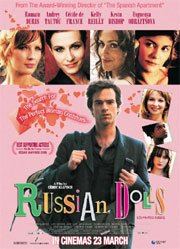
MOVIES: Russian Dolls

'Russian Dolls', sequel to 'Spanish Apartment' and you so have to watch it!


Les Poupées Russes [The Russian Dolls]

Director:
Cédric Klapisch

Starring:
Romain Duris .... Xavier
Kelly Reilly .... Wendy
Audrey Tautou .... Martine
Cécile De France .... Isabelle Wauquaire

Awards/Nominations:
Cesar Awards 2006 – Best Supporting Actress (Meilleur second rôle féminin)
- Won (Cecile De France)
Cesar Awards 2006 – Best Supporting Actress (Meilleur second rôle féminin)
- Nominated (Kelly Reilly)
Cesar Awards 2006 - Best Editing (Meilleur montage)
– Nominated (Francine Sandberg)

From the Cathay website:

The Sequel to Spanish Apartment. Five years after their summer together in Barcelona, Xavier (Romain Duris), William (Kevin Bishop), Wendy (Kelly Reilly), Martine (Audrey Tautou) and Isabelle (Cecile de France) reunite for a wedding in St Petersburg, their carefree days behind them, and now close to thirty. Xavier is a struggling writer who dreams of having the perfect career and the perfect woman. He is still in touch with his ex-girlfriend Martine, but is living with Isabelle , now a successful gay stockbroker. When he has to find a British writer to work with him, he goes to live and work with Wendy in London. Dividing his time between London and Paris, where he is ghostwriting the memoirs of a sexy and spoilt 24 year old supermodel, Celia (Lucy Gordon), Xavier struggles with his attraction to both women, slowly realizing he must grow up.


This is the movie I've been waiting to watch. A sequel to L'Auberge Espagnole [The Spanish Apartment]. Basically, it's a tale of a 30 year old who has not quite come to terms with the emotional responsibility of growing up. Ironically resonant with my own life, especially with the BIG 3-0 coming like a looming truck. It's my birthday movie. So what if I don't actually watch it on the date itself? Yay! ;p

Opening 23 March 2006

New Majestic Hotel

Just saw the website for New Majestic Hotel.

Nice. Might just get a couple of girl-friends and just hang out there over the weekend.

The Daily Dharma : March 16, 2006

From Tricycle
We make every effort to keep things as they are, because human beings, alone, lament transience. Yet no matter how we grieve or protest, there is no way to impede the flow of anything. If we but see things as they are and flow with them, we may find enjoyment in transience. Because human life is transient, all manner of figures are woven into its fabric.

-- Shundo Aoyama, Zen Seeds

I'm Back

Huh. As you can tell, I'm back again. There was some connection problems a while back, and I couldn't for the life of me post ANYTHING.

I'm back.

You know, it's something of an anti-climax.

Oh well.

Aww...

Can't post. Oh dear. Censorship? Heh.

Problem Uploading

Is this the fear of a blogger? That somehow I can no longer upload anything - or edit a previous post?

Library and What You Read

I've been trying to cut down on my book purchases these days. It's part of the "Grand Plan" to save money. (Reaching 30, and I haven't really set aside my retirement fund.)

So I've been going to the library, which is a little inconvenient as NLB is hardly up to date on the latest titles.

But it helps me save - and as a friend reminds me, it's better for the environment; The irony for this little bookseller.

You get a little receipt of your book loans, printed on filmsy thermal paper. I keep the receipt religiously, so that I do not forget the due dates for my library books. But before I return the books, I make it a point (just as religiously) of disposing the receipt.

I don't like the idea of leaving information of my name and the books I've borrowed in the books that do not belong to me. I don't know why. Yet I do enjoy finding the little receipt between the pages from the previous person. I alway read the list they have checked out - this person who just borrowed the same book I am interested in - what else do they read?

I believe what you read reveals much about you. Perhaps that is why I do not enjoy revealing my library loans to strangers. (And apparently in the US, the FBI is able to access the library records of US citizens - all for the sake of the Homeland Security, of course. It is naive to believe we have actually made any progress in freedom through the centuries.)

I once saw this slip between the pages of a serious literary title. It belonged to a female. Her receipt shows she also checked out a few titles from Sophie Kinsella's Shopaholic series. I was amused - but oddly respectful of her choices. A few friends have cried out, after reading the Shopaholic novels - "This is the story of my life!"

Wednesday, March 15, 2006

What Do I Consume?

A quick glance at the lists on the right will show you that this year at least, I probably spent more time reading than watching films.

And, I watch more films on DVD than films within cinema.

A while back, a friend asks for some feedback on why I choose not to join the local film society. Firstly, I don't see any perceivable advantage of spending $90 a year to join a film society. I did spend about $20 a year to join the premium membership of the National Library - because it allows me access to the DVD collection of library@esplanade. With the ready availability of DVDs these days, a greater variety of films are now accessible to people like myself.

The Picturehouse is opening soon - ironicaly, on my birthday. I will definitely be checking it out. However, for the local film society, I remain indifferent.

Has the film society really made that much effort to bring film-lovers together? I have not seen the efforts. While they have been working to bring in quality films that are not quite so readily available - in terms of building a community, where film lovers can come together and share passion, I have not seen the effort.

The Vendetta Behind 'V for Vendetta'

New York Times, about Alan Moore and V for Vendetta

Alan Moore, as he described himself:
"I am what Harry Potter grew up into," he said, "and it's not a pretty sight."

Book List for 2007

I'm not even halfway done with the current 100 Books To Read - but already I am planning my list for 2007.

It helps me put back some of the titles I took out earlier - so that I will eventually get to them. Classics like The Great Gatsby, which I believe I should read - if only to determine if I like it.

While this year's list is eclectic, there seems to be a theme for 2007: Travel.

For someone who does not travel much, I consume many travelogues.

But perhaps this is precisely why.