Showing posts with label Rebecca Solnit. Show all posts

Tuesday, June 22, 2010

QUOTE | Two Meanings of Lost

Sort of how I've been feeling lately, so I decided to look up this quote:


Lost really has two disparate meanings. Losing things is about the familiar falling away, getting lost is about the unfamiliar appearing. There are objects and people that disappear from your sight or knowledge or possesion; you lose a bracelet, a friend, the key. You still know here you are. Everything is familiar except that there is one item less, one missing element. Or you get lost, in which case the world has become larger than your knowledge of it. Either way, there is a loss of control.

~ A Field Guide to Getting Lost by Rebecca Solnit

Saturday, February 14, 2009

Links to Recent Solnit Essays

I spent a lot of time on Friday searching for information on Rebecca Solnit's new book. In the process I came across some of her recent essay that are available online. I decided to link them here.

Here's her essay on Iceland for TomDispatch, an essay on Iceland after the recent economic crisis, where the people are slowly rising in fury at how greed and capitalism has failed them: The Icelandic Volcano Erupts: Can a Hedge-Fund Island Lose Its Shirt and Gain Its Soul?

From the January/February 2009 issue of Orion magazine, Rebecca Solnit's Elegy for a Toxic Logic - which meditates on the opportunity for change in the midst of the current economic free fall.

Friday, February 13, 2009

FORA.tv with a Neil Gaiman video

I just discovered FORA.tv, which allows me to stream video of talks and interviews with writers, thinkers and other personalities on various topics across politics, culture and technology - things that matters.

I spent about an hour watching Rebecca Solnit read from her book, Storming the Gates of Paradise, and answering questions. It was enjoyable. (If you're interested in Rebecca Solnit's talk, it's here.)

I decided it was a good idea to sign up for an account with FORA.tv - which will allow me to download the talks on audio or video files. I was running through their archive of videos, and that's where I found this talk with Neil Gaiman in 2006, where he spoke at Cody's Books, on Fragile Things.

I thought maybe somebody would be interested. So here's the video:

An Evening's Entertainment with Neil Gaiman celebrating Fragile Things: Short Fictions and Wonders.

In this dazzling new collection of more than twenty-five pieces of short fiction including a novella featuring the hero of his masterpiece "American Gods," Neil Gaiman charts the terrain between life and death, perception and reality, darkness and light. Guaranteed to dazzle the senses, haunt the imagination, and touch the heart, "Fragile Things" is a gift of wonder from one of the most unique literary artists of our time. Neil Gaiman is the critically acclaimed and award-winning author of the novels "American Gods," "Neverwhere," "Stardust," "Coraline," and "Anansi Boys;" "The Sandman" series of graphic novels; and "Smoke and Mirrors," a collection of short fiction - Cody's Books

Friday, May 09, 2008

Doctor, O'Brian and Solnit

I took the day off for my follow-up with the Handsome Doctor. For a consultation that's just there to reassure me everything is fine -- even the severe cramps is considered "normal" -- it's costing me a lot of money.

I shouldn't be complaining. I am luckier than most, because thankfully, my company insurance promise to cover most of the hospital bill, as well as all expenses 3 months following the operation. Except it has been a month since the surgery and I have not yet seen the reimbursement for my medical bills. Then I read this piece of news, and I go, Hmmmm.

I'm currently reading two books: Rebecca Solnit's Storming the Gates of Paradise and Patrick O'Brian's The Surgeon's Mate. Both are interesting and absorbing in their own way.

In The Surgeon's Mate, the British is now at war with the Americans, so the action is picking up. I find the Aubrey/Maturin series very soothing. Like a musical composition, it thrives on patterns and repetitions, with dramatic highs and lows at strategic moments.

It amuses me that in the film version of Master and Commander (the one with Russell Crowe and Paul Bettany), they changed the enemies from the Americans to the French. I liked the film, and because of it, I read the series with the image of Russell Crowe and Paul Bettany as Aubrey and Maturin. I imagine their manner of speech, Crowe's swaggering manliness when he takes charge of his ship, Bettany's pale reserve with blue glasses as he plays spy.

Storming the Gates of Paradise is more political than the previous two Solnit titles I have read (Wanderlust and A Field Guide to Getting Lost.) In Storming, Solnit is interested in exploring the political in landscape and space itself. Along the way she also discusses her own political activism, migration, art, culture, history - and even a meditation on astronomy and the constellation. One of the things I admire about her essays is the breadth of her interests, the way she is willing to wander off a topic to explore a related idea within the same essay. Where you first started might not always be where you end up, and so it is more interesting that way - because in it is a sense of discovery, by being willing to be lost, you allow yourself to find something new.

She discusses her literary wandering in the introduction, which is symptomatic of her distaste for fences and boundaries, especially fences on thoughts and ideas. This compartmentalizing of ideas - where we see can only see one facet of an idea - limits us. Ultimately, everything is linked: nature, culture, landscape, politics, the city, the country, are all inextricably interfused. Storming the Gates of Paradise asks us to take that leap of the imagination, to see how the world is larger than we realise - and to love it, and to do something about it.

I just re-read what I wrote about Solnit, and I realise how this book affects me. It is beautiful, and it is affecting. The case studies that Solnit cites are depressing, because it tells you how much injustice there is in this world that has been allowed, often sanctioned by the government against the interest of her people. Yet - I feel a possibility of hope in her writing. Injustice will always be there, which is why we have to do what we can against it.

Can I just end by telling you I am enjoying this book? :)

Well, bye. I'm off to the library. Books to return. Reservations to pick up.

Monday, May 05, 2008

QUOTE | The desire to go home

The desire to go home that is a desire to be whole, to know where you are, to be the point of intersection of all the lines drawn through all the stars, to be the constellation-maker and the center of the world, that center called love. To awaken from sleep, to rest from awakening, to tame the animal, to let the soul go wild, to shelter in darkness and blaze with light, to cease to speak and be perfectly understood.


~ Rebecca Solnit, from Storming the Gates of Paradise

To "cease to speak and be perfectly understood." That sounds wonderful indeed, like a place of peace.

Friday, April 25, 2008

REBECCA SOLNIT | Men Who Explain Things

The LA Times has this great essay by Rebecca Solnit. I love the ancedote (quoted below) about how a pompous ass tried to talk down to her, and ended with the proverbial egg on his face. But most of all, I agree with what she has to say about the people who talk over us -- and how we allow our own voices to be silenced. The essay is worth reading whether you are male or female.

For the Ladies: Read it, please, because this is about you.

For the Gentlemen: Read it please, because you are fair-minded and you have a conscience. Most of all, read it because you might have daughters, wives, mothers, and sisters -- and this is their story.

But first, Rebecca Solnit tells a story about something that happened to her at a party:

He kept us waiting while the other guests drifted out into the summer night, and then sat us down at his grainy wood table and said to me, "So? I hear you've written a couple of books."

I replied, "Several, actually."

He said, in the way you encourage your friend's 7-year-old to describe flute practice, "And what are they about?"

They were actually about quite a few different things, the six or seven out by then, but I began to speak only of the most recent on that summer day in 2003, my book on Eadweard Muybridge, the annihilation of time and space and the industrialization of everyday life.

He cut me off soon after I mentioned Muybridge. "And have you heard about the very important Muybridge book that came out this year?"

So caught up was I in my assigned role as ingenue that I was perfectly willing to entertain the possibility that another book on the same subject had come out simultaneously and I'd somehow missed it. He was already telling me about the very important book -- with that smug look I know so well in a man holding forth, eyes fixed on the fuzzy far horizon of his own authority.

Here, let me just say that my life is well-sprinkled with lovely men, including a long succession of editors who have, since I was young, listened and encouraged and published me; with my infinitely generous younger brother; with splendid male friends. Still, there are these other men too.

So, Mr. Very Important was going on smugly about this book I should have known when Sallie interrupted him to say, "That's her book." Or tried to interrupt him anyway.

But he just continued on his way. She had to say, "That's her book" three or four times before he finally took it in. And then, as if in a 19th century novel, he went ashen. That I was indeed the author of the very important book it turned out he hadn't read, just read about in the New York Times Book Review a few months earlier, so confused the neat categories into which his world was sorted that he was stunned speechless -- for a moment, before he began holding forth again. Being women, we were politely out of earshot before we started laughing.

Am I a feminist? Probably not in the academic sense of the word. But I am a woman, so I know how it feels like to be treated as a woman. To have my abilities doubted -- simply because I am a woman. To be ignored or patronized -- simply because I am a woman. To earn less than my male colleagues doing the same job with equal or greater competence -- simply because I am a woman.

This is the reason why I am a battling ram, because I resent being dismissed and I demand to be heard. Idiots will always try to belittle you, talk down to you, make you feel small and insignificant. If you believe them, or allow them to convince you of that, then they win. Rebecca Solnit reminds us that we can't allow the Mr. Very Important of the world to silent us:

Men explain things to me, and to other women, whether or not they know what they're talking about. Some men. Every woman knows what I mean. It's the presumption that makes it hard, at times, for any woman in any field; that keeps women from speaking up and from being heard when they dare; that crushes young women into silence by indicating, the way harassment on the street does, that this is not their world. It trains us in self-doubt and self-limitation just as it exercises men's unsupported overconfidence.

As Solnit reminds us, in its most extreme form, it allows unjust laws in certain countries, "where women's testimony has no legal standing; so that a woman can't testify that she was raped without a male witness to counter the male rapist. Which there rarely is." No self-respecting women would want to live with this kind of unfairness. And I don't believe any man who loves his wife, his mother, his sister or his daughter -- would allow the women in his life to be treated like this.

Yet there are generations of women who have been brought up to believe in their inferiority. Not knowing any alternatives, these women teach their daughters the same values -- of their inferiority by default of gender. Our society enforces this.

Nothing is sadder than the victims who perpetuate the crimes done unto them. Nothing makes me angrier than abuse victims who believe what happened to them is their fault.

Yes, this is personal -- not just because I am a woman -- but because I am also a daughter: My mother was brought up by traditional Chinese parents who favoured her brothers. She believes she is worthless compared to the sons. It worn down her self-esteem. Later in her life, she would marry my father, a critical, emotionally distance man who castigated her in front of her children. She stayed silent through the verbal abuses. She never learned to talk back.

Miraculously, I did. I swear I would never become my mother.

Growing up, my own mother tried to teach me this same bullshit -- I rebelled and I never stopped resenting her for it. Even now, when I hang the laundry out to dry, she would remind me to keep my underwears away from my brother and my father. It is taboo for men to walk under women's underwears, she tells me, because women's underwears are unclean.

"I can't believe you're telling me this!" I almost screamed. My mother still had no idea what was so wrong with what she said. This happened just last year.

When I was very young, my mother would make me help out with the housework. I asked why did I have to help, when my brother did not. It is not fair. My mother's million dollar answer?

"Because he is a boy."

My mother is still the only one doing the housework. If I can, I help.

I help not because I believe women should do the housework. I help because the men in my family wouldn't. I help because my mother is old, and I can't bear her doing housework all by herself.

This is not about being a feminist. This is about fairness, respect and dignity -- and I believe these are universal human truths.

-------------------------------------------------

Rebecca Solnit wrote several books, among them, A Field Guide to Getting Lost, and Wanderlust: A History of Walking. I admire Wanderlust and would definitely recommend it -- but it is A Field to Getting Lost that occupies the place in that special bookshelf of my heart.

Say, have anyone read River of Shadows? It's "the very important Muybridge book" in the story quoted above. It's very important, so I better read it soon.

Saturday, March 08, 2008

Rebecca Solnit's Acts of Hope

I was just sorting through the files on my laptop and I found this one article on Rebecca Solnit I had stored away a while back -- for re-reading.

Solnit is a writer-activists who has written several books, among them, Wanderlust: A History of Walking and River of Shadows: Eadweard Muybridge and the Technological Wild West -- all of them worthy examination of culture and society. In between, Solnit also throws in some beautitful writings.

I am re-reading her essay, Acts of Hope, which was written back in 2003 in response to US bombing of Iraq. She reminds fellow activists not to lose hope -- because activism is a leap into the dark. The essay was later expanded into a book, Hope in the Dark, which took its title from a line written by Virginia Woolf during World War I: "The future is dark, which is on the whole, the best thing the future can be, I think." In Solnit's interpretation, it is the darkness of the womb, not the grave. From the dark comes wild possibilites for change:

Writers understand that action is seldom direct. You write your books. You scatter your seeds. Rats might eat them, or they might just rot. In California, some seeds lie dormant for decades because they only germinate after fire. Sharon Salzberg, in her book Faith, recounts how she put together a book of teachings by the Buddhist monk U Pandita and consigned the project to the "minor-good-deed category." Long afterward, she found out that when Burmese democracy movement's leader, Aung San Suu Kyi, was kept isolated under house arrest by that country's dictators, the book and its instructions in meditation "became her main source of spiritual support during those intensely difficult years." Emily Dickinson, Walt Whitman, Walter Benjamin and Arthur Rimbaud, like Henry David Thoreau, achieved their greatest impact long after their deaths, long after weeds had grown over the graves of the bestsellers of their times. Gandhi's Thoreau-influenced nonviolence was as important in the American South as it was in India, and what transpired with Martin Luther King's sophisticated version of it has influenced civil disobedience movements around the world. Decades after their assassinations they are still with us.

Friday, April 13, 2007

QUOTES | Two Meanings of Lost

Lost really has two disparate meanings. Losing things is about the familiar falling away, getting lost is about the unfamiliar appearing. There are objects and people that disappear from your sight or knowledge or possesion; you lose a bracelet, a friend, the key. You still know here you are. Everything is familiar except that there is one item less, one missing element. Or you get lost, in which case the world has become larger than your knowledge of it. Either way, there is a loss of control.

~ A Field Guide to Getting Lost by Rebecca Solnit

Friday, February 16, 2007

SOLNIT | Storming the Gates of Paradise

I haven't seen anyone announcing this, so I thought I'll just drop a note:

Rebecca Solnit, author of the deliciously discursive Wanderlust: A History of Walking and A Field Guide to Getting Lost has a new book out later in the year.

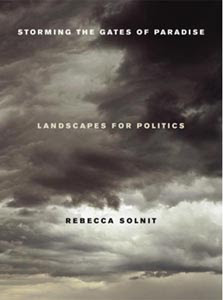
Published in a hardcover by the University of California Press, Storming the Gates of Paradise: Landscapes for Politics collects more than 40 essays across her career, and deals with her insights into culture, social politics and environmental concern. It is more politically motivated than Wanderlust and A Field Guide To Getting Lost, but yet totally coherent with her entire life's work. Her writing has always been about staying engaged with the world we live in, opening our hearts and minds to the infinite curiosities of everyday life and acting conscientiously. Afterall, this woman wrote an entire book on the ordinary everyday act of walking and made it profound and romantic.

Amazon.com states release date as June 30, 2007. If you're interested - I am - do reserve it in your Amazon cart or look out for it in your favourite bookstore after the publication date.