Showing posts with label Russian Literature. Show all posts

Tuesday, January 01, 2008

A Year Of Russian Readings 2008

The Objective: From 1st January 2008 to 31st December 2008, to (re)read anything Russian, or Russian-related - from any genre, any subject, any period, any author, any length.

Why? Because it is fun - because it is the only worthwhile reason for doing anything for its own rewards.

If anyone else is interested in reading some Russian for 2008, please join in for the Russian Reading Challenge hosted by Ex Libris.

Visit the Russian Reading Challenge blog.

Dark Orpheus's A Year Of Russian Readings 2008:

Just a little disclaimer -- this is an aspirational list -- this means I hope to finish as many titles on the list as possible, but life and other commitments makes it impossible to read everything. Still, just going to try to read as much as possible.


2008: And So It Begins


  1. War and Peace by Leo Tolstoy
    [translated by Richard Pevear & Larissa Volokhonsky]
    [01/01/2008 ~

  2. Anna Karenina Leo Tolstoy

  3. The Devil Leo Tolstoy

  4. The Cossacks Leo Tolstoy

  5. The Kreutzer Sonata Leo Tolstoy

  6. Resurrection by Leo Tolstoy

  7. Russian Short Stories from Pushkin to Buida Edited by Robert Chandler

  8. Nikolai Gogol by Vladimir Nabokov

  9. Lolita by Vladimir Nabokov

  10. Lectures on Russian Literature Vladimir Nabokov

  11. Red Cavalry Isaac Babel

  12. Give Me Songs For Lovers Irina Denezhkina

  13. The Idiot Fyodor Dostoevsky

  14. Demons Fyodor Dostoevsky

  15. The Double and The Gambler Fyodor Dostoevsky

  16. The Eternal Husband and Other Stories Fyodor Dostoevsky

  17. Crime and Punishment Fyodor Dostoevsky

  18. The Adolescent by Fyodor Dostoevsky
    [translated by Richard Pevear and Larissa Volokhonsky]

  19. The Hedgehog and the Fox: An Essay on Tolstoy's View of History Isaiah Berlin

  20. Dostoevsky: The Miraculous Years, 1865-1871 by Joseph Frank

  21. Dostoevsky: The Mantle of the Prophet, 1871-1881 Joseph Frank

  22. A Hero of Our Time Mikhail Lermontov

  23. The Heart of a Dog Mikhail Bulgakov

  24. A Dead Man’s Memoir Mikhail Bulgakov

  25. Tales of Belkin and Other Prose Writings Alexander Pushkin

  26. First Love Ivan Turgenev

  27. Virgin Soil Ivan Turgenev

  28. Sketches from a Hunter's Album Ivan Turgenev

  29. The Complete Short Novels Anton Chekhov

  30. Stories Anton Chekhov

  31. A Life in Letters Anton Chekov

  32. Sakhalin Island Anton Chekhov

  33. Oblomov Ivan Goncharov

  34. The Enchanted Wanderer & Selected Tales Nikolai Leskov

  35. Eugene Onegin Alexander Pushkin

  36. The Queen of Spades and Other Stories Alexander Pushkin

  37. Boris Godunov and Other Dramatic Works Alexander Pushkin

  38. Dead Souls Nikolai Gogol

  39. The Collected Tales of Nikolai Gogol
    [translated by Richard Pevear & Larissa Volokhonsky]

  40. The Funeral Party Ludmila Ulitskaya

  41. Medea and Her Children Ludmila Ulitskaya

  42. Doctor Zhivago Boris Pasternak

  43. Lolita Vladimir Nabokov

  44. The Slynx Tatyana Tolstaya
    [translated by Jamey Gambrell]

  45. White Walls: Collected Stories Tatyana Tolstaya
    [translated by Antonina W. Bouis & Jamey Gambrell]

  46. One Day in the Life of Ivan Denisovich Aleksandr Solzhenitsyn

  47. Moscow to the End of the Line Venedikt Erofeev

  48. Death and the Penguin Andrey Kurkov

  49. We Yevgeny Zamyatin

  50. Petersburg Andrei Bely

  51. Envy Yuri Olesha

  52. Death and the Penguin Andrey Kurkov

  53. And Quiet Flows the Don Mikhail Sholokhov

  54. Letters: Summer 1926 by Boris Pasternak, Marina Tsvetayeva & Rainer Maria Rilke

  55. Peter the Great Robert K. Massie

  56. St Petersburg: A Cultural History Solomon Volkov

  57. Lost Cosmonaut: Observations of an Anti-Tourist Daniel Kalder

2007: The Warm-Up

  1. My Life Anton Chekhov
    [translated by Constance Garnett]
    [27/11/2007 ~

  2. Fathers And Sons Ivan Turgenev
    [translated by Richard Freeborn]
    [14/11/2007 ~ 24/11/2007]

Saturday, October 27, 2007

Washington Post on Russan Lit

The Washington Post has two Russian translations on review this week.

First, a review of the Collected Stories of Ivan Bunin, translated by Graham Hettlinger.

They also have Michael Dirda reviewing the new Richard Pevear & Larissa Volokhonsky translation of War and Peace.

Stressing that their War and Peace sticks more closely to the Russian text than any other, including Louise and Aylmer Maude's semi-canonical 1923 version, Pevear and Volokhonsky retain the considerable amount of French used by Tolstoy's counts and princesses, preserve the author's penchant for word repetition and aim to match his tidy syntactic conciseness. The result certainly reads smoothly, its English being neither egregiously contemporary nor inappropriately old-fashioned. In this respect, the Pevear-Volokhonsky War and Peace joins company with recent translations of The Tale of Genji, Don Quixote and In Search of Lost Time, these being among the few works of classic fiction equal to Tolstoy's in scope and richness. Given so capacious and generous a masterpiece, it's simply impossible to do more than offer -- with due humility at how much is being overlooked -- a few introductory propositions for the would-be reader.

My copy is now sitting in my room, seducing me with its coy blue and red spine. It awaits 1st January 2008.

Friday, October 19, 2007

QUIZ | Which Wacky 20th Century Russian Author Are You?

Psst. Found this online. Think of it as a run-up to the Russian Reading Challenge. Oddly, I have no Mayakovsky on my list to read. I should look into this.

Which wacky 20th century Russian author are you?

You are VLADIMIR MAYAKOVSKY. You brood, and look sexy while doing it. Futurism and surrealism appeal to you. As a young artiste you pulled pranks like throwing tea at your audiences. You really like your friend Brik's wife, so youll write her an epic poem deemed "the most savage indictment of a woman in our time." A couple years after the October Revolution, no one will praise your work anymore, and your crappy love life will make you depressed.

So, sadly, you'll commit suicide.


Take this quiz!

Sunday, October 14, 2007

RUSSIAN LIT | Related Articles on Russian Translations

Cross-posted Russian Reading Challenge 2008


Kate S. brought up a very relevant question on translations. We keep asking it, because there really is no easy answer. While I can't claim to have the perfect answer (I can only speak for my own preference), I thought I could share some of the articles I have found online that address the subject:

In 2005, David Remnick wrote a much-talked-about story for The New Yorker on Russian-language translators. He mentioned Constance Garnett, and of course the much-lauded Richard Pevear and Larissa Volokhonsky.

[Read Remnick's The Translation Wars]

Also, the recent New York Times essay by Richard Pevear himself, on translating War and Peace:

I’ve said “translator,” and in a sense my collaboration with Larissa is so close that the two of us make up one translator who has the luck to be a native speaker of two languages. We work separately at first. Larissa produces a complete draft, following the original almost word by word, with many marginal comments and observations. From that, plus the original Russian, I make my own complete draft. Then we work closely together to arrive at a third draft, on which we make our “final” revisions. That working situation has its advantages. Translators are always in danger of drifting into the sort of language that is commonly referred to as “smooth,” “natural” or, as they now say, “reader friendly,” but is really only a tissue of ready-made phrases. When that happens to me, as it sometimes does, Larissa is there to stop me. Where I have my say is in judging the quality of our English text, that is, in drawing the line between a literal and a faithful rendering, which are not at all the same. If the translation does not finally “work” in English, it doesn’t work at all.

[ Read the rest of Pevear's essay]

And this blog post entitled, Turgenev: The Translation Game, via Steamboats Are Ruining Everything - where we get a meticulous, close-text reading of various Turgenev translators -- Constance Garnett, Bernard Guilbert Guerney and George Reavey.

NY Times with Pevear on War and Peace

The New York Times is hosting a month-long discussion (moderated by Sam Tanenhaus) on the new Richard Pevear and Larissa Volokhonsky translation of War and Peace.

They also have an essay by Richard Pevear on the epic, and on the daunting 3-year translation work.

The world of “War and Peace” envelops you. It is built on uncertainties, illusions, sudden reversals, constantly shifting perspectives, but once you enter it you feel you’re in sure hands. Over it all is the “infinite sky” that Prince Andrei discovers as he lies wounded on the field of Austerlitz. This vast unity that embraces the broadest human diversity is the secret, the mystery, of Tolstoy’s art. If it offers a great challenge to its translators, it also offers great rewards to its readers, as I’ve tried to suggest in a small way.

Wednesday, October 03, 2007

A Russian Is ...

"Only a German bases his self-assurance on an abstract idea: science, that is, the supposed knowledge of absolute truth. A Frenchman's self-assurance stems from his belief that he is mentally and physically irresistibly fascinating to both men and women. An Englishman's self-assurance is founded on his being a citizen of the best organized state in the world and on the fact that, as an Englishman, he always knows what to do, and that whatever he does as an Englishman is unquestionably correct. An Italian is self-assured because he is excitable and easily forgets himself and others. A Russian is self-assured simply because he knows nothing and does not want to know anything, since he does not believe in the possibility of knowing anything fully."

~ excerpt from "War and Peace" by Tolstoy


I am definitely Russian.

Sunday, September 30, 2007

Which War and Peace to Buy?

The new Richard Pevear and Larissa Volokhonsky translation of War and Peace is coming out soon. The crucial question is which edition to buy? When the content is the same, it becomes a question of aesthetics -- how prettily it will sit on your bookshelf. (Yes, I am shallow in my own way.)

Should I buy the US edition , with that sentimental baby blue?

Or should I buy the UK edition, with its more sombre grey and red script?

Decisions, decisions.

Saturday, September 29, 2007

Ex Libris Hosts Russian Reading Challenge 2008

In 2008, Ex Libris will be hosting a 12 month reading challenge of all things Russian - novels, short stories, biographies, history, poetry - by Russian authors or by authors about Russia.

Challenge begins January 1, 2008 and ends December 31st, 2008.

From the host:

This challenge has a lot of flexibility. Although it runs for 12 months (beginning January 1, 2008 and ending December 31, 2008), participants are only required to read 4 books. These books can be fiction (novels, short stories), non-fiction (history, biographies, etc.), or poetry. I felt that many Russian novels are of considerable length, so this allows participants to take more than 1 month to read a book if they wish. Or if you are overwhelmed with challenges, then this allows you to participate without adding too much of a burden.

I just matter to be drawing up my personal reading challenge for A Year of Russian Readings 2008. Since the two coincide, I thought it would be nice to sign up. Always encouraging to have someone reading with you, isn't it? Reading list to follow -- closer to the date.

If you're interested, please either email her, or leave a comment here or on the Russian Reading Challenge blog.

Friday, September 14, 2007

R.I.P. II | Nightwatch

Reading for The R.I.P. II Challenge:

The Nightwatch by Sergei Lukyanenko
Translated by Andrew Bromfield
[28/08/2007 ~ 13/09/2007]

I picked up The Nightwatch because of the awesome film adaptation. Having watched the film will not spoil you for the novel, as film and book share only minor storylines. The plots in the book are far more complicated than the film. Not necessary better ― just more complicated.

The story is an urban dark fantasy, set in Post-Soviet Moscow. Night Watch spins the mythology of the Others ― a race of supernatural beings (shape-shifters, vampires, magicians) divided between the Light and the Darkness. Each side has a Watch that serves to keep the other party in check. The Night Watch represent the Light, and they operate in the night; the Day Watch are serves the Dark, they watch in the day.

Each violation of the treaty by one side allows the other to a similar infraction. So, because of the treaty, the Nightwatch and the Daywatch are forced to take their battle onto more subtle, more complicated levels. The heads of the two forces play complicated games, pawns are sacrificed, the agenda is never clear – and until the end, you don't really know what was at stake:

"A complex maneuver," I said, glancing at Boris Ignatievich. "From both sides. The Day Watch sacrifices its pawns, and the Night Watch does the same. For the great goal. … But there's an end that justifies the means. Two great magicians who have opposed each other for hundreds of year cook up another little war. Amd the Light Magician is in the toughest spot … he has to stake everything. And for him to lose is more than just an inconvenience; it's a step into the Twilight, into the Twilight forever. But still he stakes everyone's lives. His own side's and the other's…"

The novel is a collection of three loosely related stories, all held together by first-person narrator, Anton Gorodetsky, who is more fleshed out in the novel. He is an normal person who was put in an extraordinary position as an Other, and as a reluctant field agent of the Night Watch (thankfully without being annoying angsty). He just wants to do his best, but his neighbours are vampires, from the Dark. He wants to be friends with his vampire neighbours, but they are wary of him.

He is also the character who pieces the conspiracies together, through guesswork and blind chance (or destiny) — but here is where the novel is most ineffective. There is never convincing evidence of how Anton figures out the political maneuver between the heads of the two Watches. He reaches his conclusions almost out of thin-air. Sloppy.

We see things through his eyes, we hear him question the ambiguity of the Watches: "All of us have to struggle, not just against the Darkness, but against the Light. Because sometimes it blinds us"

Night Watch is an old-fashioned fantasy story about the struggle of Good and Evil, and how one has to make choices. In between are some humanist messages, about how intentions do not always justify the choices. In doing good, we might serve the path of the Dark. How can one make any kind of choice with this realisation?

How many of you there still are, girls and boys of various ages, raised by naïve parents in the sixties. How many of you there are, so unhappy, not knowing how to be happy. How I long to take pity on you, how I long to help you. To touch you through the Twilight—gently, with no force at all. To give you just a little confidence in yourself, just a tiny bit of optimism, a gram of willpower, a crumb of irony. To help you, so that you could help other.

But I can't.

Every action taken by Good grants permission for an active response by Evil. The Treaty! The Watches! The balance of peace in the world?

Truth is, The Night Watch is an absorbing read. There is enough intrigue and interesting stock characters to keep a reader turning the pages. Some of the cheesy plot devices can make a more demanding reader cringe, of course (the fate of the world hangs in the balance, on a piece of ... chalk?) ― but my advice is to just ignore the cringe-worthy moments and allow yourself to enjoy the ride.

It is amazing how familiar yet different an urban dark fantasy set in Moscow can feel. The Watches are structured within a rigid bureacracy, almost like the 19th century Russian civil service that readers of Dostoevsky, Bulgakov and Gogol will find familiar.

When was the last time we get to read popular fiction from Russia? Consider it a cultural experience that is also entertaining. After this, I'm dying to pick up Day Watch and Twilight Watch ― the later books in the series.


{Housekeeping: The Nightwatch is also included in The Armchair Traveler Challenge, as it is set in Moscow, Russia.}

Friday, July 20, 2007

BOOKS | Russian Literature and the Art of the Novella

I'm planning for a Russian themed reading list next year (July is not even over and I'm already looking ahead to next year. *sigh*) - A Year of Russian Reading 2008, as I call it.

For next year, I shall attempt to read as deeply and as widely from the pool of Russian literature available in English. In anticipation of this, I have been checking out reading materials.

That was when I came across the Art of the Novella range published by Melville House. I have picked out My Life by Anton Chekhov, First Love by Ivan Turgenev and The Devil by Leo Tolstoy. The range also includes The Eternal Husband by Fyodor Dostoevsky, but I already have another edition by my preferred Russian translators, so I skipped it.

[Picture Above: The three Russian novellas published by Melville House I have laid out at my desk at work. The Homer face is from a publicity package to tie-in with The Simpsons Movie. You have to admit - the Simpson yellow against the colours of the novellas just looks good.]

I've noticed some interesting forthcoming titles from the Art of the Novella series:

In August 2007, Melville House will release How the Two Ivans Quarrelled by Nikolai Gogol. I might already have this in one of my Gogol anthologies. So I might skip it, although the temptation to just buy a copy to complete the collection is just too tempting.

Arriving February 2008:

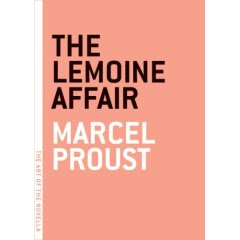
But the one I have set my eye on is The Lemoine Affair by Marcel Proust. I have never seem this title before. Is anyone aware if there has been a prior English translation of this novella?

The Art of the Novella series is a good range to keep. The titles selected are interesting, and they have these minimalist monotone covers that are rather eye-catching. Most importantly, they are all in easily digestible novellas, which is good if you are hard pressed to finish your books - like myself.

Friday, April 27, 2007

BOOKS | New War and Peace Translation

Randomhouse has the forthcoming Richard Pevear and Larissa Volokhonsky translation of War and Peace slated for November 2007. It's available as a three-volume set, and will set you back US$40.00.

And there was even a morsel of gossip on the Publishers Weekly blog. Pevear and Volokhonsky made an appearance to talk about their new translation of War and Peace:

I love the Russian writers, and after hearing Pevear and Volokhonsky talk about the work of translating (they were so intelligent and so charming. "What was the most difficult part?" the crowd asked, and Larissa said, "the boring bits." And her husband talked about the dialogue and how incredibly rich the Russian language was in Tolstoy's time, even more so than it is today, and how there would be only one word choice in English when in Russian, there were many. But my favorite anecdote was the turtle soup dilemma. Were there cox combs in the turtle soup? or scallops? Larissa researched the recipe and while scallops got into the manuscript, a sauce of cox combs will appear in the finished version), I am going to read this book. I even know when. As soon as I get the galley.

It says something about Larissa Volokhonsky that she will research a recipe to get the details right. It's meticulous, it's effort and dedication.

This is the version I have been waiting for. This will mean there is no longer any excuse not to read the Tolstoy epic. Perhaps I should set aside 2008 as "The Year of My Really Reclusive Russian Readings." (I love the rolling alliteration)

It occurred to me last night that it has been 10 years since I first read the Richard Pevear and Larissa Volokhonsky translation of Crime and Punishment — something that aroused in me a passion for Russian literature. I will need to think about this a bit more, perhaps draw up a reading list of Russian literature.

Some time back I started looking online for David Remnick's New Yorker article, "The Translation Wars." It was a highly praised essay where he compared English translations of Russian literature, from Constance Garnett to the husband-and-wife team of Larissa Volokhonsky and Richard Pevear. Unfortunately, it's not available online via The New Yorker). Yet today I found it via two different blog sites:

Tuesday, February 20, 2007

BOOKS | Twilight of Love

Twilight of Love: Travels with Turgenev
By Robert Dessaix
[16/01/2007 ~ 20/02/2007]
[Memoirs; Travel Writing; Russian Literature]

I've just finished Twilight of Love by Australian author Robert Dessaix. In a sort of introduction to the book, Dessaix provides the background to how he came to this journey, to Turgenev, and writing this book. When he was about 11 or 12 years old − a long time ago, when "the first sputnik began crisscrossing the sky", Dessaix bought himself a Russian dictionary. That purchase changed his life and set him onto a lifelong Russian romance. Within weeks he signed up for Russian classes, studied a year in Moscow, and eventually began teaching Russian language and literature to students.

Dessaix had intended to trail the footsteps of Russian writer Ivan Turgenev across Germany, France and Russia, to the places he had lived, loved, and wrote his novels. Yet like all good journeys, he meandered, "so crabwise, as it were, while seeming to fix my sights on Turgenev, I have ended up scuttling past him, heading for a broader target."

For a great part of the journey, Dessaix reveals to us how Turgenev spent forty years in love with the diva Pauline Viardot, following her and her husband around Europe until the end of his days. It was a bizarre menage a trois, as Turgenev was on good terms with the husband, Louis Viardot. It gives a perspective into another way of love, not the twosome affair that we are used to. Dessaix asserts that Turgenev understood he was never meant for the conventional twosome love. In fact, for a man so concerned with love, Dessaix noted that there was never any "happily-ever-after" in Turgenev's stories. The characters come to passion, illicit or forbidden in some ways, and it ends. Turgenev continued to have relationships with many other women, but his devotion to Pauline Viardot was unquestionable and complete.

Nowadays I expect we'd call such a scene high camp, but in 1843 it was deliciously theatrical. They knew how to do things in those days. He was twenty-five and she was twenty-two, and he was hers forever.

Dramatic, almost too unreal. Something changed in us between the time of Turgenev to present days. We are unable to love without fulfilment; we have come to assume love and happiness as our inalienable birthrights. We find it hard to believe in love like that, love that could just be − yet there is something that still remains in us that admires the chaste devotion Turgenev had for his Pauline Viardot. We have lost the vocabulary for it.

Yet all the words I might find to describe this love somehow miss the mark. To call it a 'great love affair' makes it sound oddly banal, as if he and Viardot were lovers, which, as far as anybody knows for certain, they were not. To say he was 'deeply in love' with her all his life makes him sound eternally frustrated in his feelings, even adolescent, yet for most of his life it was a stable, enriching love. It was not just a matter of 'passion', either, although there was ardour there of a kind, especially in the early years. Nor was it merely disembodied 'adoration' − in letter after letter he kissed her hands and her feet (although not her lips.) …

One thing seems obvious to me: a love such as this is only possible between two points in a triangle. Otherwise there will be thunder and lightning and what links the two lovers will eventually break asunder. The third point may be a husband or wife or it may be something else entirely.

Quite possibly there is no name at all for this kind of love. Perhaps, in fact, there is no need for a name since so few of us will ever experience anything like it. For the lives most of us lead, the old words will almost certainly do, one replacing the other as the years go by. On the other hand, if I could fin the right word for what Turgenev felt, perhaps the love my own life is rooted in would grow even more luxuriantly.

I want to know what it felt like to love someone like that. I want to find the words.

Dessaix goes back and forth between Turgenev's life and his writings. For him, the focus of Turgenev's life's works is not the politics − nor is it the nihilism, the philosophy that is supposed to have sparked a failed revolution and led the Tsar to free the serfs.

Rather, it is Love. How to love. That is core of Turgenev's life, says Dessaix. Dessaix it seems, following the footsteps of the Russian author, is also exploring his own path to love in twilight, questioning what is means to love, his own realisation of Love. And he leaves us with these thoughts:

Human life may seem pointless and always end badly, but you must make your peace with it. If lasting happiness escapes you, you must resign yourself to magnifying the blissful moments. If burning pasion kaleidoscopes into something slower, mellower and more sweet-tempered, then you must have the grace to warm yourself by this gentler flame. If shafts of light are rare, or only a mirage, wait for them quietly all the same. If love, when you try to lay hold of it with your hands or even just your heart, slips from yout grasp like water because there's no one there, you must reconcile yourself to loving what you find. Love is never enough. It must always be enough. There's nothing else. That, at least, is what I hear him say when he talks to me.

I had picked up the book expecting something else. I had not imagined a treatise of love. It is introspective, lyrical, romantic and well-written. It warms me to the idea of reading Turgenev.

My thanks to Acquistionist for recommending Robert Dessaix.

Saturday, February 17, 2007

BOOKS | More on Ice

I've previously mentioned this title, Ice, by Vladimir Sorokin. I just found out it's the first installment in a projected trilogy, to be released by NYRB (somebody go give them a pat on the back for doing a very good job, please). Sorokin himself apparently is known outside of Russia for his clashes with conservative groups over the last several years - but until now, very little of his particular brand of gritty satire has been available to English-language readers.

I still have the book on reserve. Will purchase it next week and hopefully read it soon.

My TBR pile aspires to the heights of the Tower of Babel.

There's more write-up on Ice in The Moscow Times.

News via Literary Saloon - still doing the world a favour by expanding our minds to literature beyond our own borders.

Friday, January 12, 2007

RUSSIAN Lit | Ice by

Now, I'm a sucker for things Russian. So I had to post this.

Over at Conversational Reading, they highlighted a new Russian satire, Ice, by Vladimir Sorokin. It's published by the good people at NYRB. (New York Review of Books keeps finding these interesting things to publish, don't they?)

Jon Fasman reviewed it for the LA Times, and claims it "provides a head-scratching pleasure and deceptive quickness similar to that found in the novels of Haruki Murakami."

The Publisher Weekly describes it as " a Master and Margarita for the age of Buffy the Vampire Slayer".

Russian, Haruki Murakami, Master and Margarita and Buffy. They have my curiosity piqued.

Monday, October 02, 2006

Shteyngart on a Russian Slacker

From The New York Times, Gary Shteyngart writes "the most insightful essay ever written on the subject — a short, funny, but oddly moving meditation" on Ivan Goncharov's Oblomov. It's funny.

Read it here.

Thursday, August 10, 2006

New Translations

I came across this article entitled "Flood of re-translated classics hits shelves" by Jeffrey A. Trachtenberg.

Lots of classics are getting new translations. No surprise.

Robert Fagles will have a new translation out later this year: The Aeneid. I have his renditions of The Iliad and The Odyssesy, so I'll definitely pick up The Aeneid to complete the collection.

But probably only in the Penguin Deluxe paperback.

As for the Russian masters:
In January, Viking released a version of Leo Tolstoy's "War and Peace," the first new English translation in nearly 40 years of the sprawling Russian saga about the Napoleonic Wars. A blurb on the back jacket of the 1,412-page volume, translated by Anthony Briggs, calls it "the best translation so far of Tolstoy's masterpiece into English."

In fall 2007, Everyman's Library is coming out with its own "War and Peace," translated by husband-and-wife team Richard Pevear and Larissa Volokhonsky. "It will be our most important new translation of the year," says LuAnn Walther, the imprint's editorial director.

I have the Anthony Briggs translation, which I'm reading in bite-size right now. But if I knew then that the Richard Pevear and Larissa Volokhonsky translation will be out in 2007, I would have gladly waited. Their treatment of Dostoevsky gave me confidence in their Russian translations. It brought the energy and passion back into his language that earlier versions lack. Dostoevsky was not a stiff-upper lipped Victorian gentleman and translations that made him sound British missed the point entirely. The Dostoevskian soul is closer to a manic-depressive. At least that's how I see it.

One of the crtics against new translations is Andre Aciman - not that he is against them, but he pointed out that not all new translations necessarily improves on the original. Sometimes, the new translation is just plain jack-assed. Of course, he phrased more politely:
He specifically criticizes the decision by Viking Penguin to change the title of the second volume of Marcel Proust's novel "A la recherche du temps perdu" in a 2004 translation, from Within a Budding Grove to In the Shadow of Young Girls in Flower. He describes the new title as "monstrous." "Do you know what that means, because I don't," he says.

Andre Aciman also edited the compilation, The Proust Project - which has different writers writing about their favourite passages from "The Proustian Epic." I am going to just call it "The Proustian Epic" because to call it either "Remembrance of Things Past" or "In Search of Lost Time" is getting my hands dirty on choice of translators.

On a personal note: I like the Lydia Davis translation of Swann's Way. Granted I have read no other translations to make a comparison, but Lydia Davis's effort rendered the sinuous prose intimate and endearing.

I've just started on James Grieve's translation, In the Shadow of Young Girls in Flower.

Already, I feel the difference. Sorely.

Full article.