I was checking my record for my readings for last year. I started reading Proust on 11 July 2006, and it took me about a month each to finish both Swann's Way and In the Shadow of Young Girls in Flower. But gradually, it took longer to finish the books, with The Guermantes Way taking about 3~4 months.
I'm still on Sodom and Gomorrah. Started reading it last year in December but I'm still only about a hundred odd pages into it. The society scenes bore me a little, and the narrator is getting on my nerves.
Proust started well, or perhaps I really enjoyed Lydia Davis's introduction and her translation. I like the character of the grandmother, with her humanity, real dignity, and her genuine affections for her grandson. A great contrast to the artificiality of the high society that young Marcel is hanging out with. Proust starts to lose my interest once he moves away from Combray.
I wonder why I am so obstinate about wanting to finish Proust. Is it because of the sheer challenge of it? I have no problem abandoning Moby Dick, although it did begin well also. But then again, I have started on Moby Dick about 5 times, never seeing the end of it.
Something I read last year may explain the Proustian fixtation. I read Fun Home last year (highly recommended read) and it was a memoir of artist-author Alison Bechdel's father ― a closest gay school teacher who also happens to run a funeral home (it was a family business). Her father passed away while she was in college, but it was suspected that he killed himself. Her father was a prodigious reader, and Fun Home is wonderful the way Bechdel interweaved her narrative with the readings of Fitzgerald, Joyce, Proust and Camus.
A year before her father died, he began to read Proust. Alison Bechdel wondered at the significance of the reading:
Was that a sign of desperation? It's said, after all, that people reach middle age the day they realize they're never going to read Remembrance of Things Past.
Proust was a great reminder of the passage of time. I spoke with a friend about this, and she agreed. Sometimes, you realise there is not enough time to do what you need to do.
Several things contribute to my desire to read Proust. Seemingly unconnected things, yet relevant because of the way they set me to ruminate on time and life.
On 6 June 2005, Anne Bancroft passed away. Her most famous role was that of Mrs Robinson in The Graduate. Instead of the one-dimensional predator, Anne Bancroft played her as a woman really just misunderstood.
One of the best tribute I read was by Elizabeth Kuball for Salon.com. According to Kuball, Bancroft believed the character, Mrs Robinson had dreams once, but the dreams were unfulfilled because of circumstances. So she "spent a very conventional life, with this conventional man, in a conventional house. ... And meantime, all the dreams that she had had for herself, and the talent ― she probably was a gifted artist ... I thought that she was ― and none of that could happen anymore." One can read this specifically in the scene when Mrs. Robinson and Benjamin are in bed, and Ben asks her what her college major was. With her back to him, she says one word: "Art"
"I guess you kinda lost interest in it over the years then," Ben says.
"Kind of," she replies.
That is the sadness of our lives: Though we decline, our dreams don't always fade with time. As the possibility of our dreams grows more remote, all we have is a kind of regret. Kuball sums it all up:
With her eyes alone, Bancroft gives voice to the fear we all have: that we'll reach a certain point in our lives, look around and realize that all the things we said we'd do and become will never come to be -- and that we're ordinary because of it.
Then in 2005, I saw the film Saving Face, and it felt like a rebuttal to all the pessimistic thoughts that were going around in my head. In the film, Joan Chen plays a 48 year old widow who was revealed to be pregnant. She was kicked out of her parents' house when she refuses to disclose who the father was. She ended up moving in with her adult daughter, Wil, who was NOT happy to have her knocked up mother around, especially since Wil was in the middle of her own little secret love. It was a film about the possibility of love and life, no matter how old you are. It is life-affirming and I've watched it too many times on DVD.
In the Director's Notes, Alice Wu wrote this about her film:
I wrote Saving Face as a love-letter to my mother. The character of Ma begins the movie as a woman with all major decisions in life seemingly made; at 48, she has lived a proper life and is now essentially just living to die. That she ultimately breaks with tradition and lives on her own terms is a triumph I wanted my mother ― and the world ― to see.
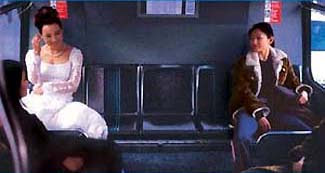
Alice Wu also admits the framing of the ending of her film was partly inspired by the ambiguous ending to The Graduate. At the end of The Graduate, after Ben (Dustin Hoffman) rescues Elaine (Katharine Ross) from the wedding, they are in the bus, scared and uncertain about the future. In Saving Face, after Wil rescues her mother from the wedding, the emotions are a little different:

Ironically, it all contributes to me wanting to read Proust. :)


