Tuesday, September 05, 2006

YOGA | Wheel

H’s a nice Australian yoga teacher who came over to teach. How do I know he’s Aussie? Occasionally he comes to class in a singlet with "Australia" printed straight across the back. No one but an Aussie will wear a shirt like quite so unabashedly; feels like someone stuck a "Kick Me" note on his back.

Now, H. is a nice, funny guy who also happens to be a good yoga teacher. He has a slacker-dude sense of humour that I appreciate. His humour and chatter lifts the mood of his classes – important when your muscles are burning from holding the pose.
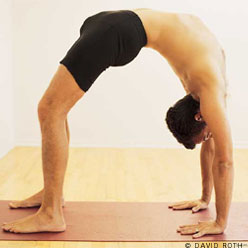


Last Saturday was Power Yoga 1 with H. Personally I find Power Yoga more demanding as I lack upper body strength. Last Saturday we were supposed to do Urdhva Dhanurasana (Wheel Pose). As you can see from the picture, it requires strength in the arms, shoulders and thighs: the areas of the body that I have yet to develop. Baron Baptiste calls it "one of the most powerful poses in yoga practice" – and he meant it.


H. understood not everyone is ready for it, and explained we do not have to try it if we are not ready. The first rule of yoga is Awareness. Be aware of yourself. Know your limits – when to surrender, when to push a little further.

I attempted the Wheel Pose that day. H. saw what I was doing, and he told me to stay down; I was not ready to go up.

When the class prepared to do the Wheel Pose for the second time. H. came over. He asked me to hold his ankles, to give me a better leverage in the arm-lifts. He assisted me in a modified version of Wheel Pose. I was grateful.

Later, addressing the class, H. reminded us that not everyone is ready for all the postures. But he will always allow us the choice to surrender or to attempt the asana. We make the choice. At the end of the day, it is our own practice.

I first learnt yoga more than three years ago in a crowded gym studio. I did yoga 3~4 times every week for more than a year. M, the yoga teacher, was a wound-up core of sheer yogic stamina. Her classes were demanding - and her battle-axe personality was intimidating. She pushed her students, sometimes shouting at them from across the room. I persisted, and because of her I grew stronger. We did Wheel Pose every Thursday. Didn’t matter if you can’t, you just try. If for no other reason, you tried because M was so scary. Then one day, I lifted.

I still remember the first time I went up in a Wheel Pose: The thrilling sensation of power as I pushed my body higher. I wanted to stay in the pose for a long time. My body was light, liberated.

In Urdhva Dhanurasana, I felt like I could fly.

Then I quit the gym. Without the regular yoga practice, I lost the muscular strength. And I couldn’t do the Wheel Pose last Saturday.

But in all that time at the gym, I have never felt so supported and safe - as I did last Saturday in H’s class.

I am grateful to H. – that he saw I was not strong enough, yet supported me in my struggling endeavour. I will continue working at my practice. I will continue to try the challenging poses. And I know H. will watch over me as I explore. I am grateful for a teacher that makes me feel safe.

Most of all, I want to fly again.

Monday, September 04, 2006

Salon's Literary Guide On China

I admit Salon.com's Literary Guide to the World starts with good (albeit ambitious) intentions. As Hillary Frey, Books editor at Salon wrote in her introduction:
"From Turkey to Togo, D.C. to L.A., Rio to Russia and beyond, the Guide promises to recommend the best books -- fiction, history, memoir or otherwise -- to take with you on your travels."

It's never an easy task, doing recommendations like this. Lists are often highly personalised choices, and doomed to the limitations of the people doing the selection. You will always be criticised for what you include, as well as your omissions.

But I have to bitch about the selection for China. Any list that does not include Louis Cha (or Jin Yong) in their list of great literature of China, does not understand Chinese Literature.

I happened onto the Chinese newspaper recently. In a study done on the national reading habits of the Chinese, Louis Cha ranked #1 as Best Loved Author. This is followed by Ba Jin and Lu Xun. Qiong Yao comes in at #4, but let's not go there. (My mother almost named me after a character from one of Qiong Yao's novels, so we really should not mention Qiong Yao here)

Louis Cha's novels are mainly in the wuxia (martial art) genre. The wuxia novel is rather unique to Chinese culture and I believe, the main reason why it resists translation into English, and why it's not better known among English-speaking readers. It's a pity, because in the same survey on Chinese reading habits, wuxia is the most read genre of choice amongst the Chinese.

In case you're interested, this is Nell Freudenberger's selection for Salon's Literary Guide to China:

  1. The Search for Modern China by Jonathan Spence
  2. Selected Stories by Lu Hsun
  3. Wild Swans by Jung Chang
  4. Ocean of Words by Ha Jin
  5. Oracle Bones by Peter Hessler

GUARDIAN REVIEW | Unsworth on Claudius

In The Guardian Review, Barry Unsworth writes on Robert Graves' Claudius novels (I, Claudius, Claudius the God) - which I have included in my 100 Books to Read 2006.

BOOKS | Turkish Literature

Salon's Literary Guide to the World goes Turkey

LIFE | SIMS 2, Books, Yoga

It is Monday again, so we due for another extract from Ms Winterson's The Times online column.

In case you're interested, you can read the column here.

I'm behind schedule on my reading of the Proustian epic. But in spite of my distractions, I still find the Proustian search of lost time seeping into my life and the things I read online.

Ms Winterson wrote on reading, and how we experience time:

If reading reclaims time, it realigns time too. Time for us is always slipping away — we talk about losing time, finding time, making time, and taking time. The wellbeing that we feel when we don’t notice time, because we are happy, or engrossed or in love, is the result of those rare moments when time inside us and time outside us are not in conflict. Reading is another way of allowing this to happen and, as it becomes a habit, like all habits, it affects the rest of our behaviour too. No question, reading is good for you.
I'm feeling that mild distress of "having not enough time." Between work, yoga and the rest of life (this includes chores like laundry) - I find less time to read.

For the past month I've stayed on course with my renewed commitment to my yoga practice. I go for yoga class straight after work, which means the earliest I reach home on weekdays is around 9pm. Dinner has become optional - but reading is still a priority after yoga.

I had intended to finish James Ellroy's The Black Dahlia over the weekend. I have not kept to this goal because I installed SIMS 2 on my laptap on Friday. I've been staying up late playing this game of simulated life - and it's addictive. On Sunday morning, I was up until 5 am even when I had a 11:45am Power yoga class later in the morning. Needless to say, it was a strain.

(Okay, I know - why not just skip yoga class and sleep in? Because I don't want to make it a habit of skipping class, that's why.)

Last night (or this morning) I was up until 3 am on the game. I woke up late for work this morning because of this. And I will be missing yoga class tonight. After work today, I'm going straight home to uninstall SIMS 2 - before it becomes a habit.

During the final years of university, a classmate neglected her thesis because she was addicted to MUD (Multi-User Dungeon). I have a similarly addictive personality, which is why I know I have to quit this gaming habit cold-turkey before it gets worst.

We are what we eat (and I'm also reading Fast Food Nation, so that's a scary notion) - similarly, the quality of our lives depends on what we spend time on. SIMS 2 allows me to control the lives of game characters. But I've neglected my own life in the process.

What I've absorbed from the Proust's epic is its journey for time lost. I speak of "lost" in the sense of time wasted. Like Charles Swann, after he fell out of love with Odette, I reflect on the time wasted in my life on things (and people) that did not matter. The revelation came only after I lost them. I decided there are things that are important and worth spending time on. I would rather give my time to family, friends, yoga and books.

This said, I'm taking time off yoga this Friday to meet up with Ms Foo and a mutal friend. Ms Foo will be flying on 18th September for her MA at East Anglia. She will be sorely missed for the year she will be gone.

Wednesday, August 30, 2006

BOOKS | Fast Food Nation and French Fries

Fast Food Nation


From my trusty Bag of Books:

Fast Food Nation:
The Dark Side of the All-American Meal

By Eric Schlosser

I'm in the middle of Fast Food Nation (brought it to work today) and I came across something that has convinced me NEVER to touch the fries at MacDonald's EVER AGAIN:


For decades, McDonald's cooked its french fries in a mixture of about 7 percent cottonseed oil and 93 percent beef tallow. The mix gave the fries their unique flavor - and more saturated beef fat per ounce than a McDonald's hamburger.

Tuesday, August 29, 2006

COMICS | Wonder Woman: Paradise Lost

Wonder Woman: Paradise LostI've been on a Wonder Woman reading spree - all thanks to the graphic novel section at the library@orchard. The selection is half-decent, and I've managed to pick up a few Batman and Wonder Woman trade paperback.

Last night I was halfway through Wonder Woman: Paradise Lost. After a bloody civil war between the rivaling factions of Amazons, Queen Hippolyta (mother of Diana aka Wonder Woman) abolished the matriarchy of Themyscira. This effectively removes Diana from her position as Princess of the Amazons. This marks a change in status for Wonder Woman, and also sets up a potential rift in mother-daughter relationship between Hippolyta and Diana in the future.

For me, Wonder Woman is forever represented by Lynda Carter's warm and elegant portrait. I have a poster of Wonder Woman in my room, by the artist Alex Ross (the portrait looks uncannily like a water-colour rendition of Lynda Carter.) But what I noticed in the comic presentation (from what I've read so far) is that the character suffered when her writers who don't know what to do with her. Wonder Woman is one of the Trinity of the Justice League America (JLA) - but it's sad when she is often made to feel more like a supporting character.

What I found annoying about Paradise Lost was when Wonder Woman ask a handsome Trevor Barnes out for a date - only to have him turn her down. The device is of course to humanise Wonder Woman: Look - even Wonder Woman faces romantic rejection. She's just like us. Awwww! Poor Wonder Woman My response: *roll eyes* Please! I find it obvious and unconvincing. The relationship, or rather Wonder Woman's crush on Trevor Barnes suffers from the lack of build-up - like Wonder Woman herself, a failure of sufficient development. I think the character deserves better. Also, how typical (here I may be accused of being feminist) to go for the "girls need to be boy-crazy to be normal" shortcut.

A major missed opportunity for character exploration is Wonder Woman's semi-exile from Themyscira. She relinquished her title as Princess of Themyscira for the sake of her motherland, and yet at the end was told her presence on the island was disruptive to the new order. This was only briefly mentioned, and sneaked in during a bitchfest with Lois Lane (over, of all things - Superman). I would think a better writer would explore this pain of exile and fall-from-grace in greater depth.

It is easy to attribute it to the poor comprehension of male writers of strong female superheroes. But Joss Whedon has done splendidly fleshing out Buffy the Vampire Slayer - so men can write kickass female superheroes without sacrificing their femininity. I'm gratified that Joss Whedon will be doing the script for the upcoming Wonder Woman movie.

The best writer for the Wonder Woman comic so far seems to be Greg Rucka, who brings out the mythic element in her. This is Wonder Woman afterall - she is gifted with the speed, strength, beauty and wisdom of the Greek gods. The challenge to Wonder Woman writers is how they can balance the ultimate paradox - the god-like heroine who also embodies the best of humanity? She is the bearer of Truth. She cannot lie - that is the burden, symbolised by the Lasso of Truth that she wields. How do you retain the iconic status of this character without reducing them to a two-dimensional caricature?

Monday, August 21, 2006

Brooks on Camus's The Fall

Since Bush is reading Camus, more Camus commentary has been unearthed. Here is Peter Brooks's article on Camus's The Fall and the idea of torture.

What Albert Camus and the "little-ease" say about U.S. torture policies.
By Peter Brooks
Posted Tuesday, Jan. 3, 2006, at 4:01 PM ET
Camus wrote The Fall during the Algerian War, when France was beginning to face a crisis of conscience over torture similar to what the United States faces now. Indeed, clear parallels exist between the French experience in Algeria and the American experience in Iraq: Like the war on terror, much of the French effort to pacify and retain Algeria was waged against a nearly invisible enemy that tended to melt into the landscape. Intelligence-gathering was crucial—and that led to torture.


See full Slate article. Link via Literary Saloon.

Friday, August 18, 2006

D'OH | Bush Reads Camus

The world is talking about George W. Bush reading Camus's L'Estranger. Now, I have been bitching about this to my colleague for the past few days.

Firstly: Just because he quotes from the book (probably written by someone else for him) doesn't mean the President has actually read the book personally.

Secondly: If he really did pick it up, it's probably because he thought L'Estranger is a nice short book. Easy to read.

But maybe it's just the gripping storyline that caught Bush's attention.

On an aside: Harry Potter is more well-known than Tony Blair in a survey on Americans. This, the nation that voted George W. Bush, Camus-reader, for 2 Presidential terms.

Thursday, August 17, 2006

Comedy by Swann’s Way

I'm going back to the parts of the Proustian Epic that made me laugh.

Legrandin is an acquaintance of the narrator’s family, who happens to be a social-climbing snob who couldn’t quite admit to his snobbery. The narrator relates that his "Mama was infinitely amused each time she caught Legrandin in flagrante delicto in the sin that he would not confess, that he continued to call the sin without forgiveness, snobbishness." His obsession is with hob-nobbing with those he considers the upper-class. So concerned with the social glamour of his associations, he often pretends not to recognise the narrator’s family, so that it will not reflect poorly on him.

One of the funniest scenes in Swann’s Way takes place when the narrator and his grandmother were planning a holiday to Balbec. Legrandin has a sister living only a mile from the place. The narrator’s father thought of asking Legrandin for the sister’s address, just in case:

…my father, curious, irritated, and cruel, said again:

"You know Balbec so well—do you have friends in the area?"

In a last desperate effort, Legrandin’s smiling gaze reached its highest degree of tenderness, vagueness, sincerity, and distraction, but, no doubt thinking there was nothing else he could do but answer, he said to us:

"I have friends whever there are companies of trees, wounded but not vanquished, which huddle together with touching obstinacy to implore an inclement and pitiless sky."

"That was not what I meant," interrupted my father, as obstinate as the trees and as pitiless as the sky. "In case something should happen to my mother-in-law and she needed to feel she was not at all alone in an out-of-the-way place, I was asking if you knew anyone there?"

"There as everywhere, I know everyone and I know no one," answered Legrandin, who was not going to give in so quickly; "I know a great deal about things and very little about people. But in that place the very things themselves seem to be people, rare people, delicate in their very essence, disappointed by life. Sometimes it is a manor house that you encounter on a cliff, by the side of a road, where it has stopped to point its sorrow toward the still pink evening where the golden moon rises while the returning boats, fluting the dappled water, hoist the flame of evening on their masts and carry its colors; sometimes it is a simple solitary house, rather ugly, its expression shy but romantic, which conceals from all eyes some imperishable secret of happiness and disenchantment. That land which is so lacking in truth," he added with a Machiavellian delicacy, "that land of pure fiction makes poor reading for a child, and is certainly not what I would choose and recommend for my little friend, already so inclined to sadness, for his heart, already so predisposed. Climates of amorous confessions and vain regrets may suit a disillusioned old man like me, but they are unhealthy for one whose temperament is not yet formed. Please believe me," he went on insistently, "the waters of that bay, already half Breton, may act as a seedative, though a questionable one, on a heart like mine that is no longer undamaged, on a heart for whose wounds there is no longer any compensation. They are contraindicated at your age, my boy. Good night, neighbors," he added, leaving us with that evasive abruptness which was his habit and, turning back toward us with a doctor’s raised finger, he summed up his advice: "No Balbec before the age of fifty, and even then it must depend on the state of the heart," he called to us.

Although my father talked to him about this again in our subsequent encounters, torturing him with questions, it was a useless effort … M. Legrandin, had we insisted further, would have ended by constructing a whole system of landscape ethics and a celestial geography of Lower Normandy, sooner than admit to us that his own sister lived a mile from Balbec …

Tuesday, August 15, 2006

Bookstore Speed Dating

Jessa Crispin, the Bookslut goes speed-dating in a bookstore. What will they think of next? The whole enterprise is a punchline waiting to happen.

But then, it gives a dim view of straight men and their reading habits. Maybe only gay men can go cruising in bookstores these days.


Who knew that six minutes could last so very, very long?

I truly thought going into the event that the attendees would be the bookstore’s customers. Not so. Evidently, this speed-dating event happens every week, most of the time taking place at a bar. Many of the men had come to these before. I asked each speed dater, "Have you been to this bookstore before?" Not a single one had.

During the break, I wandered by the line for the bathroom, and the women looked shell-shocked. "How’s it going?" I asked. Women nearly crumpled into piles on the floor. "Who are these people?" one woman holding an Alex Kotlowitz book asked me. Joanne had been quizzing the men about what their favorite books were, and the responses were interesting. "One said his favorite author is Donald Trump," she told me. I guessed that had been a certain balding accountant, and I was right. "But he’s not even like a real accountant," Joanne said, gripping my arm. "He’s in payroll."

The second half of the evening went no better. There were two men who barely spoke English. Another guy in a Cubs t-shirt. One guy was really into Philip K. Dick, and I started to perk up a bit, but then he said he was a bouncer at a generic local version of Hooters.

Another gentleman said he was reading Catcher in the Rye at the moment. "Oh, that’s a good book," I told him. "Have you read it before?"

"I heard the guy that shot Ronald Reagan was carrying it on him and had to check it out!" says he. "It's a crazy book!"

I thought it was the guy who shot John Lennon that had Catcher in the Rye?

Friday, August 11, 2006

Translation

How do I feel about the new translations? Obviously it depends on the translator. Translation at the end is about rendering the original/foreign understandable to us, the modern reader. I do not agree that a 19th century translation is necessarily the best translation of a 19th century novel, though some have argued for it. The simple fact is that I am not a 19th century reader.

Constance Garnett (December 19, 1861 - December 17, 1946) is the earliest translator of Tolstoy, Gogol, Dostoevsky and Chekhov. She is responsible for introducing the Russian masters to the English-reading public. Her life’s work made all subsequent English translations of Russian literature a little easier, I believe.

Constance Garnett's translations of Russian classics were highly acclaimed in her time and many established literary criticisms use the Garnett version for reference. Yet for the contemporary readers, the Garnett translations now feel outdated. Also, while she kept close to the syntax and vocabulary of the original, she occasionally excised certain portions liberally, as in her translations of Dostoevsky. Dostoevsky was ahead of his time, and Constance Garnett’s Edwardian sentiments and language stifled his style.

But I admit there are some idiosyncrasies I am partial to. I once came across a contemporary translation of the Christian Bible which has the Ten Commandments going "Do Not Steal" etc.

I want my "Thou Shalt Not …" thank you very much. The Bible is evergreen and should not be updated.

Thursday, August 10, 2006

New Translations

I came across this article entitled "Flood of re-translated classics hits shelves" by Jeffrey A. Trachtenberg.

Lots of classics are getting new translations. No surprise.

Robert Fagles will have a new translation out later this year: The Aeneid. I have his renditions of The Iliad and The Odyssesy, so I'll definitely pick up The Aeneid to complete the collection.

But probably only in the Penguin Deluxe paperback.

As for the Russian masters:
In January, Viking released a version of Leo Tolstoy's "War and Peace," the first new English translation in nearly 40 years of the sprawling Russian saga about the Napoleonic Wars. A blurb on the back jacket of the 1,412-page volume, translated by Anthony Briggs, calls it "the best translation so far of Tolstoy's masterpiece into English."

In fall 2007, Everyman's Library is coming out with its own "War and Peace," translated by husband-and-wife team Richard Pevear and Larissa Volokhonsky. "It will be our most important new translation of the year," says LuAnn Walther, the imprint's editorial director.

I have the Anthony Briggs translation, which I'm reading in bite-size right now. But if I knew then that the Richard Pevear and Larissa Volokhonsky translation will be out in 2007, I would have gladly waited. Their treatment of Dostoevsky gave me confidence in their Russian translations. It brought the energy and passion back into his language that earlier versions lack. Dostoevsky was not a stiff-upper lipped Victorian gentleman and translations that made him sound British missed the point entirely. The Dostoevskian soul is closer to a manic-depressive. At least that's how I see it.

One of the crtics against new translations is Andre Aciman - not that he is against them, but he pointed out that not all new translations necessarily improves on the original. Sometimes, the new translation is just plain jack-assed. Of course, he phrased more politely:
He specifically criticizes the decision by Viking Penguin to change the title of the second volume of Marcel Proust's novel "A la recherche du temps perdu" in a 2004 translation, from Within a Budding Grove to In the Shadow of Young Girls in Flower. He describes the new title as "monstrous." "Do you know what that means, because I don't," he says.

Andre Aciman also edited the compilation, The Proust Project - which has different writers writing about their favourite passages from "The Proustian Epic." I am going to just call it "The Proustian Epic" because to call it either "Remembrance of Things Past" or "In Search of Lost Time" is getting my hands dirty on choice of translators.

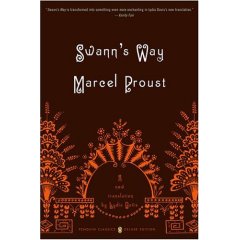
On a personal note: I like the Lydia Davis translation of Swann's Way. Granted I have read no other translations to make a comparison, but Lydia Davis's effort rendered the sinuous prose intimate and endearing.

I've just started on James Grieve's translation, In the Shadow of Young Girls in Flower.

Already, I feel the difference. Sorely.

Full article.

Tuesday, August 08, 2006

Too Many Books

From The New York Times, Joe Queenan writes on the problem we share: we are the kind of readers that start on too many books.

I'm a promiscious reader, really. A philandering reader that flirts from book to book. Now if only my love life is just as excited and varied. But then again, better not. ;p

Currently I'm reading Leo Tolstoy's War and Peace, Marcel Proust's Swann's Way, Wilkie Collins' The Moonstone and a few other books. I do feel that it reflects badly on my sense of focus.

Still, I like the cashier at the end:
A few weeks ago I visited the superb postage-stamp-size bookstore in Grand Central Station, where I bought Andrea Barrett’s Voyage of the Narwhal. Since I had only just started Tacitus’ Annals of Imperial Rome the night before, this was hardly an essential purchase. But for whatever reason, I had to take a crack at that book. Some people go into bookstores and are seduced by classics they absolutely must own; I go into bookstores and am seduced by classics I absolutely must start.

"I’m already reading 25 other books, so why am I buying this one?" I asked a friend. "Do you think this is a disease?"

"Yes," interjected the cashier. "But it’s a good disease to have."

Thursday, August 03, 2006

What Have Sonny Got to Do with Proust?


I am reading Proust in the pretty Penguin USA Deluxe edition - the one with the deckled edge and the french flap. Yes, affectations, but I like these pretty stuff on my bookshelf. But right now, only the first 4 books of the Proustian epic is available in this edition. it drives me nuts.

Did I mention my Sodom and Gomorrah is in the Penguin UK black hardcover edition? I got it for free so, no excuse.

According to this Slate.com article:
Only the first four volumes of the new translation—from Swann's Way through Sodom and Gomorrah — are available here. For this we have Sonny Bono to blame. Just before he died in 1998, the congressman sponsored a bill to extend the term of copyright by 20 years: According to the Sonny Bono Copyright Act, passed later that year, rights would expire 95, rather than 75, years after an artist's death. Since Proust died in 1922, only those four volumes first published during his lifetime had passed into the American public domain by the time the Bono Act became law. It will therefore be at least 2018 before readers in the United States can find the final three installments of the new translation (The Prisoner and The Fugitive, and Time Regained) in their local bookstores.

So American readers are screwed because late congressman Sonny Bono (the male and dead half of the duo, Sonny & Cher) decided to intervene and extend the copyright period. This stupid law benefits nobody but parasitic family members of the dead authors.

This is what happens when celebrity goes into politics.

Wednesday, August 02, 2006

PROUST | Fall In Love By Swann's Way

He told himself that, in associating the thought of Odette with his dreams of happiness, he had not been resigning himself to a second best as imperfect as he had believed until now, since she satisfied his most refined artistic tastes. He forgot that this did not make Odette any more the sort of woman he desied, since in fact his desire had always been oriented in a direction opposite to his aesthetic tastes. The words “Florentine painting” did Swann a great service. They allowed him, like a title, to bring the image of Odette into a world of dreams to which it had not had accesss until now and where it was steeped in nobility. And, while the simple view he had had of this woman in the flesh, by perpetually renewing his doubts about the quality of her face, her body, her whole beauty, had weakened his love, these doubts were vanquished, that love confirmed when he had instead, for a foundation, the principles of an unquestionable aesthetic, while the kiss and the possession that would seem natural and ordinary if they had been granted him by damaged flesh, coming as they did to crown the adoration of a museum piece appeared to him necessarily supernatural and delicious.

~ Swann’s Way, pp 232~233

Proust makes it clear that to appreciate art is an active endeavour, to work at and to cultivate. Gentlemen, like M. Swann set out to work on studying the masters, like Vemeer. Ironically, love by Swann’s way is similarly an active endeavour. One categorizes, classify and then learn to love, like M. Swann who learns to love Odette after he learns to identify and admire her beauty as a Florentine painting.

And this is the part that bites me about the world of the Proustian epic – even love itself is an artifice. One does not just fall in love, but love is itself an imagination, a performance, a study.

Why am I reading this?! The world they live it goes against everything I stand for!

Tuesday, August 01, 2006

PROUST | Swann In Love

Swann's Way
Update: 1st August 2006

I'm now into the second chapter of Swann's Way, the first book of the Proustian epic. That's only about 280 pages. Long way to go. Heh.

I had not expected to like Proust quite so much.I enjoyed how he captured the comedic side of the neurotic but snobbish middle-class. Even his narrative meandering is fun (much, much more than Umberto Eco's meandering).

In the "Combray" chapter of Swann's Way we are introduced to M. Swann as a neighbour, somewhat fallen from favour with the narrator's family due to Swann's marriage to a lady of dubious repute. "Swann In Love" elaborates on the story of his unfortunate romance with the shady but manipulative demimondain, Odette de Crecy, who will later be his wife.

CAMUS | The Plague to Despair

James Heffernan from The Huffington Post suggests Albert Camus's The Plague as antidote to the current Israel-Lebanon conflict.

It was written during the Second World War, when-not satisfied with the ten million deaths achieved by the first one-the most powerful nations of the world were doing their best to kill even more. Camus had a different agenda. Published in June, 1947, barely two years after the war ended in Europe, his novel says nothing directly about the war, but in telling the story of what a Bubonic plague does to the coastal Algerian city of Oran in the 1940s, it symbolically represents what war did to Europe in the same period. At one point, in fact, the narrator of the novel openly compares plagues to wars. Both, he writes, take us equally by surprise, and both commonly last longer than we expect them to. Also, neither one is ever wholly defeated. Like the plague, war will always come again.

But this is only a part of the final message of the book, which is narrated by a doctor who tells his own story: a doctor who sees his patients dying all around him and yet who never stops trying to save and comfort them, and never stops inspiring others to do likewise. In the end, he says, this tale records what had to be done and what must be "done again in the never ending fight against terror and its relentless onslaughts." If those words seem uncannily prophetic, consider what he says about how the fight against terror should be waged. "Despite their personal afflictions," he says, it must be waged "by all who, while unable to be saints but refusing to bow down to pestilences, strive their utmost to be healers."


Full write-up.

Thursday, July 27, 2006

Reading Break by Reading

Have interrupted my reading of Swann's Way and War and Peace with ... The Moonstone.

Wilkie Collins's The Moonstone is one of the classic detective novel of the 19th century. Dickens stole something from it for Edwin Drood. Dorothy L. Sayers admired it. It's also a sensation novel that thrives on intrigue and semi-colonial romanticism.

Good brain junk food.

Monday, July 24, 2006

PROUST & TOLSTOY


I'm still reading Swann's Way intermittently with War and Peace.

The question arises last night on how one can do such heavy reading at the same time? My explanation: short but frequent readings - kind of like watching Desperate Housewives and Lost in the same week, but somehow you can still follow the storyline.

Yoga Ache

Power Yoga 1 last Sunday with HB.

I am out of shape. Just a few rounds of Sun Salutations and my triceps and shoulders ache.

Out of shape. Which means I need to work on Power Yoga.

Yin yoga today with A.

WINTERSON | Books Are More Than Product

From Jeanette Winterson, The Times Online, 22 July 2006

Books are not beyond money, but they are not only about money either. Once the risk and the love are gone, books become product like everything else. But I won’t accept that books are just product like everything else.


Neither would I - me, the book buyer/book seller, and anyone who collects books because of a muddled kind of love.

Full article.

Tuesday, July 18, 2006

PROUST | The Person That We Know

Reading Swann's Way (very slowly). Highlighted the passage on identity:
Even the very simple act that we call "seeing a person we know" is in part an intellectual one. We fill the physical appearance of the individual we see with all the notions we have about him, and of the total picture that we form for ourselves, these notions certainly occupy the greater part.

The child narrator relates how his family seem to blinker themselves to Charles Swann, choosing what they want to see instead.

We probably have known instances when our friends see us only as their notions of us, not as ourselves truly.

Charles Swann is obviously a greater man of the world than the family wishes to allow. He is a man with the kind of prestiguous contacts and glamorous acquaintances that you only read about in Le Figaro. Yet, the narrator's grandmother only sees him as the son of their neighbour.

It says something about the inherent tunnel vision of the narrator's family - which admits only that which it is comfortable with, and blinds itself to that which is potentially new, and bigger, if not fuller. Later the narrator tells us about his aunt, who is disturbed if there should be anyone in her small village that she knows nothing about. When that happens, she sends her servant to the grocer (the fount of local gossip apparently) for intellgience.

While I am charmed by the wispy recollections filled with comforts and gentle, familiar pleasures, Combray strikes me as a hermetic society.

Saturday, July 15, 2006

Those Who Have Courage to Love

"Those who have courage to love should have courage to suffer."

~ Anthony Trollope

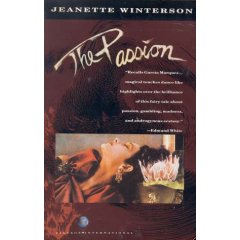
I wrote this little quote in my copy of Jeanette Winterson's The Passion.

The Passion

Back to Yoga

Just signed up with Pure Yoga. So I'm back to my practice, slowing rebuilding my stamina and strength.

From someone who previously fell to 1 practice session a week, I'm now doing it 4-5 times a week. I see it as progress, although it could be another indication of my addictive personality.

Meanwhile, I would like to introduce everyone to my new yoga practice: Yin Yoga.

In a nutshell, you hold your poses in Yin Yoga for 3-5 minutes. The emphasis is on the connective tissues, and there are a lot more hip-opening poses. I find that I enjoy it.

My Italian Reading List

The Guardian's Culture Vulture visits Italian Literature

Actually, they've been at it for a while. From all the various posts, I've gleaned a few Italian authors that I would like to sample:

Luigi Pirandello: The Late Mattia Pascal
Italo Svevo: Zeno's Conscience
Alberto Moravia: The Conformist
Giuseppe di Lampedusa: The Leopard
Cesare Pavese: Among Women Only; The Moon and the Bonfire

Also adding Umberto Eco: The Name of the Rose for next year's reading list.

Umberto Eco Unfinished

I need to finally sit down and finish Umberto Eco's The Name of the Rose. I first read (but never finished) the book in 1999. I brought it with me to the beaches of Koh Samui straight after graduation, but the leisure beach-bum life got in the way.

The only Umberto Eco I actually finished reading was Foucault's Pendulum. It helped that I was reading it when I was supposed to be working on my thesis: William Gibson and the Cybergothic.

The dilemma: work on thesis or read Eco's meandering book.

I chose the latter, but it still a long time. I would read a few pages, then set it down (bookmark in place). After some time (maybe a few months later), I would pick it up again, and continue. That took two years.

Ms F asked if I enjoyed it. I replied 'no'.

"That's so sad!" she blurted.

"No," I insisted. "In between I did other things."

Remember: reading is as healthy an interest as sports - but you're supposed to have a life.

Friday, July 14, 2006

QUIZ | What European City Do You Belong In?

I don't agree. I so prefer to be in an Italian city. Can I belong in Rome?

You Belong in Paris

You enjoy all that life has to offer, and you can appreciate the fine tastes and sites of Paris.
You're the perfect person to wander the streets of Paris aimlessly, enjoying architecture and a crepe.

Wednesday, July 12, 2006

From Neil Gaiman's Stardust

From Neil Gaiman's blog on the movie adaptation of Stardust:

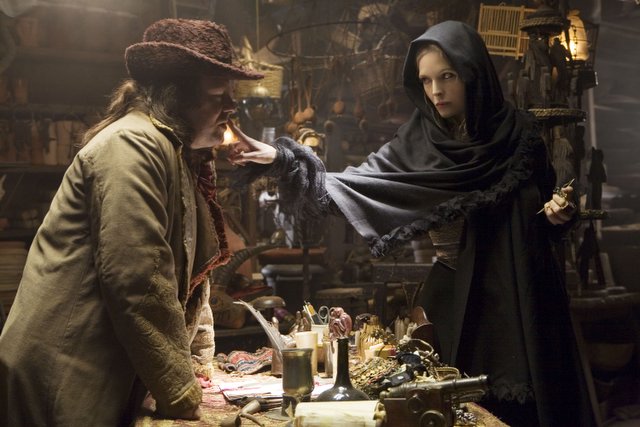
Right. Now I'm going down to the set to watch Michelle Pfeiffer cut poor Jason Flemyng's throat with a big black obsidian-glass knife.

Ha! Michelle Pfeiffer in any sort of gratuitous violence is SOOOOO something I want to see! Here's a preview screenshot from the Stardust movie:

Stardust

Michelle Pfeiffer in scary pose. I like!

Screenshot courtesty of Ain't It Cool News

Tuesday, July 11, 2006

BOOKS | The Snow Leopard by Peter Matthiessen

The Snow Leopard

The Snow Leopard
By Peter Matthiessen
London: Vintage, 1998
[01/06/2006 ~ 10/07/2006]


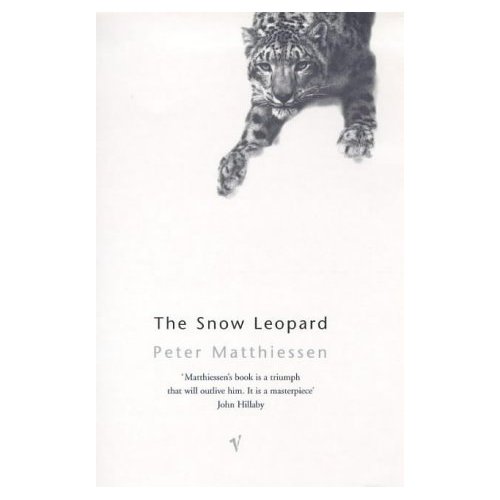
In the two hours before my yoga class last night, I finally finished re-reading The Snow Leopard. It took a while - more than a month. Perhaps I did not wish to rush it. I also know that this is a book I will re-read in the near future.

In 1973, Peter Matthiessen and George Schaller (a field biologist) travelled to the Crystal Mountain in the Himalayas. Schaller was there to study the blue bharal sheep, while Matthiessen had hoped to see the legendary snow leopard. The elusiveness of the snow leopard lent it a mystical quality. The great Tibetan yogi, Milarepa was said to have taken the form of the snow leopard.

Back then, Peter Matthiessen was also a student of Zen Buddhism. Before he left, his roshi (his Zen teacher) warned him to "Expect nothing." The roshi also issued him a koan:

All the peaks are covered with snow – why is this one bare?

Thus journey is pilgrimage, is meditation.

"I long to let go, drift free of things, to accumulate less, depend on less, to move more simply," he writes. One of the fundamentals of Buddhism – the religion of the land they tread - to simplify, to let go and thus liberate yourself from suffering.

In between the narrative of his journey and the exposition on Buddhism – Matthiessen writes about his wife, Deborah, who died a year before. He reveals his love for her, and his regrets. He also writes about the enigmatic Sherpa guide, Tukten – a dubious figure who is also a tulku – a reincarnate of a learned lama.

Matthiessen never saw the snow leopard. In the acceptance of his non-encounter is the triumph. The paradox in spiritual quest that I have only begun to sense but not yet comprehend.
If the snow leopard should manifest itself, then I am ready to see the snow leopard. If not, then somehow (and I don’t understand this instinct, even now) I am not ready to resolve my koan; and in the not-seeing, I am content. … That the snow leopard is, that it is here, that its frosty eyes watch us from the mountain – that is enough.

I am still looking. Matthiessen tells me, that is enough.

Monday, July 10, 2006

Rail Into Tibet

World Hum reports on the newly inaugurated railway into Tibet.

Not very positive.

Reading List

On the upside of reading:

As of 9th July, I've managed to complete 66 books for the Year 2006.

And I'm one-third done on my 100 Books to Read list for 2006.

Group Reading Thing

Caught DY with her husband, DT on Saturday evening - right before WW's big KTV gig (about that later)

DY and I were just chatting about how small the world is, where you keep running into people you know - and DT commented, that ironically, it's too big to meet up for a bookclub.

Oops. When we failed to read Robertson Davies, we just lost the momentum.

As for the follow-up - I guess His Dark Materials was a little too heavy for a bookclub (3 books!) DY suggested perhaps we could do Jonathan Safran Foer's Extremely Loud and Incredibly Close instead.

I winced. Not a book I want to read. Really. I rather do War and Peace - but I don't think Tolstoy's going to get a positive response from my fellow bookclub members.

Anyway, here's my plug on Involuntary Memory - it's a Reading Group for Proust. *Woooooow*

They're just warming up the gig so there should be some time to catching up on the reading. I'm interested but with my current commitment to War and Peace and other books, I wonder if I can do the 50~60 pages of Proust every week.

**I think I can. I think I can.**

Wait, this means I might not make it for my own bookclub. Heh.

BOOKS: Jane Smiley's Reading

Jane Smiley has a weekly column in The Guardian, where she comments on the 100 novels she has read. It's also the basis for her recent book, 13 Ways of Looking at the Novel.

July 8, 2006: Beloved by Toni Morrison

July 1, 2006: Annie John by Jamaica Kincaid

June 24, 2006: Main Street by Sinclair Lewis

June 17, 2006: The Man without Qualities by Robert Musil

June 10, 2006: The Man Who Loved Children by Christina Stead

June 3, 2006: The Once and Future King by TH White

May 27, 2006: The Good Soldier by Ford Madox Ford

May 20, 2006: Zeno's Conscience by Italo Svevo

May 13, 2006: House of the Seven Gables by Nathaniel Hawthorne

May 6, 2006: Cousin Bette and Cousin Pons by Honore de Balzac

April 29, 2006: The Awakening by Kate Chopin

April 22, 2006: Taras Bulba by Nikolai Gogol

April 15, 2006: Oroonoko by Aphra Behn

April 8, 2006: Saga of the People of Laxardal

April 1, 2006: Introduction and The Tale of Genji by Murasaki Shikibu

Friday, July 07, 2006

PISSED OFF | Copy Controlled F**K

I hate those Copy Controlled CDs!

Have Beth Orton's Comfort of Strangers and I can't rip it to my mpeg player!

OFF TANGENT | A Lyrical Life

I've been playing a lot of Sarah McLachlan recently. You know how sometimes, like a miracle, a song just seems to be about your life?

Actually, it's quite sad - because life is larger than a song, or a book for that matter. But I can admit sometimes - it feels like it's all about you.

A friend once pointed out hoobastank's Reason is the "Story of My Life." For the reason mentioned above, I disagree. My life is larger than that song. My friend got it wrong; my Ex is NOT The Reason I want to change my life.

Rather, I realised the choices I had made were making me unhappy. I chose to change because I believe I deserve to be happier.

But I concede there are still songs that echoed the little unhappy chapters in my life. I set these songs on "Repeat" mode on my mpeg player sometimes, when the mood hits me.

This is one of them (and it's not Sarah McLachlan):

Change
Tracy Chapman

If you knew that you would die today
If you saw the face of God and love
Would you change?
Would you change?

If you knew that love can't break your heart
When you're down so low you cannot fall
Would you change would you change?

How bad how good does it need to get?
How many losses how much regret?
What chain reaction
What cause and effect
Makes you turn around
Makes you try to explain
Makes you forgive and forget
Makes you change
Makes you change

If you knew that you couldn't be alone
Knowing right being wrong
Would you change?
Would you change?
If you knew that you would find a truth
That brings a pain that can't be soothed
Would you change would you change?

How bad how good does it need to get?
How many losses how much regret?
What chain reaction
What cause and effect
Makes you turn around
Makes you try to explain
Makes you forgive and forget
Makes you change
Makes you change

Are you so upright you can't be bent
if it comes to blows
Are you so sure you won't be crawling
If not for the good why risk falling
Why risk falling

If everything you think you know
Makes your life unbearable
Would you change?
Would you change?
If you'd broken every rule and vow
And hard times come to bring you down
Would you change?
Would you change?

If you knew that you would die today
If you saw the face of God and love
Would you change?
Would you change?

Wednesday, July 05, 2006

MUSIC | Evanescence's New Album

Evanescence, one of my favourite band, will have a new album out this year. It's currently slated for October 2006 release.

Album entitled The Open Door.

Tuesday, July 04, 2006

Fallen by Sarah McLachlan

Fallen

Heaven Bend to take my hand
And lead me through the fire
Be the long awaited answer
To a long and painful fight
Truth be told I tried my best
But somewhere long the way
I got caught up in all there was to offer
But the cost was so much more than I could bear

Though I've tried I've fallen
I have sunk so low
I messed up
Better I should know
So don't come round here and
Tell me I told you so

We all begin out with good intent
When love is raw and young
We believe that we can change ourselves
The past can be undone
But we carry on our back the burdens time always reveals
In the lonely light of morning
In the wound that would not heal
It's the bitter taste of losing everything
I've held so dear

Though I've tried I've fallen
I have sunk so low
I messed up
Better I should know
So don't come round here and
Tell me I told you so

Heaven bend to take my hand
I've nowhere left to turn
I'm lost to these I thought were friends
To everyone I know
Oh they turn their heads embarrassed
Pretend that they don't see
That it's one wrong step one slip before you know it
And there doesn't seem away to be redeemed

Though I've tried I've fallen
I have sunk so low
I messed up
Better I should know
So don't come round here and
Tell me I told you so
I messed up
Better I should know
So don't come round here and
Tell me I told you so

Monday, July 03, 2006

Smelly Cheese

A has returned. She was in Germany for the World Cup with her husband. After that, they toured Europe.

A has returned with smelly cheese for yours truly. Gourmet cheesiness that is currently stinking up the office.

Ahhh...the thought that counts.

Wednesday, June 28, 2006

World Hum's Top 30 Travel Books

"To read and to travel: that should be for anyone among the finest of vocations."
~ Gregorio Brillantes


World Hum - an excellent travel weblog - has finally put up their list of Top 30 Travel Books. Out of Which, I've only read 4, shown in Orange.

No. 1: Arabian Sands by Wilfred Thesiger
No. 2: The Road to Oxiana by Robert Byron
No. 3: The Great Railway Bazaar by Paul Theroux
No. 4: The Soccer War by Ryszard Kapuściński
No. 5: No Mercy by Redmond O’Hanlon
No. 6: North of South by Shiva Naipaul
No. 7: Golden Earth by Norman Lewis
No. 8: Video Night in Kathmandu by Pico Iyer
No. 9: The Innocents Abroad by Mark Twain
No. 10: In A Sunburned Country by Bill Bryson
No. 11: The Snow Leopard by Peter Matthiessen
No. 12: The Songlines by Bruce Chatwin
No. 13: Travels with Charley by John Steinbeck
No. 14: Riding to the Tigris by Freya Stark
No. 15: Europe, Europe by Hans Magnus Enzensberger
No. 16: City of Djinns by William Dalrymple
No. 17: A Short Walk in the Hindu Kush by Eric Newby
No. 18: All the Wrong Places by James Fenton
No. 19: Hunting Mister Heartbreak by Jonathan Raban
No. 20: River Town by Peter Hessler
No. 21: Road Fever by Tim Cahill
No. 22: When the Going was Good by Evelyn Waugh
No. 23: Behind the Wall by Colin Thubron
No. 24: Trieste and the Meaning of Nowhere by Jan Morris
No. 25: A Time of Gifts by Patrick Leigh Fermor
No. 26: Baghdad Without a Map by Tony Horwitz
No. 27: The Size of the World by Jeff Greenwald
No. 28: Facing the Congo by Jeffrey Tayler
No. 29: Venture to the Interior by Laurens van der Post
No. 30: A Turn in the South by V.S. Naipaul

Full Link

Tuesday, June 27, 2006

Observer: Jeanette Winterson

Observer interview with Jeanette Winterson for her new Children's Book, Tanglewreck.

Don't get me started. Yes, another one. ;p

'If I was a dog, I'd be a terrier. I suppose I was brought up in quite a tough culture and used to speaking out. I get angry when people behave stupidly or brutally to each other or to animals or to the planet. It seems to me a debasement of humanity when you can't be bothered to think how your actions will hurt someone else. It drives me mad. You know if there is a fight on the street, I am always in there. I have been knocked about so many times because I can't stand back.'

Thursday, June 22, 2006

Tuesday, June 13, 2006

Times Online: Malapropism

From Times Online
by Jeanette Winterson

Mrs Winterson used to talk about an interfering madam she disliked as a "proper Cleopatra". On further inquiry I discovered she had "a rod up her asp". When I asked what this meant, Mrs Winterson replied: "She won’t let sleeping snakes lie."


Full article.

Tuesday, June 06, 2006

QUOTE: Flaubert on Reading

"Do not read, as children do, to amuse yourself, or like the ambitious, for the purpose of instruction. No, read in order to live."
~ Gustave Flaubert


Now, it sounds all grand and romantic. But - keep in mind that Flaubert never married and lived with his mother his whole life.

Monday, June 05, 2006

When I have a little money, I buy books

I am currently reading The Praise of Folly (along with too many other books). This little quote seems appropriate.

"When I have a little money, I buy books. And if any is left, I buy food and clothings."

~ Desiderius Erasmus

Quotes For Your Notebook: Jeanette Winterson

Nine Wave Design is one of the moleskine-associated sites I visit regularly.

One of my favourite section of this blog is the Quotes For Your Notebook feature.

This is taken from Winterson's Weight: The Myth of Atlas and Heracles:
"I believe there is always exposure, vulnerability, in the writing process, which is not to say it is either confessional or memoir. Simply, it is real."

Yes. Anyone who quotes Jeanette Winterson is fine by my book.

Full entry.

Guardian Interview with Pink!

The Guardian's Barbara Ellen interviews Pink.

It's here because I like her kick-ass honesty. She's opinionated, she's brash and occasionally funny. But she's definitely more centered and self-aware than a lot of the people I know.
Does she ever feel pressured to sit down and shut up? 'Sometimes.' She chuckles throatily. 'And you know what? I'm a lot to take. I know that better than anyone.'


Did I mention I have ALL her CDs? Heh. ;)

Full interview

Backward Narrative

I have been thinking about narrative techniques recently. Sarah Waters' Night Watch works powerfully by telling the story backwards. This is not exactly revolutionary and Waters herself admits she was partly inspired by Harold Pinter's Betrayal.

The poignancy of the unravelled lives, and then moving back in time to where it all began. Knowing we are fated to disappointment and loss, yet yearning desperately to love.

As an explanation for this train of thought: I'm currently working on the story that I first began when I was supposed to be working on my thesis. That was more than 6 years ago. Back then I was watching too many Buffy the Vampire Slayer episodes. The tormented vampire/Slayer love story flooded my consciousness like a cheesy stew.

The story that first sprouted 6~7 years ago was supposed to be a pastiche of all the vampire stories I've imbibed my entire life. But as my computer crashed on me after graduation, and with my life consumed by an adult working life - the story went into hiatus. I stopped writing. Period.

Two years ago I picked up the thread of that lost tale. My notes and drafts were lost and I had to tell the story from scratch; I was also learning to live some aspects of my life anew.

As I begun to write, I realise another story was pushing itself into the foreground. Many of the original characters were altered, some were abandoned. My vampire pastiche became an existential meditation.

I wanted to begin the story with the broken lives of my heroes. (They are heroes because these characters bear the Promethean burden in the story.) And I wanted to trace everything back to the start of it all, 5 years ago.

Intertextuality in Fingersmith

From The Guardian

John Mullan on intertextuality in Fingersmith by Sarah Waters.

What I liked about Fingersmith was the whole Wilkie Collins feel about.

Full article.

Friday, June 02, 2006

Friday, May 26, 2006

Dogs and a Bush

Arundhati RoyAmy Goodman Interviews Arundhati Roy. On AlterNet

AR: ... Across the street from them, in a five-star hotel were Bush's 16 sniffer dogs who were staying in this five-star hotel, and we were all told that you can't call them dogs, because they are actually officers of the American Army, you know. I don't know what the names were. Sergeant Pepper and Corporal Whatever. So, it wasn't even possible to be satirical or write black comedy, because it was all real.

AG: Didn't President Bush visit Gandhi's grave?

AR: He visited Gandhi's grave, and first his dogs visited Gandhi's grave. Then, you know, Gandhians were, like, wanting to purify it. And I said, "Look, I don't mind the dogs. I mind Bush much [more] than the dogs."


Full interview here.

Thursday, May 25, 2006

Tautou and Da Vinci Code

Audrey Tautou
One the French actress of The Da Vinci Code movie, Anthony Lane wrote:
"as for Audrey Tautou, it is surely no coincidence that Howard sought out and hired almost the only young French actress who emits not a hint of sexual radiation."

I don't think Lane got it. The point of Audrey Tautou is not her sexual appeal - but the fact she looks like a potential psycho-stalker. Hence she should have been offered the Silas role instead.
Full New Yorker review of The Da Vinci Code.

Da Vinci and BAD BAD Dialogue

From Anthony Lane's New Yorker review of The Da Vinci Code:
The task of the Bishop and his hit man is to thwart the unveiling of what Teabing modestly calls “the greatest secret in modern history,” so powerful that, "if revealed, it would devastate the very foundations of Christianity." Later, realizing that this sounds a little meek and mild, he stretches it to "the greatest coverup in human history." As a rule, you should beware of any movie in which characters utter lines of dialogue whose proper place is on the advertising poster. (Just imagine Sigourney Weaver, halfway through "Alien," turning to John Hurt and explaining, "In space, no one can hear you scream.")

Sound advice really. And so, so true.

Wednesday, May 24, 2006

Which Classic Female Literary Character Are you?

Another Russian. It's my karma, I swear.


Which Classic Female Literary Character Are you?


You're Anna Karenina of Anna Karenina by Leo Tolstoy!
Take this quiz!


Quizilla |
Join


| Make A Quiz | More Quizzes | Grab Code

Monday, May 22, 2006

THE ENGLISH PATIENT: Words

"She had always wanted words, she loved them, grew up on them. Words gave her clarity, brought reason, shape. Where as I thought words bent emotions like sticks in water."

~ From The English Patient by Michael Ondaatje.

Saturday, May 20, 2006

"All atoms must jump in one direction..."

From The English Patient:
"I believe this. When we meet those we fall in love with, there is an aspect of our spirit that is historian, a bit of a pendant, who imagines or remembers a meeting when the other had passed by innocently...But all parts of the body must be ready for the other, all atoms must jump in one direction for desire to occur."

A long time ago, I was at a play by The Necessary Stage. It was an invitation from BMH, who brought her friends. I sat next to the girl who would captivate me a year later.

But at that moment, we were unknown to one another. She sat next to me, telling lame jokes throughout the play. Trying to get a laugh. Trying to break the ice. She spent the night sitting next to a sombre, silent stranger.

I did not recall much of her about that night. This anecdote was passed on to me through her narrative.

A year later, quite by accident, some antics of hers finally made me laugh. Then I fell in love.

Friday, May 19, 2006

Irene Jacob

Irene Jacob from 'Rouge'
After watching Kieslowski's Rouge, I wrote this about Irene Jacob:

"...you cannot imagine her capable of evil with that beauty"

New Yorker Story

From The New Yorker
CINDERELLA SCHOOL
by LARA VAPNYAR
Issue of 2006-05-22
Posted 2006-05-15


... He asked if I had seen "Red" and "Blue."

"Yes, I’ve seen them," I said.

"Who is more beautiful, Juliette Binoche or Irène Jacob?"

I turned my head to the right, then to the left.

"Juliette Binoche," I said.

"Why?"

"Because Irène Jacob is pure soul. Pure soul cannot be beautiful."

Read story here

Thursday, May 18, 2006

Brain on Toast

I'm just that tad bit burnt-out with the serious books I've been reading recently. So I've putting aside Maximum City, the absorbing biopic of Bombay City.

I'm now reading H. Rider Haggard's She - the same author who wrote boyish trash like King Solomon's Mine. Basically I'm regressing back to sensationalistic gothic trash. Yea.

Brain fever.

Excuse Me, I'm Looking for a Book

People have come in asking for these titles. Seriously.


  1. To Mock a Killing Bird

  2. Catcher in the Wheatfield

  3. The Little Prince by Machiavelli

  4. Who Moved My Tree


Frequently Asked Idiotic Questions:

Customer: "Hello, you work here?"
Me: "No."
I swear. This happens to me even when I'm in T-shirt and jeans in other bookstores or at the supermarket.

Idiot: "You must read lots of books."
Me: "No."

And far too many times, people coming in with, "I'm looking for a book. I don't know the title or the author or what is it about. Can you help me?"

FILM: The Da Vinci Code

Caught The Da Vinci Code movie last night. It would be an over-statement to tell it a thriller. I was not thrilled. Or excited or even intrigued by the plot.

In fact, it insults the intelligence of the audience. But if The Da Vinci Code does become the biggest box-office hit of the year, then to paraphrase JM, the people are getting what they deserve.

The movie opens on what is obviously lazy plotting and no research. A murder has occurred in the Louvre. We see the man, Jacques Sauniere, shot in the stomache by Silas (Paul Bettany playing a tortured, spaced-out albino psychopath). The police detective Bezu Fache (Jean Reno) asks for Professor Robert Langdon's (Tom Hanks in a bad haircut) assistance in the investigation. Jean Reno, who is so cool in Leon, just walks around, breathes a little and talk a bit in this movie.

When we see the naked body of Sauniere laid out in the pattern of Da Vinci's Vitruvian Man, a pentagram drawn in blood on his chest. Langdon asks, who did it to him? Fair question, I would think.

"He did it to himself," answered Fache.

Huh?

We are the generation brought up on CSI: Crime Scene Investigation. And first rule of a murder investigation: preserve the crime scene.

Query: Are we to believe that Fache can just bring in a stranger (and a murder suspect at that) into the crime scene with a dead body?

Bezu Fache supposedly cleared off some of the text Sauniere wrote in ultraviolet marker before his death.

Query: Is Fache allowed to tamper with a crime scene before the body has been removed?

Also, we are supposed to suspend our disbelief that:

1. Sauniere, after being shot in the stomache - has the time and strength to walk around the Louvre writing cryptic anagrams with a ultra-violet marker?
2. Sauniere is the kind of man who just happens to carry a ultra-violet marker with him everywhere he goes?
3. After his ultra-violet graffiti, Sauniere proceeds to strip naked, use his own blood to draw a pentagram on his chest, before lying down to die.
4. Sophie Neveu, having never met Robert Langdon or Fache, knows Fache is trying to frame Langdon for the murder of Sauniere.
5. Sophie Neveu never once suspect Langdon of the murder of her grandfather


A critic wrote that Akiva Goldman actually improved on Dan Brown's novel. This scares me and re-affirms my decision to stop reading after the first page. I gave away my copy of The Da Vinci Code and Angels and Demons to a colleague and left her these parting words, "I don't want them to come back."

25 Sexiest Novels Ever Written

Playboy compiles their list of the 25 Sexiest Novels Ever Written.

Don't judge me. ;p

BOOKS: Istanbul by Pamuk

Istanbul: Memories and the City
By Orhan Pamuk
Translated by Maureen Freely
New York: Alfred A. Knopf, 2005
[05/05/2006 ~ 09/05/2006]

Pamuk wrote Istanbul not just as a portrait of the city of his birth. It is also the portrait of Orhan Pamuk the writer - from his childhood amidst his large Turkish family, to his younger days as aspiring artist and when he finally decided to be a writer.

In his book, there is love and joy – but also a grievance against the city of his birth. He identifies a perennial sadness that possesses the entire city. Istanbul is a fallen city. The gem of the former Ottoman Empire that is no more.

Pamuk opens his book with an epigraph from Ahmet Rasim:
"The beauty of a landscape resides in its melancholy."

It encapsulates the poetry of the city.

Ahmet Rasim is a columnist of the city in the late 19th century. He is praised for his love of love, his wit and the joy in his craft. Rasim spent 50 years writing about Istanbul. Some of the best portraits of Istanbul are drawn from the ink of her journalists.

Random picks from the journalism over the years:

The celebrated French author Victor Hugo was in the habit of riding from one side of Paris to the other on top of a horse drawn omnibus, just to see what his fellow citizens were doing. Yesterday we did the same, and we were able to establish that a large number of Istanul residents take little notice of what they’re doing when they’re walking down the street and forever bumping into each other and throwing tickets, ice-cream wrappers, and corn husks on the ground; everywhere there are pedestrians walking in the roads and cars mounting the pavements, and – not from poverty but from laziness and ignorance – everyone in the city is very badly dressed. [1952]

It is only by giving up on our old way of comporting ourselves in the streets and in the city’s public places, and only by complying with traffic regulations as they do in the West, that we can hope to deliver ourselves from the traffic chaos. But if you asked how many people in this city even know what the traffic regulations are – well, that’s a different matter altogether. [1949]

Thursday, May 11, 2006

INTERVIEW: Gillian Anderson

From The Guardian, Sunday May 7, 2006
Interview with Gillian Anderson

Anderson from Bleak House
She was the intelligent, sardonic FBI agent from The X-Files. And the real star of the show, if you ask me.

The Senior Ms H once watched an interview with Gillian Anderson on David Letterman. She was indignant, and griped that Anderson "sounded like a bimbo!"

Which led to my rebuttal, a little tongue-in-cheek, but with genuine admiration, "That means Gillian Anderson is a really good actress. She actually makes you believe Scully's intelligent when she's [Anderson herself] not!"

The Guardian interview linked here is fun, with Anderson coming through as a slightly unglam actress who is actually approachable. The interviewer wrote this about her:
She's a funny creature, Gillian Anderson. I warm to her for various reasons. She's got a nice line in non sequiturs. She's un-grand. She's wearing an eccentric pair of white patent leather heels, a tatty old pair of combat trousers and a violet jersey. She swears brilliantly. She gets excited when a waiter carries a tray of puddings past, and races off to feed the parking meter so she can have the lemon tart brulee ('and please get the sticky toffee pudding'). She doesn't have a watch. She's capable, even on a day like today, of moments of almost painful candour. Last but not least, I like her because when the interview is over, she will say goodbye and attempt to leave the restaurant not through the door, but through one of the plate-glass windows. She is, I think, not altogether cool.

Remember: Anderson was the poster-girl for geeks 10 years back. (Do I still have my X-Files t-shirt? Hmm.) I believe Anderson is a geek at heart.

Other bitties from the interview. Anderson on a happiness roll:
Four years ago, she went through a really good stage, she was 'really, really happy', and there's a long, dreamy pause while she drifts off, remembering this happy time, and then she comes to and says, briskly, 'Yeah, but I was doing loads of yoga and meditation. I was going to say I was eating wholefoods a lot, but I think I was living off frozen yogurt.'

How can you not like a woman who eats? She had two desserts during the interview. (She went off to feed the parking meter - then came back for seconds.) Then she tells the interviewer:
'... Please don't write that I scoffed two desserts. You can be honest about it and say that I ate all of mine and half of yours. Well, I'm going to have one more bite before I go.'

It's the kind of remark that endears someone to you, because they come off so raw and real.

Wednesday, May 10, 2006

Barnes on Flaubert

Taken from The New York Review of Books

Julian Barnes, writing about Bouvard and Pécuchet and Flaubert: A Biography by Frederick Brown - things Flaubert.

Full article here.

Holland's shameful treatment of Ayaan Hirsi Ali.

The Caged Virgin
Holland's shameful treatment of Ayaan Hirsi Ali.
By Christopher Hitchens

Hitchens on one example of how over-apologetic attitudes of "liberal" Western countries in fact lack conviction in their policies. Ayaan Hirsi Ali was born in Somalia, and had been a refugee in several African countries. She was circumcised against her will at a young age, and then given in marriage to a distant male relative she had never met. Now a prominent activist in Holland, she has received death threats, but the Dutch government is embarrassed to have her.
Entering politics to try to alert the European left to this danger, she was first elected as a deputy for the Labor Party, but after 9/11 she changed her allegiance to the Liberals. This, she explained, was because many Labor spokesmen preferred to think of immigrants as possessing "group rights." They had become so infatuated by their own "multi-culti" style that they had ignored the rights of individuals—especially women and girls—who were imprisoned within their own ghetto.


Full article.

Also, pick up Ayaan Hirsi Ali's The Caged Virgin.

Tuesday, May 09, 2006

BOOKS: Reading "Madame Bovary"

Emma Bovary is getting on my nerves. She is the sort of protagonist that I dislike in real life - self-absorbed, deluded and vain. (But then we see too many of these women these days, so there's probably a lot of people I don't like)

The adulterous cad, Monsieur Rodolphe however, reminded me of something:
But with that critical superiority vested in the man who, in every relationship, holds back something of himself, Rodolphe sensed that in this love there lay further pleasures to be exploited. He reckoned all delicacy irksome. He used her brutishly. He made of her a creature docile and corrupt. Hers was a sort of idiot attachment, full of admiration for him, of pleasure for herself; a beatific drowsiness,; and her soul sank deep into this fuddle, drowning there, shrivelling up...

Madame Bovary's weakness was she deluded herself with literary romances. But then again, so many of us fall in love through the books we read - and suffer for it.

Perhaps Flaubert's book irritates me so much because his characters are so utterly human. It's not a romance, definitely.

Salon Archive: Madame Bovary

Taken from Salon article, by Erica Jong

"A book lives longer than a girl," Vladimir Nabokov said, lecturing to his Cornell students about Flaubert's "Madame Bovary" in the 1950s. He went on to praise the master's clinical style, the way he transformed the sordid materials of pulp fiction -- adultery, suicide -- into a poetic masterpiece by his painstaking description of bourgeois life in mid-19th century France.

"Madame Bovary" can be approached in many ways: as a notable banned book (like "Ulysses" or "Lolita"), as a book that delineates the confinement of the 19th century wife, as a book that influences subsequent development of the novel, even as a book that betrays the foot fetishism of the author. In "The Perpetual Orgy," Mario Vargas-Llosa's book about his passion for "Madame Bovary," Flaubert's erotic attachment to shoes and feet is detailed.

But what interests me most in "Madame Bovary" is the heroine's fondness for reading. She dies because she has attempted to make her life into a novel -- and it is the foolishness of that quest that Flaubert's clinical style mocks.

A novelist mocking a heroine besotted by novels? Then this must be a writer mocking himself! And indeed, Flaubert memorably said that he had drawn Madame Bovary from life -- and after himself. "I have dissected myself to the quick," he wrote.

Emma Bovary is deluded by literature. Because she is in search of ecstasy and transcendence, she falls madly in love with a cad, then with a coward, ignoring the plodding husband and child who both adore her. She is looking for a higher, more spiritual life than the one available to her as the wife of a bourgeois country doctor, and in this quest she finds only self-destruction. We identify with her because we too look to fantasy for salvation. If Emma Bovary, with all her self-delusion, still stirs our hearts, it is because she wants something authentic and important: for her life to have meaning, for her life to bring transcendence.

"In 'Madame Bovary,'" says Vargas-Llosa, "we see the first signs of alienation that a century later will take hold of men and women in industrial societies (the women above all, owing to the life they are obliged to live): consumption as an outlet for anxiety, the attempt to people with objects the emptiness that modern life has made a permanent feature of the existence of the individual. Emma's drama is the gap between illusion and reality, the distance between desire and its fulfillment. On two occasions she is persuaded that adultery can give her the splendid life that her imagination strains toward, and both times she is left feeling 'bitterly disappointed.'"

Perhaps we identify with Emma because we too feel an emptiness at the center of things -- an emptiness we try to fill with books, with fantasies, with sex, with things. Her yearning is nothing more or less than the human condition in the modern world. Her search for ecstasy is ours. "One way of tolerating existence is to lose oneself in literature as in a perpetual orgy," Flaubert wrote in 1858. If "Madame Bovary" can still move us all these years later, it is because she was both Flaubert's refuge -- and his self-portrait.

Sept. 15, 1997

Monday, May 08, 2006

READINGS: John Kenneth Galbraith

Economist John Kenneth Galbraith died recently. The Globe and Mail ran a story on what the man read.
Rather late in life, he was introduced to the work of Robertson Davies, which he thereafter avidly consumed. No doubt one reason was that Davies set his Deptford Trilogy -- Fifth Business (1970), The Manticore (1972) and World of Wonders (1975; all three published by Macmillan Canada) -- in rural and small-town southwestern Ontario, not far from where Galbraith had grown up; this, however, was more likely a co-ordinate attraction. Far more powerful, Galbraith insisted, was "the ring of truth" in Davies, embedded in his richly imagined physical, social and moral landscape, and ornamented with what Galbraith found to be "an extraordinary range of wholly unpredictable information."

In case you're tempted, The Deptford Trilogy is truly worth the effort.

Among Galbraith's works are The Affluent Society and The Good Society.

BOOKS: Lost Guide

The Guardian reviews Rebecca Solnit's A Field Guide to Getting Lost.

I brought the book to a Phuket trip last year, and I enjoyed it. It was a stronger collection than her previous book, Wanderlust. The Guardian reviewer puts it in a nutshell:
De Vaca stands at the heart of this book, not just as a symbol of the plucky adventurers and mingling nationalities that created modern America, but as an exemplar of Solnit's strongest theme: getting lost means accepting change. "The things we want are transformative, and we don't know or only think we know what is on the other side of that transformation.

Reading Baby

A 28 month old Vietnamese baby can read
The child could correctly and fluently read a Vietnamese-language newspaper though his pronunciation sounded like a foreigner’s.

Shame on us then.

Link via Bookninja

Friday, May 05, 2006

Get a Life

I'm catching up with Season 5 of CSI: Crime Scene Investigation. I'm also barely 1/4 into Natasha's Dance - an interesting book (to me at least) on the cultural history of Russia.

Now, I should be reading more, but really, I prefer to spend my time watching Grissom and his team solving crimes.

But what I really like to do is to have a life.

Excuse me, what to do huh?

NOT A POLITICAL POST

Overheard at the office:
"I hate reading the newspapers these days. The whole thing is just about the PAP."

BOOKS: Winterson in The Times

From The Times
29 April 2006

Winterson's Her Word. She's writing on the PEN World Voices Festival of International Literature. On why literature is important.
Books must now compete against films, against television, against the internet — the noisy new media. Books are quieter, but we must still listen.

Literature is a place where you can always go and always be welcome. No one is shut out. It is truly global, in that it crosses all boundaries but does not seek to make everything and everyone the same.

Literature is about discovering difference. That is why it is so important, in our world now, that it be available. The internet is no substitute for a good bookshop where a real-life browser will always find something unexpected, and come away the better for it.

The story goes, there were only 6 books in the house Winterson grew up in. One was the Bible - and 5 other books on the Bible. So she bought books and hid them under her mattress. Her mother peered in one day and found a DH Lawrence. Mrs Winterson proceeded to set the books on fire.

What she learnt that day from her mother was how some people burnt books - because you never know what you will find in books until it was too late. She also started to memorize passages from books - because they can't take away what you take from the books.

WINTERSON: Column May 2006

From Jeanette Winterson's website. The Column for May 2006

I like this bit:
As I get older I get more concerned about excess - which is not the same as indulgence or luxury, I can do both of those. But excess? Why? I don't want to carry too many pounds, too much luggage, have too much stuff, or even, know too many people.

Ever felt this way?

ESSAY: Iranian Lost Epic

From The New York Times

An essay by Reza Aslan: The Epic of Iran. He writes about Iran's national epic, the "Shahnameh."
Written more than a thousand years ago by Abolqasem Ferdowsi, the "Shahnameh," or "Book of Kings," recounts the mythological history of Iran from the first fitful moments of creation to the Arab conquest of the Persian Empire in the seventh century A.D. Ferdowsi was a member of Iran's aristocratic class, which maintained a strong attachment to the heritage of pre-Islamic Iran. According to legend, he composed the "Shahnameh" under the patronage of Sultan Mahmud of Ghazna, who promised him one dinar for every couplet. But when Ferdowsi presented the sultan with nearly 60,000 couplets, a flustered Mahmud offered him a fraction of his promised reward. Insulted, Ferdowsi rejected the money and returned home to the city of Tus, where he died impoverished and embittered. But his poem endured.

A verse from the Shahnameh:
Where are your valiant warriors and your priests,
Where are your hunting parties and your feasts?
Where is that warlike mien, and where are those
Great armies that destroyed our country's foes? . . .
Count Persia as a ruin, as the lair
Of lions and leopards. Look now and despair.


Reza Aslan is the author of No God But God.

Thursday, May 04, 2006

CULTURE VULTURE: World Literature Tour May 2006

Culture Vulture World Literature Tour goes to Japan.

Something wanky happened with the Culture Vulture page. It does not allow me to sign-in.

So I will not be adding my 25 cents worth on Japanese Literature people should read.

No, not Haruki Murakami. I think we over-dosed on him already.

Jose Saramago and Democracy

From The Observer
Interview with Jose Saramago

Jose Saramago is probably the most famous (if not the only) Nobel Prize winner Portugal can lay claim to. Ironically, Saramago left his homeland of Portugal 14 years ago in protest of the government censorship of his novel, The Gospel According to Jesus Christ. It was the sentiment of the authorities that his book offended religious sensiblities.

At 84, Saramago is still actively serving the political role of the author. He is a writer of conviction - one of the dying breed. He is also the kind of writer who ends up talking about the problem of democracy during book discussions. In light of our forthcoming election, I'm inclined to highlight something he mentioned in the interview:
'I answered that I didn't have a solution, except that we, as citizens, do have the power of the vote, but we always use it to vote for one or other of the parties on off er. But there is another possibility, which is to cast a blank vote.' He leans forward and points a stern finger. 'And this is not at all the same as abstention. Abstention means you stayed at home or went to the beach. By casting a blank vote, you're saying that you understand your responsibility, you have a political conscience and you came to vote, but you don't agree with any of the existing parties and this is the only way you have of saying so.

'Then I thought about what would happen if the blank votes went up to 50 or more per cent. It would be a way of saying society has to change but the political powers we have at the moment are not enough to effect this change. The whole democratic system would have to be rethought.'

Not that I'm advocating anything political, of course. I'm hardly political. I don't even have to vote. I live with a country where I am 30 and have never casted a single vote for my democratically elected government.

Is voting really compulsory by the way?


Read the latest title by Jose Saramago, Seeing, translation by Margaret Jull Costa. Saramago is published by Harvill Press in the UK, the original English publisher for Haruki Murakami.

Wednesday, May 03, 2006

Bayley and Iris Murdoch

John Bayley wrote his 3 part memoir on his wife Muriel Spark?

So says my jack-ass boss - Store Director of one of the biggest bookstore in the country.

I work for ignorant people.