Wednesday, November 30, 2005

Sterling Truffle Bar

"Sterling Truffle Bars blend the best of white, milk and dark chocolate, fruit, nuts and liqueurs with culinary artistry. Each decadent truffle bar flavor has an extraordinary and colorful hand-painted chocolate design. Available in 12- and 6-ounce sizes, the triangular bars are to be served sliced, exposing beautiful layers of ganache. Perfect as unique and elegant gifts, dessert garnishes or accents to a wine, champagne or cheese tasting, Sterling Truffle Bars are as versatile as they are beautiful and delicious"

Okay, so how did this blog become an advertisement for confectionary? Saw these colourful bars of delight and was so captivated by the swirling colours ("bright colour! pretty!") - had to put it up. Have added the pix of a few of my favourite flavours.


Double Hazelnut Caramel
A striking, hand-painted truffle with contrasting tiers of milk chocolate flavored with rich hazelnut puree, white chocolate infused with caramel, dark chocolate and a hint of ground hazelnut


Cappuccino Liqueur with a Twist
An artfully hand-painted truffle filled with the mingling flavors of milk chocolate, coffee-infused white chocolate, dark chocolate, coffee liqueur and a subtle finish of lemon.


Banana Honey Caramel
A hand-painted truffle with contrasting tiers of milk chocolate flavored with banana liqueurs, white chocolate infused with caramel, dark chocolate and a hint of honey.

More Books Than I Can Read

"The buying of more books than one can read is nothing less than the soul reaching towards infinity, and this passion is the only thing that raises us
above the beast that perish."


~ Alfred Edward Newton


It's a nice way of justifying it. So let's pretend it's true. This entry is dedicated to all my friends with too many books in their houses unread.

Ian McKellen

Added this picture of SIR Ian McKellen as Gandalf the White. Just in the mood for the Sexiest Man Past the Age of Sixty And Still Alive And Kicking. (He was born in 1939, so go count)

Ian McKellen still has It. Sean Connery also has It. Harrison Ford lost it waaaaay before Calista Flockhart the Stick Insect.

Once saw an episode of Saturday Night Live; McKellen was a guest star and I watched him play it up as Yves Saint-Laurent in all his queenly glory. And later he did a hilarious parody of Dame Maggie Smith - in red dress and pearls to match. He made me laugh so hard. Love a Shakespeare actor that's willing to camp it up.

Can't wait for X-Men 3. Yes, I love this man as Magneto. Patrick Stewart has nothing on McKellen.

HP & the Globet of Fire

Caught Harry Potter and the Globet of Fire last night. It was unsatisfying to put it mildly. In attempting to condense the thick (thick, thick) book into a reasonable length, it was choppy with little engagement. It's like they are so busy trying to tell you the story they don't have time to do the details that charmed audience in the earlier Harry Potter films.

I was looking forward to the entrance of the foreign students. I was expecting something more...spectacular? The book conveyed a sense of - what's the word? - magic to their grand entrance. Alas, not enough show and glam. The visual of the movie for the most part feels heavy and wet.

But liked the dragon though. Especially the bit with the drawing of lots, and they all pick out those tiny little dragons that bites. So cute! ;)

I like the actors casted for the earlier HP films. I know some friends don't, but I do. I like the fact that Emma Watson is button-cute, and I adore Alan Rickman and (Dame!) Maggie Smith. It's so frustrating that the actors have so little to do in this one. I mean, why so little of Alan Rickman? Okay, he was funny when he was thwacking Harry and Ron for talking in the study room. But that's it?!

But the bummer of the movie was Albus Dumbledore. Michael Gambon just falls short of my expectation of Dumbledore. Richard Harris played the first Dumbledore with a whimsical grace. There was good-humour and compassion in the first Dumbledore. You can see why Harry Potter would love him. Michael Gambon's Dumbledore is flaccid. A little lost, in fact, which isn't reassuring because Dumbledore will have a bigger role to play later.

Then my friend asked me last night: "I wonder how Ian McKellan would have played it."

And that's when I knew it: I had wanted Dumbledore to be Gandalf in disguise.

From Harry Potter and the Sorcerer's Stone:
[Talking about Every Flavor Beans]
Dumbledore: I was unfortunate enough in my youth to come across a vomit-flavored one, and since then I'm afraid I've rather lost my liking for them. But, I think I could be safe with a nice toffee. [eats it] ...Ah, alas, earwax.
Ralph Fiennes as Voldemort. Ahh...

A quick reminder ... A Room of One's Own

Emily Wilson
Tuesday November 22, 2005
This article is taken from The Guardian

Author: Virginia Woolf
Publisher: Penguin
Date published: 1928

Next time you hear someone explaining that women are incapable of truly great art (be it poetry, literature, painting or music), this is the book to prescribe for them. "Intellectual freedom depends on material things," writes Woolf. "Poetry depends upon intellectual freedom. And women have always been poor, not for 200 years merely, but from the beginning of time. Women have had less intellectual freedom than the sons of Athenian slaves. Women, then, have not had a dog's chance of writing poetry."

To write fiction, Woolf says, a woman "must have money and a room of her own". Woolf tells us that she herself was given the right to vote and £500 a year (from a dead aunt) at about the same time, and that the money felt "infinitely" more important. "No force in the world can take from me my five hundred pounds," she writes. "Food, house, and clothing are mine for ever. Therefore not merely do effort and labour cease, but also hatred and bitterness. I need not hate any man; he cannot hurt me. I need not flatter any man; he has nothing to give me."

A Room of One's Own is an extraordinary, beautifully written, poetic little book. It's based on two lectures on women and fiction that Woolf gave in Cambridge in 1928, and it's quite unlike the other great feminist polemics - or in fact anything else at all.

Woolf imagines for us, in a novelistic stream of consciousness, two days in which she wanders around "Oxbridge" and the British Museum, and browses through everything ever written about or by women. Why was there no female Shakespeare, she ponders? She imagines what life would have been like for a brilliant sister of Shakespeare - and finds the woman killing herself in her prime. Layer by layer, Woolf constructs her case. "[Woman] pervades poetry from cover to cover; she is all but absent from history," she writes. "She dominates the lives of kings and conquerors in fiction; in fact she was the slave of any boy whose parents forced a ring upon her finger. Some of the most inspired words, some of the most profound thoughts in literature fall from her lips; in real life she could hardly read, could scarcely spell, and was the property of her husband."

Tuesday, November 29, 2005

Woolf: A Room of One's Own


  1. A Room of One's Own by Virginia Woolf
    [25/11/2005~]


Currently on my third book for the 100 Books To Read List. I was supposed to have finished this little book over the weekend. Alas, I was caught up with the drama of Veronica Mars on DVD.

The link between Jeanette Winterson and Virginia Woolf? I went back to Winterson's collection of essays in Art Objects. There are two rapturous essays on Woolf as poet.

Confession: I have never read a Virginia Woolf. This is somewhat shameful, considering I am an English Literature major. But the truth? Her prose is heavy and overwhelms me. It makes me reach out for something lighter.

My copy of Orlando has Tilda Swinton (looking rather dashing) on the cover. It sits on the top shelf, unread for years. I shall attempt to ratify this little oversight.

Titles completed on my reading:

  1. Oranges Are Not the Only Fruit by Jeanette Winterson

    [23/11/2005-25/11/2005]
  2. The Claudine Novels by Colette

    [22/07/2005-30/08/2005]


Yes, I cheated. But I figured since The Claudine Novels was technically read and finished middle of 2005, it counts. Anyway, I have Proust's In Search of Lost Time - that counts as six novels by itself.

    Monday, November 28, 2005

    Book Club: Howl's Moving Castle

    25th November 2005, Friday - we have our first bookclub meeting. That was last Friday.

    The book to kick off the Book Club was Howl's Moving Castle, by Diana Wynne Jones.

    In the earlier stages of the email discussions, I recall throwing the title in as a possibility. It was brought up verbally as a potential book to read, but not my choice. I simply put it in writing. Yet somehow in the haze of it all, people have come to assume it was my pick. D'uh.

    Did I mention I failed to read the book? It was sold out when I went looking for it. And I just never made the effort to check if it came back in stock.

    So the day came, and I thought I'd just skip the book club. Then I recalled sending out the invitation earlier to some friends who expressed interest. It occurred to me that my friends might not know the other Book Club members. Since Ms F is going to be late, I thought I ought to be there. As a familiar face at least.

    Well, I did show up eventually, albeit sorely sleep-deprived. Decided to swing it without having read the book, relying on having watched the Miyazaki anime as a guide. I listened and it was fun. WW and JN are fun readers. Good people to have in Book Clubs.

    It was an evening of light discussion, with occasion laughs. And dubious revelation of one of my ex-classmate having had a crush on Noddy in her primary school days.

    Group dynamics is always important in social gatherings. I think the bomb arrived in the evening when YSY came in late.

    Turns out JN knows YSY.

    I recall "Saving Face," with that quote: "One billion Chinese people, two degrees of separation."

    I don't hate YSY. I reserve my hatred for people who have actually acted maliciously towards me - with intent. Like Purple Cow. But YSY unnerves me with the vibes she gives out. It's not just the bitterness in her comments from time to time. There is a rancour within her. It's like some deep-seated resentment that festered into something scary.

    It isn't about like or dislike with YSY. It's about being unsettled. YSY's vibes makes me want to avoid her. And I usually do.

    Anyway, the next Book Club meeting may be better. Or worse. But Note To Self: Pump up on Caffeine before attendance.

    And maybe read the book. ;p

    Poetry is a cure, not a painkiller. It should be subsidised by the NHS

    By Jeanette Winterson
    November 19, 2005

    Taken From Times Online

    I GO TO POETRY THE WAY THAT SOME people grab an espresso; for an energy shot, a hit of warmth, and to clear my head.

    I never go out without a poem — usually in my pocket, always in my head — and I try to learn some poetry every week. This is as good as a crossword puzzle for mental agility and, in times of stress, it is better to be thinking “Though much is taken, much abides”, than “Sneeze catcher (12 letters)”, although I think that the Sneeze Catcher might figure in my next book for kids.

    We are in a good time for poetry. Strangely, the soundbite and snapshot culture has worked in poetry’s favour. People like something short and vivid. Poetry readings are a big success, partly because poets tend to be better performers than novelists, but also because listening to a series of shorter poems read a loud allows the mind to concentrate, while refreshing it through the change of theme, tone and rhythm. Above all, the mind is not fixed on following the plot, which is a left-brain activity. A poem activates the right-brain, and just allowing the brain to change hands as it were provides relief for a time.

    Almost everything we do is left-brain work. Poetry should be subsidised by the National Health Service on the grounds that it is one of the few things in our mad world that offers a counterbalance. One-sided people need help — poetry, like music, is the help that we need.

    On my website I feature a Poem of the Month — whatever it is that I fancy — and this is the most visited and revisited spot. I had an e-mail from an oncologist last week. He tells me that while he is sitting late at night in the hospital waiting for test results he often looks at the poems on my site and that they seem like friends to him in the long low hours.

    The comfort of poetry is real, but poetry is not a painkiller; it is a cure. Where there is no cure, poetry helps us to live with the problem. Poems don’t hide things, they reveal things about ourselves, they “put into words things difficult to think” (Dante), and this difficult thinking won’t mask the trouble for a while, like an aspirin for a headache, but it will work to bring out the grief, the pain, the confusion, the mixed feelings, the anger, the impotence.

    We talk about being “lost for words”, about “having nothing to say”, but the poem finds the words, and has something to say, which is why poetry is worth our time.

    Making time for poetry is making time for a different rhythm and a different understanding. Now that we are obsessed with factoids, docudrama, reality TV, confessionals, live footage, 24-hour rolling news, we are forgetting that truth often lies elsewhere too — in what we can imagine, in what we can invent.

    The wonderful Irish poet Eavan Boland has just issued her New Collected Poems (Carcanet). There is a striking reminder of what poetry is and does in First Year (2001) “. . . I am writing this/ not to recall our lives/ but to imagine them”.

    Poetry always bears witness, but it is witness of a different kind to the front page of The Times. Only by imagining our lives can we fully understand them or remake them. Recording them is not enough. This is not to say that we have no need of history or politics or daily news — of course we do, and poetry that is made separate from life is not poetry at all. But the poet speaks differently to the historian or the politician or the journalist. The poem itself has other work to do. In a world drowning in useless information, poetry returns us to what is meaningful. The poem acts as a pocket of air in an upturned boat.

    To the bean counters and economic gurus, a poem looks like the most useless thing on earth. It is not a money machine; you can’t sell it to Hollywood or use it for product placement. You can’t say long it will take to make or how long it will last (how maddening in an economy that depends on throwaways, that a poem can last for ever).

    The poem, by its very nature, questions the dominant values of our world. As William Carlos Williams put it, “it is hard to get the news from poems/ but men die miserably every day/ for lack of what is found there”.

    Saturday, November 26, 2005

    Oranges

    As mentioned earlier, I'm in the middle of Jeanette Winterson's Oranges Are Not the Only Fruit. I've decided to re-read the book because I've recently purchased an Out of Print Bloomsbury Classics edition of the title. (Cover by the side) This means I now possess three different editions of the title.

    It's a nice pocket-sized hardcover with good paper. It feels like a pocket-sized bible in my hands, which amuses me. And yes, it'll look good on my shelf; if there's any space for it; which there isn't.

    (If you noticed, there were two semicolons in the previous sentence. I'm rediscovering the semicolon, so they might pop-up more frequently.)

    My favourite part in the book is still the bit about the mother's liberal re-telling of Jane Eyre. In Mother's version, Jane Eyre goes away with the pious St John Rivers. That has always been taken as the gospel truth, until one day the young protagonist, being old enough to read, decided to pick up Jane Eyre for herself. She felt similar emotions the day she found her adoption papers by accident.

    The revelations of childhood.

    As children we take many things for granted. And these constants we take into our adulthood and they shape our identity, our character. Then one day the scales fall from our eyes and the world shifts just that little bit. Nothing really changed. The only real difference is: Now you know.

    What you do with the truth is your choice. How you choose is that which truly defines you.

    It is the nature of stone to covert bone.
    At one time or another there will be a choice: you or the wall.
    Humpty Dumpty sat on the wall.
    Humpty Dumpty had a great fall.
    The City of Lost Chances is full of those who chose the wall.
    All the king's horses and all the king's men.
    Couldn't put Humpty together again.
    Then is it necessary to wander unprotected through the land?
    It is necessary to distinguish the chalk circle from the stone wall.
    Is it necessary to live without a home?
    It is necessary to distinguish physics from metaphysics.
    Yet many of the principles are the same.
    They are, but in the cities of the interior all things are changed.
    A wall for the body, a circle for the soul.

    ~ from Oranges Are Not the Only Fruit


    Wednesday, November 23, 2005

    100 Books To Read

    Have picked out the 100 books I'm going to read before the end of 2006. Some are books I've always been meaning to read, but never found the time. Others, an excuse for me to re-read them. Then, there are the classics that I should read, but alas...

    All here, the 100 shortlist, and I've revised it too many times over. The many omission is of course due to space constraints. And I will cheat somewhere down the road by altering the list a little.

    But meanwhile, I've started on Jeanette Winterson's Oranges Are Not The Only Fruit last night (it's down there at #54). Decided to give it a good headstart. And no, it's not my favourite Winterson title. It's also not the Winterson title that I re-read most frequently. My personal favourite Winterson title is The Passion.


    1. In Search of Lost Time Marcel Proust
    2. War and Peace Leo Tolstoy
    3. Anna Karenina Leo Tolstoy
    4. The Idiot Fyodor Dostoevsky
    5. The Gambler Fyodor Dostoevsky
    6. Don Quixote Miguel De Cervantes
    7. Love in the Time of Cholera Gabriel Garcia Marquez
    8. One Hundred Years of Solitude Gabriel Garcia Marquez
    9. Flaubert's Parrot Julian Barnes
    10. Steppenwolf Herman Hesse
    11. Moby Dick Herman Melville
    12. The Pure and the Impure Colette
    13. The Claudine Novels Colette
    14. Norweigian Woods Haruki Murakami
    15. Marioka Sisters Junichiro Tanizaki
    16. Tale of Genji
    17. To Kill A Mockingbird Harper Lee
    18. Death In Venice Thomas Mann
    19. Nightwood Djuna Barnes
    20. Perfume Patrick Suskind
    21. The Bluest Eye Toni Morrison
    22. The Confederacy of Dunces John Kennedy Toole
    23. The House of Mirth Edith Wharton
    24. The Iliad Homer
    25. The Heart Is a Lonely Hunter Carson McCullers
    26. Gilgamesh trans. Stephen Mitchell
    27. The Immoralist Andre Gide
    28. Fruits of the Earth Andre Gide
    29. The Wings of the Dove Henry James
    30. The Moonstone Wilkie Collins
    31. Great Expectations Charles Dickens
    32. Dracula Bram Stoker
    33. The Deptford Trilogy Robertson Davis
    34. The Quiet American Graham Greene
    35. Master and Margarita Mikhail Bulgakov
    36. Of Human Bondage W. Somerset Maugham
    37. Jane Eyre Charlotte Bronte
    38. Middlemarch George Eliot
    39. A Fine Balance Rohinton Mistry
    40. Villette Charlotte Bronte
    41. Midnight's Children Salman Rushdie
    42. Farewell to Arms Ernest Hemingway
    43. The New York Trilogy Paul Auster
    44. Memoirs of Hadrian Marguerite Yourcenar
    45. The Three Musketeers Alexandre Dumas
    46. Complete Father Brown G. K. Chesterton
    47. The Handmaid's Tale Margaret Atwood
    48. Lolita Vladimir Nabokov
    49. Giovanni's Room James Baldwin
    50. The Great Gatsby F. Scott Fitzgerald
    51. The House of the Seven Gables Nathaniel Hawthorne
    52. Blindness Jose Saramago
    53. Hunger Knut Hamsun
    54. Oranges Are Not the Only Fruit Jeanette Winterson
    55. Sexing the Cherry Jeanette Winterson
    56. Orlando Virginia Woolf
    57. One Flew Over the Cuckoo's Nest Ken Kesey
    58. Madame Bovary Gustave Flaubert
    59. Les Liaisons Dangereuses Pierre Choderlos de Laclos
    60. The Colour Purple Alice Walker
    61. The Secret Agent Joseph Conrad
    62. Magus John Fowles
    63. Unbearable Lightness of Being Milan Kundera
    64. The Four Quartets T. S. Eliot
    65. Fall on Your Knees Ann-Marie MacDonald
    66. Gitanjali Rabindranath Tagore
    67. The Conference of the Birds Farid Ud-Din Attar
    68. The Prophet Khalil Ghibran
    69. Maximum City Suketu Mehta
    70. The Snow Leopard Peter Matthiessen
    71. Guns, Germs and Steel Jared Diamond
    72. The Crusades Through Arab Eyes Amin Maalouf
    73. Yogasutra of Patanjali
    74. Ways of Seeing John Berger
    75. Pilgrim at Tinker Creek Annie Dillard
    76. The Qu'ran
    77. Art of War Sun Tzu
    78. Book of Five Rings Miyamoto Musashi
    79. Twenty Love Poems and A Song of Despair Pablo Neruda
    80. Hagakure
    81. Seven Storey Mountain Thomas Merton
    82. Stiff Mary Roach
    83. Bury My Heart At Wounded Knee Dee Brown
    84. Meditations Marcus Aurelius
    85. A History of God Karen Armstrong
    86. A Moveable Feast Ernest Hemingway
    87. Diet For A Small Planet Frances Moore Lappe
    88. Dark Night of the Soul John of the Cross
    89. Myth of Sisyphus Albert Camus
    90. The Places that Scares You Pema Chodron
    91. In Praise of Folly Erasmus
    92. Beyond Belief Elaine Pagels
    93. The Histories Herodotus
    94. Bhagavad Gita
    95. An Autobiography: The Story of My Experiments with Truth Mohandas Gandhi
    96. Confessions Saint Augustine
    97. Saint Francis of Assisi G. K. Chesterton
    98. The Varieties of Religious Experience William James
    99. A Room of One's Own Virginia Woolf
    100. Dhammapada

    Monday, November 14, 2005

    To Know

    Guess this blog is really just an excuse for an online journal. So many things will be out of context. Should I bother explaining the circumstances behind each blog? Maybe not. Not everything is meant to be understood, especially since we never truly have all the facts. The human insistence on understanding sometimes lead us to impose meanings where there is none.

    Or maybe this is just an excuse for me to remain non-engaged with the world.

    DVD and the Drama of My Former Life

    I spent my weekends watching DVDs. Managed to finish all 13 episodes of "Wonderfalls" and went on to the second season of "The L-Word." For the record, I think "The L-Word" is losing direction. They are adding new characters that I don't care about and doing things to well-loved characters that I don't want to watch.

    I made it past 3 episodes of "The L-Word" before I called it a night. For the uninformed, last season, Bette (played by the divine Jennifer Beals) was caught cheating on Tina, her partner of 7 years. So Season 2 opens with Bette, formerly the golden girl of the pack, suddenly relegated to social pariah.

    Bette was the alpha of the "L-Word" pack: ravishingly, well-groomed, charming, confident with a core of genuine warmth to her. It was hard to watch a character so well put together disintegrate on-screen. I watched Bette trying to apologize for her mistake, but somehow it just wasn't enough. Other aspects of her life, work and personal also edge towards collapse. It's as if anything Bette touches is tainted.

    The true charm of "The L-Word" was its focus on the close-knitted friendship between the characters. It is therefore almost cruel when the friends begin to quietly side with Tina, the wronged party - isolating Bette by default. As Bette later declares in a drunken stupor, "If I met myself, I'll run the other way."Bette's loneliness and self-loathing cuts through. This is a woman awashed with remorse, desperate for forgiveness.

    The producers are evidently going to milk the melodrama for all it's worth. So it's going to be a fair bit of painful viewing until we get to the reconciliation. *Argh*

    I find it ironic that my appetite for TV drama is inversely related to the trauma of my own personal life. Perhaps I often sublimate my own emotional drama into these TV soap-series that I watch. Maybe without the prozac-effect of these TV dramas, I may actually be at risk of acting out real-life passion plays - with their real-life consequences. However, last night's 3 episodes of melodramatic overdose came too close to home. It reminded me too vividly of a more dramatic time and place a few years back. I thought I was over it. Apparently not.

    Monday, November 07, 2005

    If We Want To Stop People Being Rude We Could Use a Bit of Horse Sense

    Taken from The Times

    By Jeanette Winterson

    AS A TRAVELLING WRITER — WHICH is a cross between a fortune teller and a brush salesman — I meet more people than most. They ask me about their marriages, confide in me their fears, invite me back for coffee, show me their manuscripts, speculate about the state of the world and sometimes, when I am not adequately fulfilling either my exotic or my practical purpose, they are rude to me.

    Writers are used to a certain class of people being rude about them; those people are called critics, and in the name of free speech you can say what you like, as long as the writer is not in the room. If the writer suddenly appears in the room — especially if they have done so by first banging on the front door, as I once did to poor old Nicci Gerrard, then you can expect a Vesuvius of a press row about what is and isn’t acceptable behaviour.

    Being rude about someone, in whatever context, is quite different from being rude to someone. As a northerner, my refugee status in the South is never more apparent than in my plain speaking, which has got me into trouble plenty of times.

    Nevertheless, I believe in good manners, and practise them up to the point where they become downright lies. “How lovely to see you,” should never conceal: “God, I detest that woman.” “I’m a big fan of your writing,” should never be a self-preservation attempt when the person whose work you have slagged off for 20 years is suddenly standing in front of you with a meat axe.

    I daresay that both A. A. Gill and Lynne Truss have had a few meat axes waved at them in their time, and A. A. Gill has never seemed over-particular to me about his use of any offensive weapon, so long as it is deployed from the safe distance of a newspaper column. Both have now published books about rudeness and rage. In Britain, we got no manners, see? And we hate each other, not just in the post office queue, but everywhere and all the time.

    Truss’s Talk to the Hand and Gill’s The Angry Island are both entertaining, as you would expect, but bafflingly naive. The glaring gap is, of course, the media itself, and journalists themselves. Truss will take on advertising but not her own kind, and Gill just doesn’t understand why being A. A. Gill means that you can’t moan about people being rude to you.

    Journalists have bred a culture of saying anything about anybody and getting away with it. This translates to readers as saying anything to anybody and getting away with it.

    Rudeness is a million different ways of saying the same thing: “I don’t respect you.” In the name of truth, the media is no respecter of persons and quite right too, but what about in the name of sex, money, sales, scandal and all the grubby excuses that the media makes to probe and expose and ridicule? I have just been reading Monty (“The Man Who Listens To Horses”) Roberts, on Horse Sense for People. It is obvious stuff — you get what you give. If a horse doesn’t respect you, you can force it to behave by beating it or you yourself can behave differently so that the horse responds differently.

    When Roberts is asked to come in and talk to big companies, he emphasises that their whole corporate culture has to change if they want to root out their problems of skiving, slacking and stealing.

    He believes that most people are externally, not internally, motivated, and that most people will follow what’s happening around them. Humans, like horses, are herd animals, highly susceptible and used to acting in groups.

    I love art and books precisely because they work on the individual and not the group, but I know that the group or the mass is hugely influenced by print and visual media — both what is said, and just as importantly, how it is said. The media has decided that everything is fair game, nothing is sacred, no-one is to be trusted, gossip is good, celebrity sucks (but it sells), politics is corrupt, art is a luxury item, (unlike the must-have Vuitton handbag), everyone, everywhere, is in it only for themselves.

    And then we get the “Why, oh why” hand-wringing columns about the state of Britain. Excuse me? As Monty would say, “there can be no positive consequences for negative actions”.

    Obvious stuff, but Horse Sense might be good on the bedside tables of a few media types who wonder why nobody is smiling at them on the Tube.

    Friday, November 04, 2005

    Back After a Break

    Back at work after a one week break, out of which three days were spent at Phuket with ladies with aspirations to tai-tai-hood. At least, they are more tai-tais than I'll ever be.

    I usually lull myself into a state of mental withdrawal on my holidays. I like my holidays to be low activity affairs, some kind of mental/spiritual escape. Ms F remarked on the absurdity of spending money on airfare to "do nothing" - her assertion being you can "do nothing" for free right at home.

    Right, but that's the point - I don't get to "do nothing" at home. Everyday work-life wears me down with the petty politics. Family life drains me with the usual emotional blackmail and other melodrama. So, on trips overseas, I want to just do nothing. Leave me alone, give me the psychic space tantamount to breathing space that I desperately need. I don't want to think. At. All. No shopping, no TV. Preferably surrounded by nature, beach or greenery.

    *sigh*

    Now back at work after the one week break, all I want is to take another break. Something very attractive right now about just quitting my job and taking a very long break. But alas, the girl has to eat.

    Wednesday, October 26, 2005

    Quote

    "I respect tradition, though I'm quite prepared to vandalise it."

    ~ Jeanette Winterson

    But of course ;p

    Tuesday, October 25, 2005

    Saving Face

    Saw "Flightplan" and "Saving Face" last Sunday. In spite of the iconic status Jodie Foster represents for me, I have to admit I was more charmed by director Alice Wu’s more lightweight movie. SPOILERS AHEAD
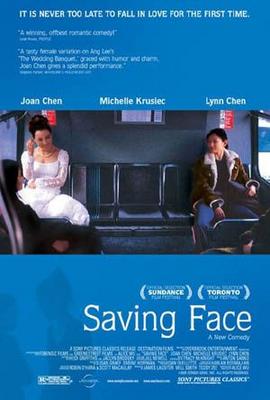
    Saving Face
    Saving Face
    Directed by Alice Wu

    Starring:
    Joan Chen, Michelle Krusiec and (the lovely, lovely!) Lynn Chen


    "Saving Face" is a simple fare done very well. It is a rare bilingual movie where almost all the Chinese actors speak fluent Mandarian Chinese – and is better for it all. It smoothes over the awkward Mandarin of the two lead actresses Michelle Krusiec and Lynn Chen. In fact, it works to position them outside their Chinese-American community linguistically (and by implication, sexually). The mother-daughter relationship between Ma and Wil works with Ma speaking only Chinese while Wil responds mainly in English. The dynamics of the relationship is so effectively communicated by language.

    The story goes like this: Wilhelmina Pang (Michelle Krusiec) is a capable Chinese-American surgical resident living in Flushing, New York. (Her boss predicts she will make Chief of Staff by the time she’s 40.) Her work keeps her busy, so her widow Ma (Joan Chen) keeps trying to fix her up with eligible young Chinese men every week at the Chinese social dances. Wil goes along with it, albeit with great reluctance. Not just because of the lameness of your mother trying to fix you up, but also because Wil is a closeted lesbian. (At least closeted from her Chinese community. Everyone else seems to know) Wil’s the kind that wears men’s shirts with sensible shoes, which Ma disapproves. But Grandma is cool here, as Grandma remarks, "Just like the pair I wore during the Cultural Revolution." "Very practical and durable," she adds. Anyone who ever had your mother complaining about your dress sense will warm to Grandma immediately. (Although on a later thought: how flattering is it to have fashion sense that dates back to the Cultural Revolution?)

    As Wil braces herself for another torturous night at the social dance, she meets Vivian (Lynn Chen), a dancer with the New York City Ballet. It was mutual attraction for both. They meet again later at the hospital where Wil works. It turns out that Vivian is the daughter of Wil’s boss. Ah. Coincidence.

    The romance between the two young women is handled with a lightness that renders their attraction believable. Michelle Krusiec shuffles around with a shy self-consciousness that’s oddly endearing. Her eyes are often hapless at the unfolding of the drama around her, like some helpless hamster. You are drawn to Wil’s gentle vunerability just as Vivian was. And Lynn Chen is the stronger of the pair, with her pretty babydoll features, and the unmistakeable mischief just gleaming out of the corners of her eyes and fluttering around her playful smiles. She’s the kind of girl that catches your eyes in a crowded room. (Okay, she’s the kind of girl that catches my eyes in a crowded room.) Lynn Chen plays Vivian with a self-assured charm, first smiling sweetly across the dance hall at the pretty little surgeon with the ponytail, later making a pass at Wil at the candy machine. She totally disorientates the young doctor.

    As the young lovers slowly sidestep their way towards one another, a tango plays on the soundtrack and Wil returns home one night to find Ma at the steps outside her apartment. Turns out Ma is pregnant, and refuses to name the father. Grandpa found out about Ma’s condition from one of his old student. Now everyone knows.

    "One billion Chinese. Two degrees of separation," Wil mutters as she’s packing Ma’s stuff.

    So Grandpa threw Ma out – unless she gets married (apparently it doesn’t have to be the baby’s father) or "proves immaculate conception."

    The chaos of juggling your pregnant mother and a new lesbian romance just gets too much, and Wil resorted to trying to find Ma a husband. In the midst of trying to get Ma ready for her first date, there was a touching moment when Wil observed her mother up close. She stares, as though seeing Ma for the first time. Ma, a bundle of insecurities, asks if there was anything wrong with her face.

    "You’re beautiful," she tells Ma. And yes, Joan Chen is beautiful in this movie.

    All her other films have never prepared me for this comedic side of her. Joan Chen’s Gao Hwei-Lan is funny because she is entirely believable as the character she plays. You laugh because it’s so touchingly familiar. Even as she’s s/mothering Wil, she’s also a sheltered child experiencing freedom for the first time in 48 years. In one scene she wanders into a video store asking for Chinese videos. As she scans the shelves, we glimpse the titles "The Last Emperor" and "Joy Luck Club." It’s the kind of in-joke that brings a smile to your face. Later, she meandered onto the shelves for porn videos – and we see only her eyes from above the video rack. The eyes spoke eloquently of the innocence of this grown woman who’s fascinated by the forbidden.

    When Ma finally reveals the father of her baby, it wasn’t really much of a surprise. Wil asks her, "Why did you put us through all these?" Ma replies that she has never dated in her life, and she just wanted to feel how it’s like to get out. And most importantly, she needed the father (of her unborn baby) to declare his feelings for her in front of everyone. She needed him to be sure of his feelings for her. While there’s something of a petulant child in this, what she yearns for is so achingly human. She wants her love to be stronger than fear. Straight, gay, old and young, we want our love to declare itself in front of the world.

    Wil couldn’t learn this from Ma soon enough, because Vivian, tired of waiting for Wil all the time, signs up for a 4 years stint with the Paris Opera Ballet. At the airport, Wil pleads with her girlfriend to stay. And Vivian asks this of her: "Kiss me in front of everyone here." Wil couldn’t. And she loses the girl she loves.

    The movie poster has Joan Chen and Michelle Krusiec seated a little apart from the other. I found the image odd at first. I wondered why Lynn Chen was not included in the poster. After the movie I realised I was misled by my expectation of what "Saving Face" was about. It wasn’t a just a lesbian romantic comedy as I had presumed. I fell in love with "Saving Face" because the heart of the story is Ma and Wil – it is definitely a love story – between a mother and a daughter.

    After the movie I visited the website for "Saving Face" and came across Alice Wu’s "Director’s Notes":

    "I wrote SAVING FACE as a love-letter to my mother. The character of Ma begins the movie as a woman with all major decisions in life seemingly made; at 48, she has lived a proper life and is now essentially just living to die. That she ultimately breaks with tradition and lives on her own terms is a triumph I wanted my mother – and the world – to see. I suppose if there is one thing I am trying to say with the film, it is that no matter who you are – Asian or black, gay or straight, young or old – that everyone basically wants to love – and that love can start at any point in your life that you want it to. I made SAVING FACE because I wanted my mother to know that it was never too late to fall in love for the first time. And that it is not by doing things right, but by sometimes getting them wrong, that we launch the journey that allows us to come into our own."


    It's the kind of thing that makes you smile when you read it. "Saving Face" is Alice Wu's first film. It isn't a great arthouse movie, but it's a lovely, personal film. Chekhov identified compassion as one of the six characteristic vital to good writing. I think Alice Wu got it pat down.

    Some background on director Alice Wu: She graduated from Stanford University with Bachelor and Masters degrees in Computer Science. She was a software designer with Microsoft until the day her script for "Saving Face" won an award.

    In the film, Vivian is a talented ballet dancer. But despite the disapproval from her father, she has been venturing into modern dance , simply because, "it is more ... expressive."

    Impressive.

    Friday, October 21, 2005

    People Doing Odd Things

    I'm trying to get a more focused grip on my readings, so I'm in the process of drawing out my 100 Reading List. Will I be able to finish all 100 titles in the Year of Our Lord 2006? Probably not. But it's fun trying! ;p

    "Why do it?" you may ask.

    Because it's fun.

    A brief anecdote:

    I dislike popcorns in general. I find that they have the texture of styrofoam when you bite into them, and the salted ones are usually too salty, and the sweet ones are usually sticky and cloyingly sweet. And the butter - if the popcorn's not fresh, the butter usually have that rancid smell that clings to your clothes and hair.

    Don't like popcorn.

    Once, out with Ms F for a movie, I mentioned the "popcorn has the texture of styrofoam" observation. Ms F piped: "Yeah, like you've tasted styrofoam." Or something along that sentiment.

    Actually I have. When I was a wee thing, I had some styrofoam around the house to play with. It was nice. Lots of things you can do to styrofoam. Then one day I wondered how it will taste. So I bit into it to check out the texture. What can I say? It crunch like popcorn without the butter, salt and caramel syrup.

    No, I do not swallow.

    "Why do it?" you may ask.

    Because it's fun to find out things like these.

    Anyway, recently I'm taken with this writer, Mary Roach. She strikes me as someone with the curiosity in the unusual things in life. Her previous book, Stiff: The Curious Lives of Human Cadavers made it to the bestsellers. I've perused it briefly, and she's an illuminating sprite amongst the chaos of dull books out there.

    The book apparently first began with the Salon.com article she wrote on how much a human stomach could hold before it burst. It was a Thanksgiving thing and with all the feasting I guess the question just popped into her head.

    She is fun person. ;)

    Wednesday, October 19, 2005

    Ba Jin dies aged 100

    Jonathan Watts in Beijing
    Tuesday October 18, 2005

    From The Guardian

    Ba Jin, the Chinese anarchist intellectual who became one of the 20th century's great authors, died yesterday in Shanghai, aged 100.

    From the 1931 publication of his most celebrated work, Family, the story of a disintegrating feudal household, Ba Jin rose to prominence as a critic of the injustice of the pre-revolutionary era. Although associated most with the turbulent period of 1930 to 1950, he remained a leading force.

    He had Parkinson's disease and cancer.


    You know? I thought he was dead a long time ago. How many people out there are still alive?

    Monday, October 17, 2005

    (Possible) Planet Xena Has Moon Named "Gabrielle"

    I kid you not.

    I Have Many Skills WASHINGTON (Reuters) - Xena, the possible 10th planet in our solar system, has its own moon, a dim little satellite called Gabrielle, its discoverers reported.

    Astronomers who reported Xena's discovery in July said they detected Xena's sidekick on September 10 using the Keck Observatory on Mauna Kea in Hawaii. Their findings will be submitted to the Astrophysical Journal Letters on Monday.

    "Since the day we discovered Xena, the big question has been whether or not it has a moon," Michael Brown, of the California Institute of Technology, said in a statement. "Having a moon is just inherently cool -- and it is something that most self-respecting planets have, so it is good to see that this one does too."

    Xena, known formally as 2003 UB313 but nicknamed for the warrior princess of television fame, and Gabrielle orbit the sun out beyond Pluto in a band known as the Kuiper Belt, a swath that is home to comets, asteroids and other space rocks.

    The possible 10th planet moves in a highly eccentric orbit, tilted some 45 degrees above the orbital plane of the other planets. Its orbit is also elliptical, zooming in as close as 3.5 billion miles (5.6 billion km) from the sun and moving out to as far as 9 billion miles (14.5 billion km) away.

    Earth orbits rather consistently at 93 million miles (150 million km) from the sun.
    It takes Xena 560 Earth years to complete one trip around the Sun, compared to Pluto's 250 years.

    Xena is one of three big planet-like bodies recently found in this region. The others have equally playful nicknames: Santa and Easterbunny.

    A PLANET - OR NOT?

    I Am Unlikeable

    Size is important when it comes to making the grade as a planet. Astronomers know that Xena is bigger than Pluto but since they don't know what it is made of, they can't be sure that it is more massive. The discovery of the moon Gabrielle means Xena has at least enough mass to keep a satellite.

    Gabrielle is estimated to orbit close to Xena, making a circuit perhaps every 14 days. Named for the TV princess's travelling companion, Gabrielle is about 60 times fainter than Xena.

    The International Astronomical Union, which makes the decision on what is a planet, considers Xena a trans-Neptunian object, meaning its orbit crosses that of Neptune, just as Pluto's does. Many astronomers, including Brown, question Pluto's planetary status, too.

    But Xena's discovery, and its size, have prompted the union to rethink the definition of planet.
    On the union's Web site, it said: "The very rapid pace of discovery of bodies within the solar system over the last decade, and so our understanding of the Trans-Neptunian Region is therefore still evolving very rapidly. This is in serious contrast to the situation when Pluto was discovered."

    A working group of the union is considering a new definition. Until the group finishes its work, the Web site statement said, all objects discovered at a distance of 40 times Earth's distance from the sun, "will continue to be regarded as part of the Trans-Neptunian population."

    More information and images are available at http://www.gps.caltech.edu/(tilde)mbrown/planetlila/moon/index.html.

    Wednesday, October 12, 2005

    Copy Protection Part II


    October 20, 2005 Issue of Rolling Stones


    A follow-up on my entry on the copy protection on KT Tunstall's CD.

    This issue of Rolling Stones reports fans of Dave Matthews Band, Foo Fighters and Switchfoot are mighty pissed by similar Copy Protection software rigged into their CDs.

    Currently, it's mainly labels like Sony BMG and EMI that's adding the copy protection software into their CDs. It's not yet know how this affects CDs sales, from pissed off fans - like myself who are refusing to pick up a copy protection CD in protest. Apparently freewares are offered online to decode the copy protection. And Sony BMG will actually email detailed instructions on how to use the decoding software if you ask.

    Still - why make fans of the musicians go through these extra hoops? Why punish the fans?

    Labels will work to keep their profits, naturally. But this measure really only serve to alienate the very people who bothers to buy an original CD - because someone used to downloading the mp3 files illegally isn't going to be really affected by the copy protection CDs. Simply because he or she isn't going to buy one.

    Sale of CDs really goes to the profit margins of record companies, not the artistes. Yes, I know that - but really, do I care if the singer/musician I like can't afford an expensive Ferrari?

    What matters to me is that record companies are only willing to sign musicians who can sell CDs for them. A talented musician who can't sell his/her first CD will probably not have a second one. Now, that matters to me.

    My favourite example here is Joss Whedon's Serenity. The TV series died a premature and unnecessary death because the TV network didn't know what to do with it. But it was the overwhelming DVD sales that finally pushed convinced the powers that be a Serenity movie was worth the investment.

    I don't care if Joss Whedon don't get rich from the Serenity franchise. Good for him if he is. But I am looking forward to the movie.

    And yes, I am one of the many who bought the original DVD boxset for Serenity.