Wednesday, March 15, 2006

Which Literature Classic Are You? II

Some of my friends did the quiz, and here are some of their results:
Oscar Wilde: The Portrait of Dorian Gray.
You are a horror novel from the world of dandies, rich pretty boys, art and aesthetics, and intellectual debates between ethical people and decadent pleasure-seekers. You value beauty and pleasure but realize their dangers, as well.

Shakespeare: Sonnets.
Everyone has heard of you, and almost everybody can find something touching in you. You are calm and control yourself, even though your wisdom and your messages are no lesser than those of others.

J.R.R. Tolkien: Lord of the Rings.
You are entertaining and imaginative, creating whole new worlds around yourself. Well loved, you have a whole league of imitators, none of which is quite as
profound as you are. Stories and songs give a spark of joy in the
middle of your eternal battle with the forces of evil.

T.S. Eliot: The Wasteland.
You are a desperate cry to God, moulded in intricate word-craftmanship. Your language is controlled, but inside, you feel empty and are not content with your life. You see both the world and your inner self as a waste land: nothing good can come out of it anyway. People find you difficult to understand but admire you nevertheless.

Virginia Woolf: Orlando.
You are a challenge, for outer events, the outside world, the time etc. play no importance to you. Your focus is in writing, in gender issues, and inside your own head. Self-analysis and exploration of yourself as well as the outer world hold great importance to you.

Count as of this morning:
1 Picture of Dorian Gray
2 Shakespeare's Sonnets
3 Name of the Rose
1 Lord of the Rings
1 Flower of Evil
1 T. S. Eliot's Wasteland
1 Orlando

Tuesday, March 14, 2006

Places I Must See Before I Die

Was in bed last night with my journal and my fountain pen. The list just popped into my head.


  1. Tibet

  2. New Orleans

  3. San Francisco

  4. Cambodia, especially Angkor Wat

  5. Egypt

  6. Turkey

Which literature classic are you?

Did the quiz, and I never actually got around to finishing the book. Heh.

The name of the rose
Umberto Eco: The Name of the Rose.

You are a mystery novel dealing with theology,
especially with Catholic vs liberal issues.
You search wisdom and knowledge endlessly,
feeling that learning is essential in life.

Which literature classic are you?
brought to you by Quizilla

What I Am Currently Reading

Ladies and Gentlemen,

I am currently re-reading To Kill A Mockingbird. And I don't want it to stop. :)

Monday, March 13, 2006

Let's Not See Each Other Again

March and September have always been the busy months of my social calendars. March is my birthday month, and my life is heavily doused with the Virgo influence (August-September).

But this year, I'm attempting to simplify things.

Last Saturday (11 March 2006) I met the Brat for lunch. Actually, I ate and she had coffee.

Last Saturday a classmate from my Secondary School got married. Church ceremony in the morning, dinner in the evening. I wasn't there for either.

I actually like The Bride - my ex-classmate. She has always been kind to me, and the fact she still invited me after all these years of absence was thoughtful.

So why didn't I go?

Reason #1: One of my former manager will be there. My former manager is first cousin to The Bride. I do not wish to see my former boss.

There is truth to Six Degrees of Separation - you're bound to have mutual acquaintances, especially if you date your friends.

Reason #2: EX #2's sister is good friend with The Bride, so they will be helping out with the wedding. It tortures me to have to be nice to EX #2, someone I no longer like very much.

Why did I go out with him in the first place? Rebound relationship. On hindsight I had always known he's too self-absorbed to love anyone but himself. He was the safest, least guilty and cleanest break-up I EVER had.

I don't want to speak to him again. Actually, it's more like I don't want to have to listen to his self-pitying, ego-centric rambling anymore. I can think of 1000 better ways of wasting my time - all of them painful - but all less dreadful than his personality.

Reason #3: EX #1 - first love, if we can call it that. How I feel now is very different. Too many unresolved issues.

I don't think we should see each other again.

Friday, March 10, 2006

Asia Argento: That J. T. Leroy Thing

According to Gawker.com, Asia Argento shoots her mouth off at the Q&A following the screening of The Heart Is Deceitful Above All Things. All this following revelations that J. T. Leroy is really a 40 year old woman named Laura Albert.
To heavily paraphrase: "What is truth? Am I telling you the fucking truth right now? How do you know what the fucking truth is?" She then talked about her personal experience with J.T. and how she had no idea he didn’t exist until everyone else found out about it. "I mean, I slept with J.T. I touched his pussy. I just thought they make great pussies these days. I don’t know. I couldn’t see, it was dark. He said he was on hormones, that was why the boobs were there. I just thought they make great pussies nowadays."

I have to stop reading trash like these online. But gawd, Asia Argento is just so much fun!

Asia ArgentoHere's a picture of the tattooed Italian star. What is it with me and tattooed bad girls? ;p

SMACKDOWN: Nuns vs Librarians

Nuns versus Librarians in a Spelling Bee Showdown.

Yay!

It's so true it's surreal.

What are they saying about each other?

"Librarians give us a scare," said Sister Mary Carol Hellmann, who says she's been brushing up on Latin, Greek, Hebrew and Spanish root words to prepare for the bee. Some of the other sisters say they use the Internet to practice.

"They have that strong Latin background," said Cindy Brown, director of the Boone County Library. Brown said her spelling team is made up of "voracious readers with a certain verbal attitude."

I'm having too much fun with this snippet.

I need a life.

Via Blog of a Bookslut

Thursday, March 09, 2006

Norman Mailer: On Sex and Deodorant

Nerve.com interviewed Norman Mailer, and the guy's a firecracker.
Norman: That's true, but it's a huge distortion. Look back to the court of Louis XIV. They bathed every three or four weeks, so you got the raunchiest crotch odors mixed with some very special perfumes. And of course, they were screwing in every bush, not to mention every bedroom in Versailles. I'm just saying, the kinkiness now, whatever it is — being hung upside down while getting a blowjob? The point is, it's all in search of a lost smell.

BOOKS: Reading "The English Patient"

I am re-reading The English Patient, by Michael Ondaatje. I have a copy of my own (Yes, yes, because of the movie! Don't judge me!;p) - but could not find it. So I'm reading a library copy instead.

It's another one of those moments when the movie affects your reading of the book. As I follow Hana through the novel, I see the frail, tragic beauty of Juliette Binoche in my mind's eye.

I came across this passage, where Hana is reading a book from the abandoned villa she is living in with the English patient:
This was the time in her life that she fell upon books as the only door out of her cell. They became half her world. She sat at the night table, hunched over, reading of the young boy in India who learned to memorize diverse jewels and objects on a tray, tossed from teacher to teacher - those who taught him dialect those who taught him memory those who taught him to escape the hypnotic.

She is reading Kim!

Wednesday, March 08, 2006

Sudan man forced to 'marry' goat

From BBC NEWS

A Sudanese man has been forced to take a goat as his "wife", after he was caught having sex with the animal.

Full story here.

Monday, March 06, 2006

OSCARS: Crash? My ASS!

How the hell could anyone award Crash Best Picture? It was such a watered down feel good shit of a movie!

To Cuddle A Mockingbird

From The Times, 3 March 2006
By Ben MacIntyre

With the recent revelation that most readers prefer the tragic endings, McIntyre rewrites great literature to pump in popular sentiments.

For Pride and Prejudice:
Pride and Prejudice could be rendered less saccharine by introducing the scene where Darcy explains to Elizabeth that it is a truth universally acknowledged that a single man in possession of a good fortune still in want of a wife is obviously gay, so he is moving to Tangiers to live with Wickham.

My personal favourite:
Godot finally turns up.

Full article here.

Brevity and Telegram

From The Times, 4 March 2006
By Ben MacIntyre

'No invention more clearly showed the benefits of brevity than the telegram'

MARK TWAIN ONCE RECEIVED the following telegram from his publisher: NEED 2-PAGE SHORT STORY TWO DAYS. Twain replied: NO CAN DO 2 PAGES TWO DAYS. CAN DO 30 PAGES TWO DAYS. NEED 30 DAYS DO 2 PAGES.


Full article here.

Sunday, March 05, 2006

Books On Loan

There are moments in your life when you are embarrassed by the stuff you have borrowed and not returned. I've taken stock of the books & DVDs I've borrowed, and I hope these are the only things than have stayed unreturned for more than 3 months:

MN's:
Jack by A. M. Homes
In A Country of Mothers by A. M. Homes

PW's:
Blindness by Jose Saramago
The Passion of Joan of Arc DVD Directed by Carl TH Dreyer

JN's:
Master and Commander by Patrick O'Brian (on loan from last year!)

Sab's:
Harry Potter and the Sorceror's Stone (Which I borrowed just after we graduated, so it's been on my shelf for more than 6 years - but that's more due to loss of contact than anything else)

Breakfast At Tiffany's and Romantic Comedies

I watched Breakfast At Tiffany's over the weekend, and was charmed by the kooky Holly Golightly - played with oddball grace by Audrey Hepburn. I wonder if there is any actress today that come close to embodying this state of grace and stylishness? Cate Blanchett? Yes, she played a queen and an elven queen - but will we, twenty years later, use Cate Blanchett as a byword and symbol for elegance?

Also, I was not prepared for the cynicism in Breakfast At Tiffany's. George Peppard and Audrey Hepburn play characters who are essentially selling their affections for cash. Holly Golightly wants to marry into money. She beams when she laid eyes on short and ugly Rusty Trawler ("He's the nineth richest man in American under the age of 50!" she declares to her friend Paul Varjak) She also charges men $50 for every trip to the pwoder room. (I never learn what was involved in the powder room. I presumed it's a code for sexual impropriety). And Paul Varjak (played by George Pappard) is a writer "sponsored" by a rich man's wife (Patricia Neal).

I expected a romantic comedy, and this being a movie shot in the 1960s, I expected an innocence. Surely we are the age that has more cause for material cynicism?

But no - this is a story by Truman Capote, and if you believe the movie, he was the tin man who never got his heart. Everyone in Breakfast At Tiffany's is caught up in money for affections and the best that could be said of Holly Golightly is that while she's a "phony", she's a "real phony." The love affair between Holly Golightly and Paul Varjak is the exception to the rest of the world. At the end, while it ends with "Moon River" in the soundtrack, and the quinessential kiss in the rain, it's doesn't sugar-coat love enough; it doesn't make you want to fall in love, or believe in love.

I don't recall many current romantic comedy that dares to say these things so upfront.

On a slightly different note, after the demise of the Meg Ryan-Tom Hanks partnership, we don't have many great on-screen couples anymore. Now, Kate and Leopold was beautiful because you could fall in love with Hugh Jackman; I would buy butter from that man - but I wasn't quite convinced a stud-muffin like Jackman would fall for Meg Ryan.

Who today, could fill the shoes of the king and queen of romantic comedies? Ashton Kutcher? I don't get him. I am uncharmed by him. Drew Barrymore was adorable in 50 First Dates, but one shouldn't hang around Adam Sandler too much if you want to be taken seriously. But I admit I loved Spanglish, and the ending was satisfying - even if Adam Sandler never got the girl.

We need to find our romantic stars again. Not just pretty boys and girls that look good, but actual adults that fall in love onscreen beautifully and sincerely, and make you forget - just for the length of the film at least - that love may not always be innocent and pure.

Friday, March 03, 2006

Lesbian Aesthetic

A friend emailed me this recently:

hey, was just thinking...

when i read those poems by carol ann duffy, and also
when i listen to tracy chapman, it occurs to me to
wonder if they are lesbian, and they turn out to be.
but thing is that what they write, or at least their
stuff that i have come across, is not specially
lesbian-ish or out-ish, but there's something there to
make me wonder about them. does this mean there is
some sort of lesbian aesthetic, or at least some sort
of sentiment in the work of lesbian artists that can
be identified/ are characteristic of them? come to
think of it, k d lang as well.

what do you think?

it's not a theory lah. just wondering out loud. or
rather, electronically.

it seems that there might be leh. i mean, like
"smitten, straining your tea" is not an image that
someone would write about a guy? or rather, the tone
of that piece is not something one would use to
describe feelings for a guy, and not something a guy
would write about a girl either. what thinks you?

me, being oh too "eng" again.


I think it's just her gaydar...

BOOKS: Oddest Literary Title

Taken from The Guardian

The winner of the Bookseller magazine award for the year's oddest book title is the US volume, People Who Don't Know They're Dead: How They Attach Themselves to Unsuspecting Bystanders - and What to Do About It, by Gary Leon Hill, which is said to have sold 15,000 copies.

The runner-up was Rhino Horn Stockpile Management: Minimum Standards and Best Practices from East and Southern Africa, by Simon Milledge.

Another contender was Nailing: Best Practice Guidance.


I'm trying to keep a straight face right now.

Thursday, March 02, 2006

DVD: Northern Exposure: Cicely

I finally got my Season 3 Northern Exposure DVDs back. Yay!

Northern Exposure is a pleasure trip to nostalgia. A quirky, delightful comedic drama - it never got the ratings it deserves. But it did earn a respectable cult status among TV viewers.

It used to be shown late at night on Sundays. That was way back during my Junior College days. We would stay up late to watch it on Sunday nights, and talk about the show in school on Monday mornings.

The episode that stayed closest to our hearts then was the last episode of Season 3, "Cicely". Back in our dreamy school days, we sighed when we recalled the "Cicely" episode. It was a simple but beautiful story of the town's founders: Roslyn and Cicely. They rode into town one day in 1909, in an automobile. They were strong-minded liberal women with a vision. That day they decided the dirt-hole Alaskan town shall be their site for the "Paris of the North."

A few things, minor details stayed with me for that episode. One of it was the bandit Kit (played by John Corbett, who's also Chris in Northern Exposure) who counts down with the basic tenets of Hegelian dialectics. ("Thesis! Antithesis! Synthesis!")

You know, I haven't heard that for a while. :)

But last night when I was watching the episode, I was once more moved by the words that touched me more than ten years ago:
"One person can have a profound effect on another.
And two people -
Well, two people can work miracles.
They can change a whole town.
They can change the world."

They don't make shows like this anymore.


Northern Exposure, we loved you well

[ Northern Exposure. We loved you well. ]

BOOKS: "To Kill A Mockingbird" B4 U Die

From BBC News

To Kill A Mockingbird by Harper Lee has been voted the book adults should read before they die.

The survey of librarians to mark World Book Day came out in favour of The Bible in second place and The Lord of the Rings trilogy in third place.


I'm usually skeptical of these votes, but when the results show something I like, I'm always willing to use statistics to make my point.

I am a social scientist. Hee. *wide grin*

Wednesday, March 01, 2006

Best of Singapore Erotica

Someone I Know has a story published in Best of Singapore Erotica, edited by L. Q. Pan and Richard Lord. It's the first compendium of erotic writings from our island-state, as far as I know.

If you're interested, it should be coming out May 2006. Check out your friendly bookstores for it.

As for the Someone I Know, she's been telling everyone NOT to read it. I think she's genuinely embarrassed by it.

Of course, everyone will now dive straight into her story first.

More Logo Parody

Kill Bill

Yes, you've probably seen my hoodie with the Kill Bill parody, featuring Tux the Penguin. Tux is the mascot for Linux, a free source OS waging the good fight against the dictatorship of Microsoft (Kill Bill, geddit?)

Why a penguin as the icon of technological discontent?
Some people have told me they don't think a fat penguin really embodies the grace of Linux, which just tells me they have never seen a angry penguin charging at them in excess of 100mph. They'd be a lot more careful about what they say if they had.
~ Linus Torvalds

I really like 'em penguins. ;p

Starbucks vs Cartoonist

The Comic Book Legal Defense Fund Board of Directors has voted to support cartoonist Kieron Dwyer in his legal defense against lawsuits by Starbucks Corporation. You know, the coffee place.

Starbucks is suing Dwyer for copyright and trademark infringement of its "mermaid" logo, a parody of which appeared on the cover of Dwyer's Lowest Common Denominator #0.


Parody


You know, I actually like the parody logo. This kind of bullshit makes me want to quit Starbucks coffee. So, the next time you guys want to meet me for coffee, can we do Spinelli's instead? Thanks.

Full story here

Tuesday, February 28, 2006

SALON: Get Over It

From Salon.com, Getting Over Happiness

Steven Hayes wrote Get Out of Your Mind and Into Your Life - which in a nutshell, is trying to remind us that life is not going to be any easier by running away from your pain. A truly meaningful life is the balancing act. It involves acceptance of all your experience, coming to terms with the emotions, notice your thoughts, and "carry all that forward down a path that you value that's neither indulgence nor suppression."

It echoes a very Buddhist teaching of mindfulness.

There should be a middle path between suppression and indulgence.

Western culture promotes feel-goodism. In part it's a side effect of having technology to make things easier or feel better. It's natural progress, so we don't have to do the sweaty, hard things our forebears had to do. But inside that is a meta-message, which is that you're supposed to feel good from morning to night. And add on top of that commercialism and medications -- because they feed it too: If you consume the right products, eat the right pill, drink the right beer, drive the right car, you believe that you're not going to feel anything you don't like. What I'm saying is that that is not the definition of a meaningful life, and I'm saying people know it.


In what little I know about life, it rings true.

It's not pain that makes us jaded. A jaded cynic is nothing more than someone trying too hard to hide away from pain. Pain has a capacity to teach, and offers an opportunity to grow - but our whole experience now is about avoiding pain. No wonder we don't seem to grow up.

Monday, February 27, 2006

BOOKS: Carson McCullers and February House

I was reading February House recently.

"February House" was the title given to a shabby brownstone house on 7 Middagh Street, Brooklyn, New York. What made this little place outstanding was its famous occupants in the 1940s, which included: Jane and Paul Bowles, W. H. Auden, Carson McCullers (with her husband Reeves) and siblings Erika, Klaus and Golo Mann (children of Thomas Mann).

The February House was an experiment in artistic communal living, the initiative spearheaded by Harper's Bazaar literary editor, George Davis.

In particular, the portrayal of Carson McCullers intrigued me. It was her stint in the February House, where she enjoyed Auden's mentorship, that she wrote the novel that was to become The Member of the Wedding.

It was during a discussion with Auden, on what the poet termed the "inarticulates" of the world, the down-trodden, the ones who did not have the refinement of artistic expressions, that Carson McCullers declared that she would write of these "inarticulates."

February House made me more interested in Carson McCullers as a writer, until the irony struck me:

Why don't I just read Carson McCullers, instead of reading about her?

D'uh.

So I dropped February House and picked up Reflections In A Golden Eye, her second published work. What astonished me is this: Reflections was a novella written as a relaxation exercise for McCullers.

Woowee.

Friday, February 24, 2006

BOOKS: Kim by Rudyard Kipling

I finished reading Kim last night. While I avoid British colonial literature in general, the admiration for Kipling by some authors I enjoy persuaded me to try Kim.

I was charmed by Kim, and Kipling's literary India, where all supporting characters endear in their own manner.

And Kimball O'Hara himself, a boy poised between the worldly concerns of The Great Game, and the spiritual pursuits of the Lama.

It's good to try some new books once in a while.

Thursday, February 23, 2006

THOUGHT: Brand

We speak of "brand loyalty" these day, and I dislike the association. I have greater esteem for the virtue of loyalty than to mistake it as a function of mere consumerism.

To speak of loyalty to a brand of shoes is to belittle that virtue.

To ascribe loyalty too carelessly is to belittle this virtue.

THOUGHT: To Forsake

Right before the outbreak of World War II, even when the political situation in Germany was swiftly turning hostile for the German Jews, many of them refuse to leave the motherland.

I was struck by the statement made by one of these patriotic German Jews, which goes something like:
One does not forsake one's parents, just because they behave badly.

My memory is hazy, but the statement was to this effect. I imagined the man paid dearly believing this. In hindsight of the events that followed, it even seems naive. Yet there is an admirable quality in it. Something that inspires, even.

In this instance, the country failed the man, even as he stayed true.

Fidelity is that which has to be able to withstand adversity. And loyalty which has never been tested, can we claim that it even exists?

THOUGHTS: Remains of the Day

In The Remains of the Day, Stevens serves as butler to Lord Darlington. Towards the end of the novel, Stevens seems to express a regret for his loyalty to Lord Darlington, and the latter's Nazi sympathies.

It's a question I ask myself from time to time: how does one remain loyal if the person you have bind yourself to behaves in a matter that contradicts your own principles?

In The Remains of the Day, we, the reader, have the advantage of hindsight. Most of us not gifted with wisdom and clairvoyance, make our choices with our usual half-blindness. And sometimes we try to keep faith with someone, even as we hope the other will keep faith with us.

But what if keeping faith - this binding loyalty, is nothing more than blind faith?

Wednesday, February 22, 2006

WORD OF MY LIFE: non sequitur

non se·qui·tur (noun)

  1. An inference or conclusion that does not follow from the premises or evidence.
  2. A statement that does not follow logically from what preceded it.

Tuesday, February 21, 2006

BOOKS: Locked Rooms

Locked Rooms by Laurie R. KingFinished Locked Rooms last night. This means I'll have to wait a few more months before the release of the next novel by Laurie R. King. Oh dear, oh dear. What will I do now?

Monday, February 20, 2006

Death of Handwriting

From The Guardian
Tuesday February 14, 2006

Somebody bemoaning the death of handwriting. Postmodernism and culture theory sucks. We're always moaning and groaning about the death of the author or something or another.
Yesterday afternoon I received a lovely letter from a correspondent that began: "Please forgive scribbled note. I can no longer type." But why, with all due respect, should anyone ask forgiveness when favouring me with the personal touch of their penmanship? When did typing become better than handwriting? (To which question an irritatingly good reply is: If you're so clever, why didn't you write this article by hand?)

See full article here

BOOKS: A Plea for Eros

Siri Hustvedt's new collection of essays, A Plea for Eros, embraces her psyche, herself - and her passion for the Brontes, says Serena Davies

The Observer
Sunday February 19, 2006

Read article.

FILM: Cache with Haneke

We love Hidden. But what does it mean?
From The Observer
19 February 2006

Jason Solomons asks director Michael Haneke to
shed some light on Cache.

Saturday, February 18, 2006

BOOKS: Everyman's Library

Independent write-up on the centenary of the Everyman's Library.

In every Everyman's Library classic there is this quote:

Everyman, I will go with thee,
and be thy guide,
In thy most need to go
by thy side


Each volume is printed on acid-free, cream-wove paper with full-cloth sewn bindings, gold stamping, and silk ribbon markers.

It's an indulgence for the reader, but if you want the collection of your favourite authors bound in beauty, this is a good series.


Check out Everyman's Library

Friday, February 17, 2006

QUOTE: Convent Girls

The BRAT reminded me of something I sent out a long time ago.

"I think one of the reasons why I was never properly domesticated is because I was actually socialised by a gang of mad women in flapping black habbits"

~ Germaine Greer

STUFF: From "Non Sequitur"

For those who know what's this is about... Hee.

BOOKS: A. M. Homes Sells Book

Variety reports that novelist and L Word producer A.M. Homes has sold the film rights to her novel This Book Will Save Your Life, which Viking will publish in April.

Click here for a slightly fuller report.

And if you're going to ask me why it's a link to Advocate.com, I will personally slap your ass. ;p

Thursday, February 16, 2006

BOOKS: Salterton Trilogy Missing

Hmmm.

The only copy of the complete Salterton Trilogy by Robertson Davies has been bought by person unknown. So. There is someone out there patient enough to try.

We were supposed to do The Fifth Business (the first book of The Deptford Trilogy) for our January 2006 Book Club. Alas, Robertson Davies proved ... challenging.

Abu Ghraib Photos

In a Salon.com exclusive, never-seen-before Abu Ghraib photos are released.

Walter Shapiro, Salon's Washington bureau chief wrote:
Abu Ghraib cannot be allowed to fade away like some half-forgotten domestic political controversy, which may have prompted newsmagazine covers at the time, but now seems as irrelevant as the 2002 elections. Abu Ghraib is not an issue of partisan sound bites or refighting the decision to invade Iraq. Grotesque violations of every value that America proclaims occurred within the walls of that prison. These abuses were carried out by soldiers who wore our flag on their uniforms and apparently believed that Americans here at home would approve of their conduct. Rather than hiding what they did out of shame, they commemorated their sadism with a visual record.

That is why Salon is willing to publish these troubling photographs, even as we are ashamed to live in a country that somehow came to accept that torture and prisoner abuse were simply business as usual -- something that occurs while a sergeant catches up on his paperwork.

Miffy Turns 50

Miffy
When I was young(er) my mom would bring us to the Queenstown National Library every Saturday. It was the only regular family outing we had. That was where I first got to know Miffy, the bunny with the "X" for a mouth.

For a while, I would dig through the "Just Returned" bin of the library for some Miffy titles that I had not seen before. Now, close to 30, I realise I don't remember much about those Miffy books. Just the "X" for a mouth.

Visit www.miffy.com

BOOKS: Current Reading

Paradise
By A. L. Kennedy
[ 16/02/2006 ~

Kim
By Rudyard Kipling
[ 16/02/2006 ~

Madame Bovary
By Gustave Flaubert
[ 14/02/2006 ~

February House
By Sherill Tippins
[ 11/02/2006 ~ Stopped. Bored ]

A Burnt-Out Case
By Graham Greene
[ 10/02/2006 ~ 14/02/2006]

Firecrack
By Sean Stewart
[ 09/02/2006 ~ Stopped ]

Don Quixote
By Miguel De Cervantes (Translation by Edith Grossman)
[26/01/2006 ~ hiatus

Jack
By A. M. Homes
[08/02/2006 ~ hiatus

Tibet, Tibet
By Patrick French
[12/01/2006 ~ hiatus

Tuesday, February 14, 2006

NEWS: The Compact

From San Francisco Chronicle

About 50 teachers, engineers, executives and other professionals in the Bay Area have made a vow to not buy anything new in 2006 -- except food, health and safety items and underwear.
"We're people for whom recycling is no longer enough," said one of the members of the fledgling movement, John Perry, who works in marketing at a high-tech company. "We're trying to get off the first-market consumerism grid, because consumer culture is destroying the world."

LINKS:
Compact blog
Compact Yahoo Group

Monday, February 13, 2006

BOOKS: Wuthering Heights - NOT a Love story

The Washinton Post recently has a book feature: Editors' Choices: Who Wrote the Book on the Brokenhearted?. It's a Valentine's Day thing everyone's doing. This is the entry on Wuthering Heights:
Wuthering Heights , by Emily Brontë. Gothic romance endures in the haunting love story of stubborn, stormy Catherine and wild, dark Heathcliff. This is a classic tale of "what becomes of the brokenhearted who had love that's now departed," made all the more heartbreaking by the fact that Brontë died in 1848, just a year after the book was published.

Are you fine with this? I'm so NOT.

Wuthering Heights is not a love story. I read it when I was young and naive - when I was too ignorant to ask the question: if Heathcliff never laid a hand on Isabella as they claim, how the hell did she get knocked up?

BUT - I was still sober enough way back then to realise Wuthering Heights is an S&M novel. And Catherine Senior is the sexiest sadist ever in literature - not that it's a bad thing.

The next person to call Wuthering Heights a love story needs to be kicked in the teeth for sheer NOT GETTING IT!

FILM: Brokeback Mountain

Saw the much hyped Brokeback Mountain on Sunday.

The question remains: did I cry?

No. And I wondered, for those that did: why do they cry? What part of them relate so poignantly to the story that they wept?

I saw it as a story of damaged lives. It’s about people so haunted by Brokeback Mountain that they make choices that crippled themselves and those who loved them.

What is Brokeback Mountain?

For Ennis Del Mar and Jack Twist – it seems Brokeback Mountain represented a happiness that they are forever trying to reclaim. And so caught up with reclaiming a lost paradise they inevitably lose sight of what is in front of them.

Or perhaps, so weighted down by the wreckage they made of their married lives, they needed to believe in a return to Brokeback Mountain.

Del Mar continues to work at his ranch jobs. He refuses to try for other occupations that might allow him to earn enough to support his family. He breaks the heart of the waitress who really seems to have loved him. When his eldest daughter Alma Jr, in trying to escape an unhappy home, asks to stay with her father. Again, he could only disappoint her.

And Jack Twist and his wife? Towards the end, we see a cold, almost indifferent Lureen (Anne Hathaway) informing Ennis Del Mar the details of her husband’s death. By now middle-aged, with a blowsy blonde hair job and vulgar, redneck jewelry. She is too often seen at her account books counting up the profits - it’s hard to sympathise with Anne Hathaway’s character. But she wasn’t always this cold. She was wild and young and sexy like hell – a cowgirl in hot-red riding hard and fast. And she smiled when she first met her husband. A flashy, seductive smile. Something happened to turn her so brittle.

I don’t see it as just a story of a doomed gay love affair. I find that simplistic. Perhaps that is why I failed to cry. It is poignant, but so very human. We break the hearts of those who loved us, because our hearts were broken long ago. We do it everyday.

Del Mar tells Twist, "If we can’t change it, we just have to stand it." But he fails to see the third option – just let go. So they hold on, and their lives are crushed by their Brokeback Mountain.

It is rare to find successful Hollywood movies where characters learn from their loss and are able to let go, to move on with their lives. Perhaps it is less dramatic and therefore less Oscar-friendly.

In spite of the possible backlash, I will still state this: perhaps the best thing Jack Twist could have done for Ennis Del Mar was to die. Jack Twist’s death forced a conclusion that neither men were strong enough to make.

After Twist’s death, all Del Mar have left of Brokeback Mountain is the postcard and the bloodstained shirts. But there is the part when Alma Jr drives up to Del Mar’s trailer. She is getting married, and she wants him to be there. Perhaps for the first time Ennis Del Mar finally sees what is truly important. He will be there for his daughter.

Friday, February 10, 2006

FILM: Cache and Binoche

La Binoche.

Throughout the movie I can't help but feel a little regret that La Binoche's body is gravitating towards a matronly plumbness.

FILM: Cache

Saw Cache last night. It's a French film, starring Juliette Binoche and Daniel Auteuil.

There were mixed opinions on the film. Personally I did not find Cache powerful. So, my somewhat lukewarm response here and now.

The film opens with a still long take of the cozy, middle-class home of Anne (Binoche) and Georges (Auteuil) Laurent. Nothing seems to happen, the credits run across the screen in small white letters. You watch little banal scene. Nothing dramatic.

Then you hear the voices of Binoche and Auteuil. The screen runs in a fast-forward and you realised you are shown the video-recording the Laurents received at their door-step.

It's this sense of unease that I like about the film. You do not know what exactly you are looking at. The unknowing quality charge the scenes.

I wasn't allowed to sit back passively. The director keeps throwing me into the point of view of the video-recording (and by implication, the POV of the Laurents as they watch the video, and the POV of the mysterious person who taped the scenes.)

There's a kind of complicity via voyeurism. I think. Need to think about this a little more, but I don't think I will.

In the most evocative scene, Majid tells Georges Laurent that he wants Laurent to be here, and immediately slashed his own throat. It's an aggressive suicide, bearing the full blunt of Majid's self-annihilation on Laurent.

But that's about it. WW calls it an "edge of the seat" experience, although my butt very comfortably sank into the cushion. Hitchcock used similar still long takes technique in Rope and Rear Window to greater effect.

So it's not that great. But it's not that bad either.

FILM: Derek Jarman's The Garden Withdrawn

Celluloid Fringe 2006 - part of the M1 Singapore Fringe Festival - will be held at Cathay Cineplex Orchard Hall from Feb 23 to Mar 4.

I was interested in Derek Jarman's The Garden, but found out things were not to be.

See Alvin Tan's (Artistic Director of The Necessary Stage) statement on the withdrawal.

MURAKAMI: A Shinagawa Monkey

The New Yorker loves Haruki Murakami.

From Issue of 2006-02-13 and 20: A Shinagawa Monkey.

WATERS: The Guardian

The Guardian on everything Sarah Waters.

"Why, oh why, did I ever allow the phrase "lesbo-Victorian romp" to cross my lips?"

Thursday, February 09, 2006

Quotes: Oliver Wendall Holmes

"What refuge is there for the victim who is oppressed with the feeling that there are a thousand new books he ought to read, while life is only long enough for him to attempt a hundred?"


~ Oliver Wendall Holmes, Sr.

Wednesday, February 08, 2006

BOOKS: From "Break, Burn, Blow"

Camille Paglia's Break, Burn, BlowWas reading some poems from Break, Burn, Blow last night. I came across this Shelley poem I first read as an impressionable 16 year old.


Ozymandias
Percy Bysshe Shelley

I met a traveller from an antique land
Who said: Two vast and trunkless legs of stone
Stand in the desert … Near them, on the sand,
Half sunk, a shattered visage lies, whose frown,
And wrinkled lip, and sneer of cold command,
Tell that its sculptor well those passions read
Which yet survive, stamped on these lifeless things,
The hand that mocked them, and the heart that fed:
And on the pedestal these words appear:
‘My name is Ozymandias, king of kings:
Look on my works, ye Mighty, and despair!’
Nothing beside remains. Round the decay
Of that colossal wrecks, boundless and bare
The lone and level sands stretch far away.

Tuesday, February 07, 2006

BOOKS: Harper Lee Letter

Since Lee refused to write a foreword for the thirty-fifth anniversary edition, HarperCollins published her letter so indicating, already two years old, in its place:
"Please spare Mockingbird an Introduction. As a reader I loathe Introductions. To novels, I associate Introductions with long-gone authors and works that are being brought back into print after decades of internment. Although Mockingbird will be 33 this year, it has never been out of print and I am still alive, although very quiet. Introductions inhibit pleasure, they kill the joy of anticipation, they frustrate curiosity. The only good thing about Introductions is that in some cases they delay the dose to come. Mockingbird still says what it has to say; it has managed to survive without preamble."

Monday, February 06, 2006

WINTERSON: Books That Don't Need To Be Books

Taken from Times Online
By Jeanette Winterson
February 04, 2006

'Let's stop publishing books that don't really need to be books'

Yes, she often rants, but she also has some pretty strong ideas that make sense. Winterson's recent comment on what should be in the future of books:
"First, we stop publishing books that needn’t be books. People who don’t really read don’t really need books — so let them have Jordan and Becks in lots of other ways. Audio, animated-audio, that is, audio with pictures — is just about right for most celebrity publications. Before you think that I have gone mad, remember that Susan Greenfield, who knows a thing or two, has speculated that in the future people won’t need to be able to read or write.
...
"Academic papers could also easily be stored as digital downloads. Most PhD theses will never be read, and that is probably no loss."

I so agree. If I have to order another football player's memoir...or Paris Hilton...

BOOKS: The Night Watch

The Night Watch by Sarah WatersThe Night Watch
By Sarah Waters
[26/01/2006~29/01/2006]

From Times Literary Supplement

Carol Ann Duffy's Telegraph review

Personally, I prefer this little profile of Sarah Waters in The Scotsman.

Carol Ann Duffy (Yes, you have been informed I like her poetry) claims Night Watch is "a quieter, sadder book than its predecessors". I disagree. Affinity left me heavy-hearted for a long while after I put it down. The Night Watch does not possess the same heart-breaking tragedy, but it is still haunting with its affliction of nostalgia.

Sarah Waters calls her previous novels (Affinity, Tipping the Velvet and Fingersmith) "lesbo Victorian romps." (I like the word "romp." It’s a plumb bird of a word, stuffed with colour and play.) Of course she lives to regret it. "Why, oh why, did I ever allow the phrase 'lesbo Victorian romp' to cross my lips?" she later groaned in an interview for Fingersmith. I also say. ;p

The Night Watch is not a romp though. It’s a deviation from Waters’ earlier Dickensian pastiche. (Oh, I loathe the word "pastiche." Brings to mind all those dreary postmodern tutorials we had to sit through in the university.) Her new book is set in the 1940s.

Set in grey London, you feel the character of the city in her dust and fallen buildings, the people in their fears and loneliness. A ravaged city and her damaged souls. All the characters are linked in some way to each other, yet all terribly isolated in their own manner.

Kay was an ambulance driver during the war. Now she lives alone, and walks the London streets at night, wandering.

Viv is having an affair with a married man. She can’t leave him, and he will not leave his wife.

Duncan was in prison during the war. But for what?

Helen, whose jealous passion for Julia threatens everything.

The story starts in 1947, and it jumps back to 1944, and finally 1941.

Look back at what you would lose. The affliction of nostalgia.

All we have is the here and now. In the darkness we reach out - because not to do so will be unbearable. Yet to love is to risk, and only in possession can there be dispossession. So to love is to know loss. At the end is just the wandering, the nostalgia of what we risked and lost; Kay in her haunted walks. Duncan in his prison cell.

We struggle against it. We clutch desperately to our unhappiness, even as it devours us and we come to despise the face that stares us back in the mirror. Better the pain you can hold onto than the alternative; Viv with her married lover. Helen with her jealousy.

How does it feel after I put down the book?

I have been Kay. I have known Duncan. I have known Viv. I have been Helen.

I have felt how it was to love with the kind of pain Waters writes about. It made me think of all my failed loves, the loves of my friends - and wonder why we do the things we do, just to find love.

Essay: Cultivating Loneliness by Kaplan

Above all, it is the lack of appreciation for geography in the broad, nineteenth-century sense of the word that is basic to an age of journalism increasingly given to summarizing from above rather than reporting from below.

~ Excerpt from Robert D. Kaplan's essay, "Cultivating Loneliness".

Robert D Kaplan is a long-time journalist and travel-writer, an author of 11 books. His essay bemoans what is currently lacking in journalism, and he prescribes a return to travel-writing, to get us back to the "vivid reality of places."

BOOKS: A Journey Around My Room


A Journey Around My Room and a Nocturnal Expedition Around My Room
by Xavier De Maistre
(Hesperus Classics S.)

From the foreword by Alain de Botton:
In the spring of 1790, a twenty seven year old Frenchman, Xavier de Maistre, undertook a journey around his bedroom, later entitling the account of what he had seen "A Journey around my Room". Gratified by his experiences, in 1798, de Maistre undertook a second journey. This time, he travelled by night and ventured out as far as the window ledge, later entitling his account "A Nocturnal Expedition around my Room".

Xavier de Maistre was born in 1763 in the picturesque town of Chambéry at the foot of the French Alps. He was of an intense, romantic nature, was fond of reading, especially Montaigne, Pascal and Rousseau and of paintings, especially Dutch and French domestic scenes. At the age of 23, de Maistre became fascinated by aeronautics. Etienne Montgolfier had, three years before, achieved international renown by constructing a balloon that flew for eight minutes above the royal palace at Versailles, bearing as passengers a sheep called Montauciel (Climb-to-the-sky), a duck and a rooster. De Maistre and a friend constructed a pair of giant wings out of paper and wire and planned to fly to America. They did not succeed. Two years later de Maistre secured himself a place in a hot air balloon and spent a few moments floating above Chambéry before the machine crashed into a pine forest.

Friday, February 03, 2006

BOOKS: Graham Greene Reading List

What?! Another list? Yes, I have lots of them, usually in my head somewhere. From time to time I actually take the trouble of typing them out.

As WW once said, geeks make lists. And I have the T-shirt that declares my geekness. You might have seen it. It's blue.

I have a desire to read ALL the Graham Greene novels, and some of his non-fiction works. For those interested in Greene biography , I recommend Greene on Capri, a memoir of a sort by his friend Shirley Hazzard. Otherwise, there's always Norman Sherry's extensive Life of Graham Greene. it's 3 volumes in all.


Graham Greene Books To read

  1. The Man Within
  2. It's a Battlefield
  3. A Gun For Sale
  4. The Confidential Agent
  5. The Ministry of Fear
  6. The End of the Affair [Done]
  7. The Quiet American
  8. The Tenth Man
  9. A Burnt-Out Case
  10. Travels With My Aunt
  11. Dr Fischer of Geneva or The Bomb Part
  12. Stamboul Train
  13. England Made Me
  14. Brighton Rock [Done]
  15. The Power and the Glory
  16. The Heart of the Matter
  17. The Fallen Idol
  18. Loser Takes All
  19. Our Man in Havana
  20. The Honorary Consul
  21. The Comedians
  22. The Human Factor
  23. Monsignor Quixote
  24. The Captain and the Enemy
  25. A Sort of Life
  26. Ways of Escape

Thursday, February 02, 2006

Hicksville Report

Spot the mistake. Come on.
"The further you go into the mountains, the more dangerous it gets," said author Salmon Rushdie, speaking of the remote country of Kashmir where he spent boyhood summers, a region now torn by war between Muslims and Hindus.

Taken from the Clarion-Ledger report

BOOKS: Harper Lee Sighting

Harper Lee, pix courtesy of New York Times
Saw this in the New York Times, and I knew I had to put it up. She's still alive and kicking at the grand age of 79.
Since the release of "Capote," much of her time has been spent writing demurrals to reporters seeking interviews about her life. Someone suggested she come up with a form-letter response to such requests.

What it would say, she joked, "is hell, no."

Full article here.

Saturday, January 28, 2006

LIST: Favourite Things That Aren't Books

Came across this, and started thinking of my own list.

Favourite Things That Aren't Books

  1. Yoga
    - To think I almost skipped my first yoga class because my ex was in the studio
  2. Hamsters + Puppies + Kittens
    - Small, furry four-legged things. I never understand fish as pets. Fish has no fur and you can't pet them very much.
  3. Heavy silver rings and pendants of Egyptian designs
    - I take to silver. But for some reason I hate gold.
  4. Fountain Pens
    - I spend too much time staring at them. The nice lady at Elephant and Coral recognises me because I go there too often. And she still remembers the Pelikan I bought from her 4 years ago.
  5. Pretty notebooks and journals
    - er - not really, books?
  6. Lapis Lazuli
    - The brilliant blue captivates me.
  7. Sculptures in wood, stone and clay
    - I like the idea of bringing form to raw material.
  8. The Sound of Fountain Pen Writing On Good Paper
    - Listen closely. It's beautiful.
  9. Silence
    - Not enough of it.

TIBET: Tentative 8th February

Daddy informed me the trip is tentatively scheduled for 8th February 2006.

My HR colleague informed me I will have 15 days of leave by April 2006.

The organiser is hoping to get a group of 10 people so that he can bargain for cheaper airfares. Right now there's only about 5 on the trip.

Anyone interested?

Friday, January 27, 2006

BOOKS: Arturo Pérez-Reverte and ME!

Links:
New York Times review
Times Online review

Yay! The second installment in Arturo Perez-Reverte's Captain Alastriste series is out in the bookstores. Go get it! ;)

Why is it there's always someone who will stare in disbelief (and an occasion bit of scorn) when I make it known I have a penchant for swashbuckling "pulp-fiction" like these? The last time I picked up Isabel Allende's Zorro, Ms F's response was an incredulous "Why?".

Why cannot? And why is reading George R. R. Martin's A Storm of Swords unbecoming for me? An ex-classmate actually asked if I bought the book for someone else.

"Wah, read modern high fantasy meh? So low-class," says he.

Get a clue, lah. I read whatever I want to. Don't tell me it's "so not you!" I AM reading it, and it's me. What it is not - your erroneous assumption of my taste.

But why Arturo Perez-Reverte? I like his characters, where the men are masculine and heroic in a world-wearied way. They stand like forgotten knights on a high plateau, standing on a line, between two lights. (I am para-quoting Perez-Reverte here.)

And his women. They are dark, beautiful and inscrutable. They lead men to bad ends. In The Seville Communion, one such dark lady lights her cigarette, waits for the lighter to cool a little before tucking it under her bra-strap. A simple chain of small gestures, but charged with a noirish eroticism.

I like. ;p

Word of the Day: Malediction

mal·e·dic·tion (noun)
1.
  • The calling down of a curse.

  • A curse.

  • 2. Slander.

    n : the act of calling down a curse that invokes evil (and usually serves as an insult); "he suffered the imprecations of the mob" [syn: imprecation]


    Yes, I am thinking maledictory thoughts. ;p

    Wednesday, January 25, 2006

    Poetry: Tonight I Can Write

    Tonight I Can Write
    By Pablo Neruda

    Tonight I can write the saddest lines.

    Write, for example, 'The night is starry
    and the stars are blue and shiver in the distance.'

    The night wind revolves in the sky and sings.

    Tonight I can write the saddest lines.
    I loved her, and sometimes she loved me too.

    Through nights like this one I held her in my arms.
    I kissed her again and again under the endless sky.

    She loved me, sometimes I loved her too.
    How could one not have loved her great still eyes.

    Tonight I can write the saddest lines.
    To think that I do not have her. To feel that I have lost her.

    To hear the immense night, still more immense without her.
    And the verse falls to the soul like dew to the pasture.

    What does it matter that my love could not keep her.
    The night is starry and she is not with me.

    This is all. In the distance someone is singing. In the distance.
    My soul is not satisfied that it has lost her.

    My sight tries to find her as though to bring her closer.
    My heart looks for her, and she is not with me.

    The same night whitening the same trees.
    We, of that time, are no longer the same.

    I no longer love her, that's certain, but how I loved her.
    My voice tried to find the wind to touch her hearing.

    Another's. She will be another's. As she was before my kisses.
    Her voice, her bright body. Her infinite eyes.

    I no longer love her, that's certain, but maybe I love her.
    Love is so short, forgetting is so long.

    Because through nights like this one I held her in my arms
    my soul is not satisfied that it has lost her.

    Though this be the last pain that she makes me suffer
    and these the last verses that I write for her.


    translated by W.S. Merwin

    Tuesday, January 24, 2006

    Gong Li's Blog


    Thanks to WW for the link to Gong Li's blog http://blog.sina.com.cn/m/gongli. Not updated by her, but by Gong Li's spokesperson. Still, many pretty pictures.

    Tibet: April Plans

    Have sounded My Old Man about Tibet. He's allowing his ex-student/now colleague to do most of the planning, and this time he's just going to do the honour of just showing up at the airport.

    It's currently planned for a 16 days tour in April, but I only have 6 days leave after Phuket.

    How?

    Sunday, January 22, 2006

    Books: Giving Away "Tess of the D'Urbervilles"

    Was thinking about the significance of giving books. I am reminded of this little anecdote:

    Back when she was in Katong Convent (a breeding ground if there ever was one), Purple Cow was given a copy of Thomas Hardy's Tess of the D'Urbervilles. A saintly priest gave it to her. He tells Purple Cow that Tess reminds him of her.

    Purple Cow was pleased to be so honoured by the priest.

    Then the day came when she finally read Tess of the D'Urbervilles - and realised what the priest truly meant to tell her: she reminded him of a spirited fallen woman who will come to a bad end.

    It was a gift of caution.

    Books: Favourite Books

    Still on Winterson's article:
    I always ask people about their favourite books, and I don’t care if it’s Noddy in Toyland, as long as there is something to say about it. In fact, Orlando the Marmalade Cat is certainly a book I would take with me in the life-and-death struggle. What about you?

    A friend told me once she had no favourite book. No favourite movie. No favourite. It seems to be something that vexed her a little.

    I wondered about that. She is passionate, definitely, and she has many books that she loves. Yet still I wonder why she has no favourite books.

    Perhaps she loved them all generously. And there was never a need to love any less.

    Books: Books That You Love Most

    About five years ago, while preparing for the anniversary of the store, CC asked for three books that I loved the most.

    I considered the question. I chose:
  • To Kill A Mockingbird by Harper Lee
  • Villette By Charlotte Bronte
  • Crime and Punishment by Fyodor Dostoevsky

    Dostoevsky haunts me still, but Crime and Punishment, by virtue of being my first Dostoevsky, stands in an esteemed position above the rest of his works.

    To Kill a Mockingbird? Villette? At that time, they were the only books that made me cry. A few more came after that day.

    Later that same evening, I had dinner with BMH and DA. I told them CC asked for my favourite books - and before I could reveal the titles I had chosen, BMH said she would pick Villette.

    "Most people will pick Jane Eyre but I think Villette is better," she said matter-of-factly. BMH loved Charlotte Bronte. The only person I know who have read all the Brontes, and all the Bronte biographies available.

    Then, in a soft voice, DA told us about her love of Harper Lee's little novel.

    I was stunned. And in the discussion that ensued on the books we love, I never got around to revealing my 3 choices.

    I regret having lost BMH and DA as my friends.
  • Books: The Books We Choose to Keep And Share

    'The quickest way to intimacy is not to share a bed, but a book’
    By Jeanette Winterson
    January 21, 2006
    From The Times


    The private life of books is what happens when ordinary readerly enthusiasm gives way to silence; to talk about such books at all would involve confession. When we give such a book to a new friend or a new lover, or a child who is growing up, we are giving away part of ourselves. Books are good at keeping our secrets. Sharing certain books is like telling a secret. Often it is like telling a secret in code.

    This can be obvious — E. M. Forster’s Maurice, for instance, was given to me as a teenager in dreadful, dreary Accrington, by someone who wanted me to know that they were on my side.

    I gave Antoine de Saint-Exupéry’s Le Petit Prince to someone I loved because I wanted them to understand that "you are responsible for ever for that which you tame".

    Less obviously, I recently gave the Chronicles of Narnia to my godchild, not to save her from the awfulness of the movie, but because she needs to know that Aslan is not a tame lion. Make of that what you will.
    If I ever fall in love again, there will be a copy of Le Petit Prince . And an Aries lover should never be tame. ;)

    Read the complete article

    Books: Richard Pevear and Larissa Volohonsky

    Richard Pevear and Larissa Volokhonsky are best known for their translation of Leo Tolstoy's Anna Karenina - which was selected by Oprah Winfrey for her Book Club. They are my default translators for Russian literature. You could say they were the ones who introduced me to Dostoevsky, through their translation of Crime and Punishment.

    Apparently one fine day many years ago, Volokhonsky happened to scan through a translation of The Brothers Karamazov that Pevear had been reading. She was dismayed at the unworthy effort. Later the husband and wife team decided to try a little translation of their own. Small beginnings, as they say.

    I dug up this article on them. A little on their relationship and how they go about their work. I like the idea of them coming together because of a shared love of Russian literature, and coming together to share this love in their translations. Their translations feel intimate because of this.
    ... it was a love of Russian literature that brought Pevear and Volokhonsky together. Volokhonsky, who was born and raised in Leningrad (now St. Petersburg), first visited the United States in the early 1970s and happened across Pevear's Hudson Review article about the Soviet dissident author Andrei Sinyavsky. (A part-time academic, Pevear teaches courses in Dostoevsky and 19th and 20th century Russian writers at the American University of Paris.)

    "Larissa had just helped Sinyavsky leave Russia," Pevear recalls. "And she let me know that, while I'd said he was still in prison, he was actually in Paris. I was glad to know it." Married 22 years ago, Pevear and Volokhonsky have raised two trilingual children and now live across the street from Samuel Beckett's old apartment. But if the couple's personal and private lives have always been intertwined, the thing they seem to have in common with the writers they've translated is a long-standing love affair with the Russian language itself.

    In Russia, literary translation is viewed as an art unto itself. In English-speaking countries, it tends to be seen as a specialized, second-order occupation -as a result, good translations into English can be hard to come by and tough for even the best translators to sell. But Pevear and Volokhonsky put more care into their translations than many authors put into their own work.

    First, Volokhonsky produces a rough, literal translation. Then Pevear - a Boston native who admits that his "Russian is not great" - produces a more idiomatic draft. Next, he says, "Larissa goes over it, raising questions. And then we go over it again. I produce another version, which she reads against the original. We go over it one more time, and then we read it twice more in proof."

    With Anna Karenina, the process took about a year and a half. In the case of Tolstoy's War and Peace, which Knopf is due to publish in the fall of 2007, it will take much longer -"it's four novels in one," Pevear explains. Other upcoming projects include translations of Bulgakov's White Guard, Alexander Pushkin's collected prose, and, Pevear and Volkhonsky hope, a book or two by Chekhov's mentor, Nikolai Leskov - "A great writer," they say, "who keeps going out of print."

    List of Their Translations:
    Anton Chekhov
  • The Complete Short Novels
  • Stories

    Mikhail Bulgakov
  • The Master and Margarita

    Fyodor Dostoevsky
  • The Eternal Husband and Other Stories
  • Crime and Punishment
  • The Brothers Karamazov
  • The Idiot
  • Demons
  • Notes from Underground
  • The Adolescent
  • The Double and The Gambler

    Nikolai Gogol
  • Dead Souls
  • The Collected Tales of Nikolai Gogol

    Leo Tolstoy
  • What Is Art?
  • Anna Karenina
  • Saturday, January 21, 2006

    Russian: Turgenev’s Obituary to Gogol

    In 1852, between Turgenev's Sketches from a Hunter's Album and his first important novels, he wrote his now notorious obtiuary to his idol Gogol in the St. Petersburg Gazette. The key passage reads:
    "Gogol is dead!...what Russian heart is not shaken by those three words?...He is gone, that man whom we now have the right, the bitter right given to us by death, to call great."

    The censor of St. Petersburg did not approve of this idolatry and banned its publication, but Turgenev managed to fool the Moscow censor into printing it. These underhanded tactics landed the young writer in prison for a month, and he was forced into exile at his estate for nearly two years.

    Where Did I Read It?

    Recently, I read something online that I like. The problem is, I can't recall where I found it.

    It goes something like this:
    The two saddest words in the English Language are these: Too Late.

    Friday, January 20, 2006

    Books: Short Stories

    The Guardian has an article on the "lost" art of short stories that advocates are trying to revive. I wonder how successful they will be.

    Excerpt from The Guardian article:
    Good short fiction requires the reader's time and attention. It relies not on explanation but asks for interpretation. It conveys the narrative qualities of our existence by embracing the past, present and future. You can't leave and come back to a short story the way you can an episodic, multi-narrative novel, or episode of Eastenders. The short story demands commitment.

    I was talking to a friend last year about my growing interest in exploring the short story form; I was looking at the weakness of my writing style: I write too much but say so little. I was impressed by how the great short story writers can compact such intensity and complexity in words, and I aspire to it.

    The friend later remarked to me she had problems getting into poetry and short stories. As a genre, they don't seem to grip her. I wondered if she just never found the author or poet that spoke to her - or was it an issue of attention span. After careful consideration, I decided it's a bit of both. ;p

    We don't appreciate the short story form enough. But then, we don't appreciate poetry enough either. It's a pity that as our attention span slowly diminish, our ability to recognise beauty is also slowly weathered away.

    I suddenly recall what R once said about Raymond Carver's writing. She calls it "the phantom limb syndrome." I like this expression. I know how a Raymond Carver story can make you feel.

    Have you ever felt so dulled, that you don't even feel it when your body's screaming at you? Then one day, like a kind of miracle, under the most mundane circumstances - you feel something.

    A really good short story or poem can make you feel this way.

    Thursday, January 19, 2006

    Duffy Wins TS Eliot Poetry Prize

    From The Guardian, Tuesday January 17, 2006

    Carol Ann Duffy, whose new collection Rapture is one of the top-selling poetry collections in the UK, last night won the £10,000 TS Eliot poetry prize.

    The Poetry Book Society, which awards the prize, said: "This year's TS Eliot prize highlights a (some would say) rare moment of agreement between the critics and the booksellers as to what constitutes great poetry." The judges' chairman, David Constantine, called Rapture "a coherent and passionate collection".

    Tuesday, January 17, 2006

    News: Arundhati Roy Rejects Literary Award

    Arundhati Roy stands up against Indian oligarchs and special interests - turn down this year's top literary award
    Media Release
    Jan. 15, 2006

    Excerpt from India Daily:

    Booker prize winner and environment activist Arundhati Roy, is unlikely to reconsider her decision to turn down this year's Sahitya Akademi award

    "There is no possibility of Roy reconsidering. Once she has declined the honour, she cannot change her mind despite the Akademi asking her to reverse her decision," sources close to the author said.

    Roy had declined the award, saying she cannot accept the honour from an institution linked to a government whose policies she opposes, they told media reporters.


    You know what, she's quite plucky.

    Full coverage at India Daily

    Books: Too Much Intense Reading

    Too much intense reading over the past few months. I'm going to put the 100 Books on hiatus and go back to some lighter entertainment.

    If you have time, feel free to pick up George R. R. Martin's A Song of Ice and Fire. Martin was a writer for the TV series Beauty and the Beast, starring Linda Hamilton and Ron Perlman. Besides that he's been a long-time contributor to the Science Fiction and Fantasy genre.

    A Song of Ice and Fire is an epic in the sword-and-sorcery genre. Personally I think it's greater in scope and imagination than Robert Jordan's Wheel of Time series.

    Synopsis:

    George R. R. Martin's superb fantasy epic continues in consummate style as bloodshed and alchemy lay waste the Seven Kingdoms in the second volume of A Song of Ice and Fire. The Iron Throne once united the Sunset Lands, but King Robert is dead, his widow is a traitor to his memory, and his surviving brothers are set on a path of war amongst themselves. At King's Landing, the head of Lord Eddard Stark rots on a spike for all to see. His daughter Sansa is betrothed still to his killer's son Joffrey -- Queen Cersei's son, though not the son of her late husband Robert. Even so, Joffrey is now a boy-king, Cersei is his regent, and war is inevitable. In Dragonstone, Robert's brother Stannis has declared himself king, while his other brother Renly proclaims himself king at Storm's End - and Eddard Stark's fifteen year old son Robb wears the crown of the north at Winterfell. A comet in the night sky, red and malevolent, the colour of blood and flame, can only be an omen of murder and war. Stannis's child Princess Shireen dreams of dragons waking from stone. And a white raven has brought word from the Citadel itself, foretelling summer's end. It has been the longest summer in living memory, lasting ten years, and the smallfolk say it means an even longer winter to come...The first rule of war is never give the enemy his wish. But winter will be the biggest enemy. From beyond the Wall the undead and Others clamour for freedom, and from beyond the sea the long-dead Dragon King's daughter hatches her revenge.


    I've stopped reading the sword-and-sorcery genre for a while now. I've abandoned Robert Jordan and I have yet to pick up my Robin Hobb in spite of all the good things I've heard about her. But I'm still waiting for every book in the Song of Fire and Ice series.

    Currently in the series:
    Book I: A Game of Thrones
    Book II: A Clash of Kings
    Book III: A Storm of Swords
    Book IV: A Feast for Crows

    Link to Official Website of George R. R. Martin

    Notebooks: 12 July 2005

    Random entry from my black notebook. Destination is the Phu Chai Sai Mountain Resort and Spa in Chang Rai, Thailand. I was there last year with a friend for a break.

    5:00 pm 12 July, 2005
    At the balcony:

    I'm writing in the journal. There is a rainbow far ahead, from the mountains. WW is still at the spa. I wonder if it'll still be around when she returns from her massage. I've killed three mosquitoes so far. These are small, and not as fast as the mosquitoes in my room.

    From the balcony I can look down at the entrance of the spa.

    5:15pm
    WW is walking up to the room.

    5:22pm
    4th mosquito murdered. Oh well.

    Looked up, and the rainbow is gone now. WW is glad she got to see it.

    WW did take a picture of the rainbow that day. Unfortunately her digital camera was later found to be missing - from our room. The effort made by the service staff in recovering the missing camera was weak. So if you are interested to go there, be warned.

    So we never got to take the rainbow home with us.

    Film: Memoirs of a Geisha

    Gong Li as Hatsumoto
    Watched Memoirs of a Geisha over the weekend like I promised, and lessons to be learned here: Do not order the LARGE Coke - my bladder is strictly a SMALL.

    Gong Li was lovely. She looks best when her hair is all dishevelled and she has that out-of-bed look. Looks much better than she did in 2046 or The Hand, both of which over-coiffured her characters. She looks best when the director allows her natural allure to breathe.

    Michelle Yeoh did better than the abysmal Crouching Tiger, Hidden Dragon. Maybe because she speaks better English than Chinese.

    Zhang Ziyi? Sorry, did not notice.

    Saturday, January 14, 2006

    Stuff: What's Your Project

    I found this online today. It offers the alternative to memories of your vacations.

    Project 103

    The next time you go on vacation, don't bring a camera. This sounds counterintuitive but think about all the memories you have of places, times, events that actually come from photos and not actual memories. Rather than taking photos to remember your holiday, collect tidbits from your days and nights out: the coaster that sat under your beer while you watched people hurry down a Parisian street, a wooden bookmark bought from a girl hawking her wares at a Mexican market, the beautifully printed ticket stub from the Uffizi. Put these items in a box when you get home. They will help you remember your vacation in a different light than through photographs in an album.

    Ada Chu
    Brooklyn, NY

    Taken from What's Your Project


    I don't bring cameras on my vacations. I hate taking pictures on normal days, and on vacation, the easiest way to piss me off is to insist on taking my picture.

    Don't tell me it's strange, it's anti-social or it's "not sporting".

    And don't tell me I have no right to impose this rule on others. I don't impose this on anyone else. I'm just fine if you want to take your own picture. Go ahead. Just don't expect me to like it when you insist on me smiling and posing for your sake.

    Why? When I am on holiday, I actually prefer to spend the time BEING on holiday, not trying to accumulate memories of the trip. I just find that people are often too busy posing for the pictures to actually enjoy the scenery.

    In defense of photo-taking, someone once explained, "But I want to remember my holiday with you!"

    My reply? "You mean you're going to forget this trip if you don't?"

    But don't I want souvenir of my trips? Yes, I do keep souvenirs. But not the kind people expect. From my trip in Melbourne, I have a single white feather from the Grampians. From Hanoi, when we visited a new restaurant for almost every meal, I keep the business card for all the establishments. For Rome, a rosary from the Vatican, and a postcard sent from the Vatican postage service to myself.

    These souvenirs mean more to me than any photos. Do not mistake the photos as memories. And I hate to take pictures on holidays. Please take note.

    Thursday, January 12, 2006

    Books: Sarah Waters' Night Watch

    Yea! Just received the book proof for Sarah Water's Night Watch!

    Books: Onwards Deptford Trilogy

    I am glad to have finished the first book of The Deptford Trilogy - Fifth Business. The denouement was nicely staged, and it was worth the effort. So, thanks to WW for the not-so-subtle recommendation.

    So here I am, working my way to the finale of the second book, The Manticore, which certainly took its time with a lot of Jungian blah blah blah. Compared to Fifth Business, The Manticore felt light-weight. In fact, The Manticore feels like a bun sandwiched between two beef patties (of course I'm assuming World of Wonders is beef patty, and not more bun...)

    The next Robertson Davies I am considering is The Cornish Trilogy - but I shall attempt restraint at this point in time. Roberston Davies was a Romantic, and quite a cheeky bugger.

    Quotes: Chekhov

    After all, in real life, people don't spend every moment in shooting one another, hanging themselves, or making declarations of love. They do not spend all their time saying clever things. They are more occupied with eating, drinking, flirting, and saying stupidities. These are the things which ought to be shown on the stage. A play should be written in which people arrive, depart have dinner, talk about the weather, and play cards. Life must be exactly as it is and people as they are...Let everything on the stage be just as complicated, and at the same time just as simple, as in life. People eat their dinner, just eat their dinner, and all the time their happiness is taking form, or their lives are being destroyed.

    ~ Anton Chekhov

    Something to remember.

    Tuesday, January 10, 2006

    Books: The Night Watch

    Smoother than velvet

    Sarah Waters leaves behind the intimate tricks and turns of Victorian life for a simply truthful study of wartime alienation, The Night Watch, says Philip Hensher

    Sunday January 8, 2006
    The Observer

    When a novelist with a passionate following and, up until now, a special niche, changes tack, she is taking quite a risk. It might prove that her appeal really lies in the setting, in the gorgeously appointed scenery, rather than anything distinctly hers. On the other hand, a novelist who removes herself from the scene of her familiar triumphs may become more distinct in our minds. We might start to see her particular preoccupations: images that make themselves clear whatever the setting; preferred rhythms of plot; unchanging corners of society. The Night Watch, with its austerity-period and wartime setting, is certainly quite a risk; but Waters emerges from it as a still-more-characterful and boldly flavoured novelist. I felt afterwards I knew better what sort of writer she really is.

    Read the complete review .

    Saturday, January 07, 2006

    Books: Sharing the Love

    I was stuck between 2 really dull books. Mainly Marcus Aurelius's Meditations and Andre Gide's Fruits of the Earth. Of course, I chose to read them. Still, it's a good example of how sometimes recommendations should be taken with a pinch of salt.

    Reading is a profoundly personal experience. What one loves may not be loved by others. Which is why it's so annoying to have people come up to me to ask," What's good for a 15 year-old girl?"

    Really, it depends on who is the 15 year-old. Is she a science-nerd? A goth-punk? And what makes you think the goth-punk and the science-nerd don't like reading the same book?

    And what makes you think they do?

    I do put a lot of faith on book recommendations and reviews. It's part of my job to rely on Word-Of-Mouth, because book-buyers usually don't get to read the book before we place the orders.

    And for my personal readings, I do make it a point to listen to people's recommendations too. It's quite an adventure to pick up a book someone else loves - but it's a little different from your usual reading diet. The fact is, somebody loved this book (or film or music) - and that is enough reason to take a closer look. If you're lucky, you'll like it too. If not, you allowed yourself an opportunity to experience something different.

    Meanwhile, I'm back to reading The Deptford Trilogy. Put it on hiatus a while back to read other books. A friend loves Robertson Davies (the author). She's so enamoured of his books she's gone to the trouble of giving it away, just so that she can share her love of this Canadian author.

    That's why I put it down on my 100 Books To Read list, even though I know very little about the author.

    Someone I know loves this book.

    Friday, January 06, 2006

    Reading Detox

    Kathryn Hughes decides to ditch her bad reading habits
    Saturday December 31, 2005
    The Guardian
    'Tomorrow I am going to start my detox. This, though, won't involve giving up booze, steaming vegetables or running round the park crossly at dawn, but something altogether more difficult. I have pledged instead to refine my reading habits, turning myself from a greedy omnivore who snuffles around dustbins looking for left-overs when she's not even hungry, into an aesthetic and disciplined reader who snacks only on the best quality, high-fibre fare. Over the next 12 months I am resolved to effect a personal transformation from a dumpling of a print consumer who crams herself with anything she can get her hands on, into a discerning connoisseur with sharp literary cheekbones and not a spare ounce of fat. Ladies and Gentleman, I am, finally, going to learn to say "no".'

    Easier said than done. Somewhere along the way there will be some trashy reading material that looks interesting (or sexy). And then your ambitious 100 Books To Read reading plan will be fucked.

    Oh wait, that's me.

    Thursday, January 05, 2006

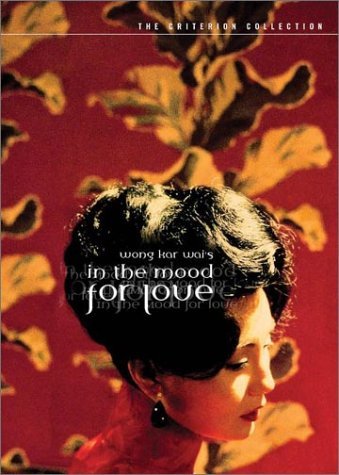
    DVD: In the Mood For Love - Criterion Collection

    In the Mood For Love - The Criterion Collection
    Directed by Wong Kar Wai

    There are many reasons to watch this film over and over again - although my personal favourite is watching Maggie Cheung (in cheongsum, with tiffin carrier) just sashay sashay to the soundtrack.

    Nerd that I am, I did not realise the Spanish music were from Nat King Cole. But of course Wong Kar Wai will inform you as much in the interview on Disc 2 of the Criterion Collection of this film.

    Did I mention Mr Wong does all his interviews with sunglasses on? Did his mother teach him nothing?

    While watching the Wong Kar Wai interviews, it struck me that if I didn't know better, Wong Kar Wai has the sort of face you wouldn't find very talented. In fact, he could be mistaken for a typical sweaty Mainland Chinese businessman in the "import-export" trade.

    I have been accused of being overly harsh on Ziyi Zhang in 2046. Perhaps I am. Ms Maggie Cheung is beautiful in this movie. It's incredible how she evolved from the buck-teeth little duckling she was in the 1980s to become the actress she is today.

    Books To Look Forward To In 2006

    David Foster Wallace's collection, Consider the Lobster : And Other Essays. His previous books were the kind of door-stoppers that's too thick for my consideration. I will always wonder what I could be doing with my life if I wasn't wasting it reading this thick, thick book. But this collection looks fun.

    A.M. Homes's new novel, This Book Will Save Your Life (April), tells the story of a self-sufficient stock trader struck with a crisis that teaches him how much he needs other people.

    Also in my to look out for basket (it's a small basket) - Sarah Water's Night Watch, coming out February.

    From Amazon.co.uk, the synopsis goes:
    Moving back through the 1940s, through air raids, blacked out streets, illicit liaisons, sexual adventure, to end with its beginning in 1941, The Night Watch is the work of a truly brilliant and compelling storyteller. This is the story of four Londoners - three women and a young man with a past, drawn with absolute truth and intimacy. Kay, who drove an ambulance during the war and lived life at full throttle, now dresses in mannish clothes and wanders the streets with a restless hunger, searching ...Helen, clever, sweet, much-loved, harbours a painful secret ...Viv, glamour girl, is stubbornly, even foolishly loyal, to her soldier lover ...Duncan, an apparent innocent, has had his own demons to fight during the war. Their lives, and their secrets connect in sometimes startling ways. War leads to strange alliances ...

    And what all this tells me is that Waters's not doing Victorian lit anymore. D'uh.

    Books I'm looking out for in paperback this year:

    A Plea for Eros: Essays by Siri Hustvedt
    Veronica by Mary Gaitskill
    The Year of Magical Thinking by Joan Didion

    Whitbread Award Winners 2005

    This is the second time that my vote for the Man Booker ends up winning the Whitbread Best Novel instead. The last time that happened was for Mark Haddon's The Curious Incident of the God at Night-Time. So it's a close miss, but am I good at my job or what? ;p

    From The Guardian
    Ali Smith beat Salman Rushdie, Nick Hornby and Christopher Wilson to the novel award with The Accidental, her first full-length novel, which had previously lost out to John Banville's The Sea in 2005's Man Booker prize contest. The judging panel, headed by novelist Philippa Gregory, described the story of 12-year-old Astrid, who is spending the summer with her family in Norfolk, as "a glorious work of fiction that inspired both laughter and sadness."


    All the Whitbread Winners:

    Novel: Ali Smith's The Accidental
    First Novel: Tash Aw's The Harmony Silk Factory
    Poetry Collection: Christopher Logue's Cold Calls
    Biography: Hilary Spurling's Matisse The Master
    Children's Book: Kate Thompson's The New Policeman

    Official Whitbread Site

    Wednesday, January 04, 2006

    Books: Kick-start 2006

    1. The Key by Junichiro Tanizaki

    Was looking for Diary of a Mad Old Man but it was out. So I picked up this little novel instead. Tanizaki is always reliable for stories with that perverted erotic twist.

    2. In Praise of Idleness: And Other Essays By Bertrand Russell

    Confession: I picked it up because the title seemed like a Slacker's Manifesto.

    I found Russell surprisingly readable - except when he goes on and on about Fascism and Socialism. But how can you not like a man who advocate a 4-hour work day so that we can have more leisure time to become more well-rounded people?

    3. Without Blood by Alessandro Baricco

    Synopsis:
    When—in an unnamed place and time — Manuel Roca’s enemies hunt him down, they fail to discover Nina, his youngest child, hidden in a hole beneath his farmhouse floor. And so, doing just as her father instructed, she neither speaks nor stirs as he is viciously slain above her hiding place. Only after this carnage will one of the murderers discover Nina’s trapdoor. But Tito, a mere boy himself, is so enthralled by the sight of Nina’s perfect innocence that he says nothing to his accomplices.

    By the time she has grown up, Nina’s innocence will have bloomed into something else altogether, and one by one the wartime hunters will become the peacetime hunted. But not until a striking old woman calls upon an old man selling newspapers in town — the old man Tito has become—can we know what Nina will ultimately make of her brutal legacy.

    A compact little book by Italian writer Alessandro Baricco. The story starts with the murder, and then we cut to the old newspaper seller and the striking old woman. Cutting back and forth, Nina's life story is told in bits. There are the facts of Nina's life that she had been unaware of, but known to Tito. In the process some parts of Nina's life is reconstructed in the narrative, and metaphorically, what we see of Nina's journey is not revenge but a lifelong search to make whole what was destroyed on the night of the murder of her family.