Saturday, September 01, 2007

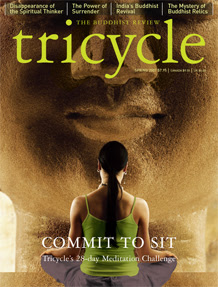
MEDITATION CHALLENGE | Day One

The mind - or the ego - always finds a way to sabotage our best intentions; I stayed in bed this morning just to avoid having to meditate. This meant I finally kicked myself out of bed around 10 am, when I'm usually up by 5 am.

I used to keep to a daily meditation schedule, twice a day, mornings and nights. It was one of those practice that made life and its ensuring chaos seem a little more manageable. Or maybe it just kept my emotions more manageable, and allowed me to deal with bad situations more intelligently.

Things have been feeling a little off-centre recently. I also noticed that the tiniest mishaps or rudeness from colleagues can set me off. Just showing up for yoga classes is not enough. I know I need to sit.

For the first week of the 28 Days Meditation Challenge, I'm supposed to meditate for 20 minutes, twice a day. I allowed myself to sit a little longer this morning because my mind kept drifting. I compared my state of mind this morning to the days when I still maintained a regular practice, and the difference is obvious: Instead of just observing my in-and-out breath, I started thinking about meditating and about the last episode of House I watched last night. My thoughts kept running away with me, and it took a while before I remember to rein them back to the breath. This 28 days will be more challenging than I had expected.

Let's hope tonight I will be more focused.

Friday, August 31, 2007

Making Time to Sit

Tricycle Magazine

A while back I mentioned my interest in taking up the 28 Day Meditation Challenge. That was way back in February and I haven't actually started on it.

Last night I decided to just get over the procrastination. Our lives are not going to be any less busy. Instead of wishing for more time, I'm making time to sit.

I've set 1st September 2007 as the day I start the 28 Day Meditation Challenge.

Thursday, August 30, 2007

Watching Taichi Videos

Jenclair was kind enough to post some taichi videos on her blog recently, after a certain pesky blogger pestered her about it. I finally managed to finish watching all the videos without my internet connection breaking up on me in mid-download.(Yay!) Jenclair said to look out for the last video, a performance by Vivian. It was nicely described as "Tai Chi. Woman in pink." on Youtube. Hee.

I'm not a taichi expert, but I thought Vivian was very graceful in the video. I replayed the video a few times, all the while paying close attention to her leg movements.

Why? Because Vivian made it look easy to move like that, and it's something I'm currently having difficulty with in my own yoga practice.

My weakest poses are balance poses. I often stumble, my legs start quaking and I fall out of poses. Often during transitions from one asana to another, I am awkward, stumbling a little.

There's a lot of legwork in my Shadow Yoga classes ― and some of them are similar to certain movements I saw on the taichi videos. My struggles with these legworks is pretty obvious to my teacher, J. Everytime we have to do the legworks, J. would turn to me and say: "Your favourite pose."

I think she knows I dislike and avoid doing legwork because they challenge me the most - which ironically is the reason why I need to do them more. To build up the strength in the inner thighs.

I am still in awe of the grace Vivian exudes in her taichi demonstration. It sets me thinking about the source of grace in life. Often in class, I would watch some of the more graceful yoga teachers in their own demonstrations, the way they move fluidly from one asana into another, like a dancer. Grace springs from a reservoir of strength - something that comes only with consistent practice, from consistent effort.

So often we look at someone like Vivian, and we think, "Wow. She's so good." We forget that she's probably worked hard to be so good. Yes, talent counts, but hard work is what makes the difference between potential and reality.

Then we look at personalities like Aung San Suu Kyi, and we admire her grace under great oppression, and we think, "If only we can be like her. If only we are so strong." Again, we forget: Their grace in the midst of great suffering comes from a source of inner strength. And then we need to ask ourselves, where do they find that kind of inner strength?

I believe, from consistent practice, from consistent effort.

Christmas Prezzies!

What I want for Christmas is a Happy Bunny Love and Revenge Voodoo Kit!

Comes with pins!

Tuesday, August 28, 2007

Closing on the Southern Reading Challenge

Southern Reading Challenge 2007

1. The Color Purple by Alice Walker
2. Confessions of a Failed Southern Lady by Florence King
3. Fried Green Tomatoes [Film]
4. Black Snake Moan [Film]

According to the rules of the Southern Reading Challenge, two films can replace one book, so technically I've finished the challenge. So, I'm officially done with the Southern Reading Challenge, which has led me to two GREAT books/authors - Alice Walker and Florence King.

Books and Films, Into the Wild

I picked up two of my library reservations this afternoon. Both titles have been adapted into films and I'm the sort of person who keeps an eye out for film tie-ins all the time.

The first was Nightwatch -- the Russian vampire-supernatural thriller by Sergei Lukyanenko. I saw the teaser posters for Daywatch at the local cinemas last weekend and I decided to throw Nightwatch into my R.I.P. II Challenge.
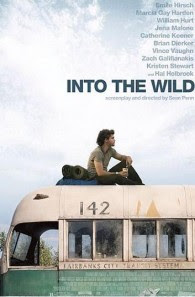
Movie poster for 'Into the Wild'

The other was Into the Wild, by Jon Krakauer. The recent interest was piqued when I was browsing a recent issue of Outside magazine, which was running a feature on the upcoming film adaptation of Krakauer's book. (Outside also run the original 1993 story Jon Krakauer wrote on Christopher McCandless for the magazine, available here)

Sean Penn wrote and directed the film. (The film is scheduled for a September release in the US.) There's some big names attached to the film: Vince Vaughn, William Hurt, Hal Holbrook and Catherine Keener.

I admit I was drawn to the romance of the subject. On September 1992, a decomposed body was found in an abandoned bus on a disused mining trail. The deceased had apparently died of starvation. He had no identification with him, and his journal chronicled a descent into sickness and slow death after 112 days alone in the wilderness.

When they finally identified the body, it revealed that he was Chris McCandless, a 24-year-old Honours graduate, star athlete, and beloved brother and son from a wealthy but dysfunctional East Coast family. He was something of a romantic, fond of Leo Tolstoy, Jack London and Thoreau. McCandless rechristened himself "Alexander Supertramp," cut all ties with his family, gave his trust fund to charity, and embarked on a two-year odyssey that brought him to Alaska, where he hoped to find his true self by renouncing society and living off the land. When he was found dead, his tale became something of a legend, an inspirational tale of an American solitary hero.

If you're interested in the film, here's the Into the Wild movie site

I was surfing the net earlier and via Worldhum, I came across a Men's Journal article by Matthew Power which doesn't quite buy into the romance of McCandless. Perhaps in our desire for a hero, some clever editing has been done to the real story.

From almost the moment he was found, the meaning of Chris McCandless's life and lonely death has been fiercely argued. The debate falls into two camps: Krakauer's visionary seeker, the tragic hero who dared to live the unmediated life he had dreamed of and died trying; or, as many Alaskans see it, the unprepared fool, a greenhorn who had fundamentally misjudged the wilderness he'd wanted so desperately to commune with. If the cult that has grown up around McCandless is any indication, we want the romantic portrait to be true: that he made a series of small mistakes that compounded in disaster. But the truth doesn't always conform to Hollywood's ideals.

Part of the argument against mythologizing McCandless was that the young man's death was essentially due to inadequate knowledge of living long-term in the wilderness and bad luck. As the native Alaskans know it: "the Alaska wilderness is a good place to test yourself. The Alaska wilderness is a bad place to find yourself." There were some who even suggested that McCandless might not have been in his right mind.

Powers also highlighted the difference between Sean Penn's film adaptation and Jon Krakauer's book:

But whereas Krakauer showed both sides of McCandless -- the hapless tenderfoot and the enlightened eternal seeker -- Penn presents only the latter version. His McCandless is almost Christlike. It is a deeply mythic take on a character who is largely a cipher. Clearly, in Sean Penn's eyes, Into the Wild is a story about something profound and universal in the human spirit, a longing for freedom and a pure connection to the natural world that's been lost.

There's obviously conflicting versions of the McCandless story in both book and film. From Matthew Powers' article, Sean Penn seems out to create a cult-hero, perhaps at the expense of objectivity. Or perhaps Penn just chooses to tell the story the way he read it. Each time a story is told, we add a bit of ourselves in the re-telling. One of the reasons I read travelogue is because it fulfills a yearning within myself. Like McCandless, and like Sean Penn, we look towards a wilderness that we believe calls out to us. It is real enough for us.

All these have not yet dampened my interest in the book or the film, but it does help remind me that non-fiction need not always be the truth, nor stories need to be true to be real. Meanwhile, I will see what meaning I can find from the pages of Into the Wild.

Shopping for NYRB Classics via Catalogue

Was looking through the new catalogue for NYRB Classics earlier this afternoon. Of course, when I say, "looking through" - I was shopping.

Other girls buy shoes and lingerie via catalogue, I buy books. ;p

Some of the forthcoming titles that's on my To Check Out List (All book descriptions from Amazon.com):

  1. Afloat by Guy De Maupassant
    Published February 19, 2008

    Afloat, originally published as Sur l’eau in 1888, is a book of dazzling but treacherously shifting currents, a seemingly simple logbook of a sailing cruise along the French Mediterranean coast that opens up to reveal unexpected depths, as Guy de Maupassant merges fact and fiction, dream and documentation in a wholly original style. Humorous and troubling stories, unreliable confessions, stray reminiscences, and thoughts on life, love, art, nature, and society all find a place in Maupassant’s pages, which are, in conception and in effect, so many reflections of the fluid sea on which he finds himself–happily but forever precariously–afloat. Afloat is thus a book that in both content and form courts risk while setting out to chart the meaning, and limits, of freedom, a book that makes itself up as it goes along and in doing so proves as startling and compellingly vital as the paintings of Maupassant’s contemporaries van Gogh and Gauguin.

  2. Alien Hearts by Guy De Maupassant
    Published February 19, 2008

    Alien Hearts, originally published as Notre coeur in 1890, was the last novel that Guy de Maupassant completed before succumbing to the effects of tertiary syphilis of which he was to die at forty-three. It is the most original and surprising of his novels and the one in which he attains a truly tragic perception of the wounded human heart. Alien Hearts is the story of three lovers bound by bitterness as much as passion. Maupassant’s artist hero falls for a woman of the world, a glacially dazzling beauty whose past with an abusive husband leads her to hold him–and everyone–at arm’s length. He seeks solace with his doting mistress, but remains racked by pointless infatuation. Richard Howard’s new English version of this complex and brooding psychological novel reveals the final, unexpected flowering of the great French realist’s art.

  3. The Post-Office Girl by Stefan Zweig
    Published April 15, 2008

    The post-office girl is Christine, who looks after her ailing mother and toils in a provincial Austrian post office in the years just after the Great War. One afternoon, as she is dozing among the official forms and stamps, a telegraph arrives addressed to her. It is from her rich aunt, who lives in America and writes requesting that Christine join her and her husband in a Swiss Alpine resort. After a dizzying train ride, Christine finds herself at the top of the world, enjoying a life of privilege that she had never imagined.

    But Christine’s aunt drops her as abruptly as she picked her up, and soon the young woman is back at the provincial post office, consumed with disappointment and bitterness. Then she meets Ferdinand, a wounded but eloquent war veteran who is able to give voice to the disaffection of his generation. Christine’s and Ferdinand’s lives spiral downward, before Ferdinand comes up with a plan which will be either their salvation or their doom.

    Stefan Zweig worked on The Post Office Girl, originally published as Rausch der Verwandlung in 1982, in intervals for more than twenty years. The manuscript of the book was found completed and awaiting only minor revisions after his suicide in 1941. Never before published in English, this extraordinary book is an unexpected and haunting foray into noir fiction by one of the masters of the psychological novel.

  4. Belchamber by Howard Sturgis
    Published April 22, 2008

    Afterword by E. M. Forster and introduction by Edmund White

    Charles Edwin William Augustus Chambers–Marquis and Earl of Belchamber, Viscount Charmington, and Baron St. Edmund and Chambers–known familiarly as Sainty, is the scion of an ancient English aristocratic family. Behind him stretches a rogues’ gallery of picturesque upper-crust scoundrels. But he is uninterested in going to hounds or drinking or whoring in the great tradition of his forebears, and though he sympathizes with his puritanical Scottish mother, he also lacks her unrelenting moral self-assurance. Sainty is instead a sensitive soul, physically delicate, sexually timid, intellectually inclined, deeply decent, and constitutionally incapable of asserting himself. When it comes to assuming the responsibilities of his inheritance, to managing his feckless younger brother Albert or fathoming his sly cousin Clyde, and, above all, to the business of marrying and continuing the family line, he hasn’t a prayer.

    Howard Sturgis, a Bostonian who lived most of his life in England, was close friends with Henry James and Edith Wharton. He wrote three novels, of which Belchamber is the finest. A brilliant, frequently hilarious satire of the English ruling class, it is also a powerful lament for individualism destroyed and innocence deceived. It is this that marks it, notwithstanding its English setting, as a profoundly American book and one of the overlooked triumphs of our literature.

Of course there's a few more titles to be released later next year, but these are the ones I have my eyes on.

Monday, August 27, 2007

MUSIC | Siouxsie Sioux is back

The Times interviews the high priestess of goth-punk-rock here.

If you're too young to remember Siouxsie and the Banshees, don't tell me! It'll only make me feel lousy about my age.

Meanwhile, sample the single, "Into the Swan" from her new abum, Mantaray via the "evil" of YouTube:

Mantaray, available in stores September 11, 2007. Or later.

Some online interviews

If some of you are thinking of reading Sigrid Undset's Norwegian epic, Kristin Lavransdatter this year, here's an interview with Tiina Nunnally, who translated some of Sigrid Undset's more important works. [Link via Imani]

From Worldhum, Frank Bures talks to Klara Glowczewska about the joys and challenges of translating the late Polish writer, Ryszard Kapuscinski. [Read it here.]

From the Salon.com archives (via Bookslut), a 1998 interview with Grace Paley, by A.M. Homes. [Read it here.]

Paley on not giving a shit:

I think one's freest almost at the beginning, when you really don't give a shit. And you have to watch that freedom and keep it. You must keep it. You can lose it. You have to keep not giving a shit. But, on the other hand, in ordinary life you're freer in talking up, saying what you think. You're freer in who you talk to. The only thing you're not freer in is yelling at your children. You have to stop at a certain point. Like when they're 35.

If you want to start reading Grace Paley, Literate Kitten recommends starting with Enormous Changes at the Last Minute.

I first read about Grace Paley from a issue of Oprah Winfrey's magazine. In an odd realisation of serendipity, I believe I bought that issue because Amy Bloom contributed an essay on Grace Paley, and she wrote so eloquently about Paley's short stories that Paley's name stuck to my head. Now would be a good time for me to start. Going online to check out the inventory at the local library.

Dear Universe,

I appreciate you sending great authors my way as a way of widening my reading horizon. However, I would appreciate it if you could also arrange for a large chunk of reading time in my schedule in the near future?

PS: I would still like to stay employed, of course.

Yours Sincerely,

Dark Orpheus

Perspective on Anton Ego and Critics

Anton Ego

In the movie Ratatouille, Peter O'Toole provides the gravelly voice for food critic and antagonist Anton Ego, whose scathing review for Gusteau's restaurant caused Gusteau to lose one of his 5-stars rating, and caused the chef to die of a broken heart.

(I'm smiling as I type it, because it's so cheesy but also funny.)

When Anton Ego first dropped in at Gusteau's restaurant, where Alfredo Linguini is gaining some fame as a chef to be reckoned with (with the help of Remy), there was a battle of wits between Alfredo and Ego:

Anton Ego: You're a bit slow for someone in the fast lane.
Linguini: And... you're thin for someone who likes food!
[Crowd gasps]
Anton Ego: I don't LIKE food, I LOVE it. If I don't LOVE it, I don't SWALLOW.

{INSERT JOKES ABOUT NOT SWALLOWING}

It's an exchange worth a few snickers, but it summed up Ego as a food critic who in his exacting pursuit for food excellence may have forgotten the simple pleasures of food itself. More on this later.

When Ego finally comes to the restaurant to dine and to hopefully to hammer the nail on the coffin of Gusteau's restaurant, he asks for "An order of perspectives." The waiter of course has no idea what Ego was talking about, so Ego just drolls that HE, Anton Ego, will provide the perspective. The chef will just need to give him "his best shot."

What little Remy decides to serve was a dish of ratatouille ― a surprising choice because it is a provincial dish ― not what you would expect to serve to impress a high-powered food critic who can make or break you.

This being a Disney/Pixar film, of course the poor farmer's dish of ratatouille was spectacular; the first bite brought Ego back to his childhood memory of his mother and her ratatouille. When I was watching this scene in the cinema, I was reminded of M.F.K. Fisher and why she writes about food, and how it all fits.

What little Remy served was exactly what Ego had asked for: perspective. What Ego finally wrote is moving and quote-worthy:

In many ways, the work of a critic is easy. We risk very little yet enjoy a position over those who offer up their work and their selves to our judgment. We thrive on negative criticism, which is fun to write and to read. But the bitter truth we critics must face is that, in the grand scheme of things, the average piece of junk is more meaningful than our criticism designating it so. But there are times when a critic truly risks something, and that is in the discovery and defense of the new. Last night, I experienced something new, an extraordinary meal from a singularly unexpected source. To say that both the meal and its maker have challenged my preconceptions is a gross understatement. They have rocked me to my core. In the past, I have made no secret of my disdain for Chef Gusteau's famous motto: Anyone can cook. But I realize that only now do I truly understand what he meant. Not everyone can become a great artist, but a great artist can come from anywhere. It is difficult to imagine more humble origins than those of the genius now cooking at Gusteau's, who is, in this critic's opinion, nothing less than the finest chef in France. I will be returning to Gusteau's soon, hungry for more.

I draw your attraction to Stephanie Zacharek’s Salon.com review for Ratatouille, specifically her response to Anton Ego's review:

Near the end of the picture, Ego has a speech that begins with a statement about the uselessness of critics, about the way they live for the experience of slapping things down instead of creating anything worthwhile themselves. The speech winds its way around to a more complicated revelation, about the importance of finding beauty and wonder in unexpected corners of our world. Still, I suspect many professional critics will take Ego's speech as a slap on the wrist, and people who hate critics -- you know who you are -- will feel they've received some juicy vindication.

But for me -- a person who writes about movies but doesn't make them -- Ego's speech rings completely true, and I can't read it as Bird's way of cutting down critics, of painting them as evil creatures who must be reformed. If anything, I wonder if he doesn't feel a kinship with them. Criticism, done right, isn't about destruction; it's about the pursuit of pleasure and delight and surprise, the seeking of both sensation and meaning, and sharing it with as many people as you can. At the end of "Ratatouille," I felt nothing but gratitude for the joy that Bird and his very large team -- doing work that I know is painstaking, time-consuming and extremely difficult -- were able to give me. Sitting down at the keyboard later, to work out the meaning of that pleasure, is my job. But the deep happiness I got from the movie itself is still my truest reward. I'd gotten the last bit of juice from every grape, and I couldn't ask for more.


Zacharek is one of my favourite film reviewer, and the main reason I still visit Salon.com. Besides her wonderful turn of phrase that marks her as a writer playful with language, her reviews consistently exude warm and personal engagement and joy. When I read her reviews, I sense a woman still in love with her job as critic — the antithesis of a jaded, elitist Anton Ego. Reviewers like Anton Ego do exist real-life. They have lost perspectives, forgetting the importance of joy in their jobs. They approach it with a kind of gloomy self-importance, symbolised by Anton Ego's coffin-shaped office. Sometimes, it takes a return to simple pleasures, like a ratatouille dish, to re-awaken their senses and why they came to their calling in the first place. But then again, isn't this true for everyone?

I find it interesting though, that in a moment of self-reflexivity, in the middle of a film review, Zacharek takes the time to address the role of her own role as a critic: "Criticism, done right, isn't about destruction; it's about the pursuit of pleasure and delight and surprise, the seeking of both sensation and meaning, and sharing it with as many people as you can."

That, I believe, is Perspective.

Sunday, August 26, 2007

FILM | Ratatouille

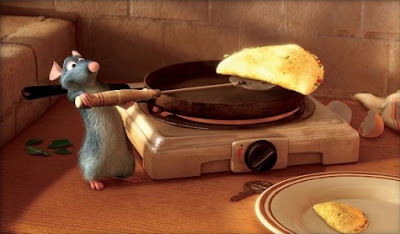
Remy making omelette

I am love with a cartoon rat that cooks.

Without a doubt, Ratatouille has made it as my favourite movie of 2007. It is basically a simple (if outlandish) story told with humour and heart: a rat, Remy, with a highly developed sense of taste and smell who wants to call. His inspiration is the deceased formerly 5-stars rated chef, Gusteau, who wrote the book, Anyone Can Cook, and who appears as a spiritual guide, offering pep-talks to this little rodent chef with big dreams. Through some incident that separated him from his rat family, he arrives in Paris, in the Gusteau's restaurant where he meets the inept kitchen boy, Alfredo. By some chance rat and boy realise Remy can teach Alfredo how to cook by some feat of puppetry on the boy's body (It's outlandish, yes, but it's a cartoon and it's so fun you just suspend disbelief.)

Through the talents of the little rat the restaurant is brought back to it glory days. In between they have to battle the villian of head chef Skinner, the health inspector and finally, the most powerful food critic Anton Ego, voiced by the majestic Peter O'Toole.

It's a beautiful picture, with the city of Paris rendered in subtle palette of dreamy nostalgia. It's also chocked full of little details that catches you ― like the scene when the rats take over the kitchen, one of the rats was boxing a piece of meat to tenderize it, or Anton Ego's coffin-shaped office, or the oven mitten Remy sleeps in in Alfredo's dingy apartment.

Visually the film is so well-made, it's addictive. The animators have obviously spent some time observing the scamperings of rodents, their leaps and bounds and little ratty gestures.

Remy himself is just adorable, with his pink bulb of a nose, with those big expressive eyes. The animators have gifted him with the cutesy gestures ― the little nods, the modest shrug when Alfredo first asks him if he could cook, the way his cheeks just droops a little so that his mouth is more expressive. Most of all, there is that child-like dreamy look everytime he looks out at the view of Paris and all that the city promises for someone who dares to dream.

And the way he walks, on two legs in a kind of swagger, almost like John Travolta ― if John Travolta was a rat. Or if Saturday Night Fever was about cooking rather than dancing.

Can you just tell how besotted I am with this little rat?

I suspect I will be watching Ratatouille again further down the weeks. It will definitely be one of my DVD purchases. It is a picture for children and adults to enjoy, and it is all about a little rat who don't want to settle for eating garbage, and who is given an extraordinary talent, and goes all out to be what he can be.

Near the end of the film, Anton Ego, the jaded antagonist food critic realises a rat has cooked the best meal he had ever eaten. And he wrote this:

In the past, I have made no secret of my disdain for Chef Gusteau's famous motto: Anyone can cook. But I realize that only now do I truly understand what he meant. Not everyone can become a great artist, but a great artist can come from anywhere. It is difficult to imagine more humble origins than those of the genius now cooking at Gusteau's, who is, in this critic's opinion, nothing less than the finest chef in France. I will be returning to Gusteau's soon, hungry for more.

"Not everyone can become a great artist, but a great artist can come from anywhere."

I love that little rat with the pink bulb nose.

COMICS | Fallen Angel: Back In Noire

I just finished Fallen Angel: Back In Noire by Peter David, J.K. Woodward & Kristian Donaldson. While reading it, I realise I missed volume 2 of the IDW run of the Fallen Angel series, so there were some minor plot details that I'm clueless about.

BACKGROUND TO THE SERIES:

Fallen Angel: Back In Noire is the third installment of the IDW run of Peter David's graphic novel series about Liandra "Lee", the Fallen Angel. She is a sort of superheroine in the city of Bete Noire, "the city that shapes the world". As the back story was revealed in Fallen Angel: To Serve In Heaven, she was a former guardian angel (of the heavenly sort, with wings and all) who fell from the grace of God and found herself as the Court of Last Resort for the desperate in Bete Noire. She has the power to enforce her will, but all who comes to her are subjected to her judgement. She may help you if she finds your cause worthy, but she will just as soon hasten your end if she deems it so.

According to Lee, God has no say over the city of Bete Noire. Instead, it is ruled over by The Hierachy, through the power of the Magistrate. The Magistrate has dominance over everything within Bete Noire. It is a position passed from father to first-born son, and a ritual is performed on or after the son's 18th birthday to seal the transfer of power. Bete Noire is later revealed to be the Biblical city of Enoch, and the Magistrates are direct descendants of the city's founder, Cain.

The Magistrate bears the mark of Cain and none may harm the Magistrate. All injuries attempt on the Magistrate shall rebound unto the perpetrators. While the position protects the Magistrate, it also bounds him to the city. One day of every year, The Magistrate is allowed a "day off" ― the only time he is allowed to leave the city, which possesses a sentience of its own. On top of that, the Magistrate is cursed with the constant voices of the city, which he cannot blockout and causes him unending suffering.

BACK IN NOIRE

Last we left off, Lee's son, Jude, had taken over as the Magistrate of Bete Noire. Jude is a priest and he still wears the collar. He is new to the city and he believes he can use his power for good, not realising the corrupting influence of his new position.

Back In Noire explores Jude's new role as Magistrate, and how it creates a conflict of interest with Lee when Jude arrests the local drug lord, Asia Minor, and placed him on trial. Lee on the other hand, needs Asia Minor's help to save a man's life. The story is resolved a little too conveniently, but it has Jude compromising his ethics for a way to end the incessant voices in his head. He has taken the first step to condemning himself, and it is hinted that darker factions are waiting on the sidelines. And they are patient.

Fallen Angel has a great backstory ― rivalries between agents of divine and mystical powers, as well as an interesting protagonist with perpetual PMS. The story opens with a vampire-like attack, and the Fallen Angel makes her entrance with these earth-shattering lines:

It's nearly sunrise.

I haven't slept in two days.

And I've got cramps.

I am so not in the mood for this shit.

Even when Jean Grey was the Dark Phoenix and threatening to destroy earth, you still wouldn't catch her admitting to cramps.

Lee is something of a reluctant heroine, as you can tell. Unfortunately, Fallen Angel still only has something of a cult following only, and I truly believe it deserves a wider readership. Perhaps not everyone has patience with a comic series that takes time to unfold little backstories and drop small hints of future things to come.

Fallen Angel even has a premise similar to Garth Ennis's Preacher on the subject of divinity. When Jude asks Lee why Evil exist, she replies that God wants to die. Humanity was intended to be God's crowning achievement, and God was prepared to move on after its creation. However, the constant prayers of people on Earth prevent him from being able to do this. For centuries, God has been sending disasters to Earth in the hope that people will stop believing in Him and let Him pass. It is an interesting concept ― not to mention daring. It is also one of the reasons why Peter David remains one of the more interesting writers around.

Finally, Back In Noire has a second story where Lee's predecessor ― a young girl named Lin ― returns to Bete Noire. It develops the idea further of the sentience of the city, as well as explore a story of the darker history of the city. A long time ago, the Magistrate one day decides to neglect his duties. This power vaccum led to the emergence of newer factions, and the Fallen Angel (Lin) arrived as a balancing force.

SUM UP

On the whole, the stories in Back In Noire are not as strong as the first volume, To Serve In Heaven, and I don't think there was much explored in the conflict of interest between Jude and Lee ― although there was some freaky incestuous stuff happening between Jude's half-brother, Jubal and Jubal's mother. The stories seem to serve only as fillers in the on-going power struggle for dominance of Bete Noire, but weak plot, and little forward movement in the storylines. And they probably will not make sense unless you are already a Fallen Angel fan.

Saturday, August 25, 2007

Reviews Coming in for Amy Bloom's Latest


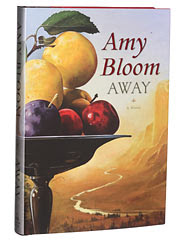
The reviews are coming in for Amy Bloom's new novel, Away. Here's one from The Guardian, another from The New York Times, and from The Washington Post.

Even Lionel Shriver has something to say about Amy Bloom:

The pleasures of "Away" are the ordinary pleasures of extraordinary novels: finely wrought prose, vivid characters, delectable details. There's a soft-smile, along-the-way humor. A business card condenses one character's whole frustrated life: "Yaakov Shimmelman / Tailor, Actor, Playwright / Author of The Eyes of Love / Pants pressed and altered." Having been given a thesaurus to help her learn English, Lillian tends to think in synonyms -- as when Meyer is late for their first rendezvous: "It is rude (crass, inelegant, uncouth, and also lacking in social refinement)." Employed deftly and never overused, the device is charming.

Not that I need any critics or reviewers to convince me to look out for her latest book. I'm an Amy Bloom fan since I first read her short story collection, Come to Me. (How I came to pick up Come to Me though, is another story.) Her writing is sparkling, and her characters raw with yearnings and insecurities - yet there is a palpable compassion in Bloom's prose, an understanding, and forgiveness of human vunerability. Amy Bloom makes me feel the grief and heartaches of characters caught in situations I have never been before, and that is the most powerful sort of writing around - the power to create empathy.

Homer Shook the World

Homer's the "Iliad and the "Odyssey" by Alberto Manguel

This is one of the forthcoming titles in the "Books That Shook the World" series that I'm interested in: Alberto Manguel analysing The Homeric classics. I'm not even sure why I'm looking at it when I have not tackled the Homeric epics yet. Probably because of the nifty "H" on the cover.

Friday, August 24, 2007

Strangers in Paradise 19: Ever After

So this is ever after. It's been a while, but we are finally at the end.

I first picked up Terry Moore's Strangers In Paradise series when I was 18, I think. I can't even begin to describe the story, because Terry Moore has chocked it full of plot twists and entanglements. The plot was totally unbelievable, yet the characters are so raw and likeable that I just kept reading.

Katchoo as Power Girl, but without the boobies, because SIP was never meant to be that sort of comic with women of impossible bosoms

There is this girl, Katina "Katchoo"" Choovanski and her best friend from high school, Francine Peters. Then there is this guy, David Qin, who is sort of in love with Katchoo, but Katchoo is sort of in love with Francine. Oh, and Francine has problems - she desperately wants to find The Right Guy, get married, have children - but her taste in men sucks. So one day her boyfriend cheats on her, and Katchoo steps in and threatens to castrate Francine's cheating beau. It was funny, and there's always humour in Terry Moore's comics. There's friendship, love, loyalty and heartbreaks. But always you know they will come through for each other.

In between, Katchoo gets dragged off to jail, where her shady past as a high-class prostitution for a high powered mafia group comes up (the plot is unbelievable, really, but so Over The Top that it's entertaining in its own way)

The series finally ended with volume 19 of the trade paperback. I have been with Katchoo, Francine and David for 13 years. The ending is tied up with a big pink bow and it ends well for most of the characters, even Tambi, who finally allowed herself a human side. Is it satisfying? There were moments in the past few years when it seemed like Terry Moore was really going to end the story with Katchoo heart-broken. Instead he continued, writing about how Katchoo, with the help of David and their friend Casey, found her way to healing through her painting.

For more than a decade I followed Terry Moore's characters, his ridiculous plots - I even considered having a tattoo like Katchoo's on my body. Why? Because Strangers In Paradise is a story of how we come to Paradise, lost, unsure, and someone is there to hold our hand, to guide us through a beautiful place where we need not be afraid. It reminds us that love will guide us.

My ex used to call me a "Katchoo", because of my anger. But over the years I find myself more a Francine, an insecure girl who just wants to be loved - but is somewhat obtused about love. Or maybe even a David, who loves whole-heartedly, even though he knows he will never be the One True Love of the object of his affections. I can even see a Tambi in me - a strong, formidable character who enjoys scaring people. I guess I love Strangers In Paradise, because I am a composite of all of the characters. I am a Stranger In Paradise.

Yet Another Meme

I stole a meme off Stefanie.

List some of your favorite words:
Languid. Robust. Vigour. Bombastic. Boobies. Oooh-la-la. Romp. Blob.

And my all time favourite: Gayatri Chakravorty Spivak. Yes, it's a name. But try saying it out loud six times and feel her name roll on your tongue.

What’s your favorite maxim or proverb?
"A broken heart is an open heart."
~ Gretel Ehrlich

What’s your favorite quotation?
I can't limit it to one.

"Must then a Christ perish in torment in every age to save those that have no imagination"
~ George Bernard Shaw, Saint Joan

"Passion will work in the fields for seven years for the beloved and on being cheated work for seven more, but passion, because it is noble, will not long accept another's left-over."
~ Jeanette Winterson, The Passion

What’s your favorite first line of a novel?
"Why is the measure of love loss?"
~ Jeanette Winterson, Written on the Body

Give an example of a piece of description that’s really pleased you in your reading lately:
"Red is the most joyful and dreadful thing in the physical universe; it is the fiercest note, it is the highest light, it is the place where the walls of this world of ours wear thinnest and something beyond burns through. It glows in the blood which sustains and in the fire which destroys us, in the roses of our romance and in the awful cup of our religion. It stands for all passionate happiness, as in faith or in first love."
~ G.K. Chesterton, The Red Town

Okay, this isn't from my recent reading, but everytime I read it I feel good.

Guess what's my favourite colour?

Which five writers do you particularly admire for their use of language?
Carol Ann Duffy, Michael Ondaatje, Mary Oliver, Jeanette Winterson and G. K. Chesterton

(I named 3 poets – 4 if you include Chesterton, who has written some verses too. I always consider Ondaatje a poet who happens to write the occasional novels)

And are there writers whose style you really dislike?
Dan Brown. Dan Brown. Dan Brown.

What’s the key to really fine writing, in your opinion?
Wit and passion, with a strong self of self-awareness. Words that inspire and make me feel.

You think you feel like doing this? Please go ahead.

Thursday, August 23, 2007

CHALLENGE | Readers Imbibing Peril II


For the R.I.P. II Challenge, I'm going to go low-key. I will be undertaking Peril the First - which just requires me to read 4 books of any length, from any subgenre of scary stories that you choose.

So, the goal is to read at least 4 books from this list:

  1. Baltimore,: Or, The Steadfast Tin Soldier and the Vampire by Mike Mignola & Christopher Golden
    Mike Mignola is one of my favourite artist/comic writer. I loved the moody starkness of his signature artwork, which just brings out his well-researched tales of monsters and supernatural terrors. I have the hardcover of this illustrated novel sitting at my desk right now. Come 1st September I will purchase it and read it.
  2. Hellboy: The Troll Witch and Other Stories by Mike Mignola, P. Craig Russell & Richard Corben
    This is supposed to be published in October, but let's see if I can throw it in. Hellboy is my hero. A demonspawn, a Prince of Hell summoned by the Nazi to bring about the Apocalypse, he grew into his own man. The two round stumps on his forehead are the stumps from his broken hell-horns - horns that he broke off in declaration of his own Free Will, against his demonic destiny. I love my Hellboy.
  3. The Stress of Her Regard by Tim Powers
    Had wanted to read this earlier this year, but just never got around to it. A historical fantasy starring the Romantic poets Keats, Byron and Shelley. Now, where did I put that book?
  4. 30 Days of Night by Steve Niles & Ben Templesmith
    Vampires visit a far northern Alaskan town that experience 30 days of continuous nights. Blood. Murder. Mwhahaha!
  5. The Last Wish by Andrzej Sapkowski

    This is a new Polish author I picked up from the bookstore. I know very little about him but the synopsis at the back looks interesting:

    Geralt was always going to stand out, with his white hair and piercing eyes, his cynicism and lack of respect for authority ... but he is far more than a striking-looking man. He's a witcher; his sorcerous powers, enhanced by elixirs and long years of training, have made him a brilliant fighter and a merciless assassin. ...

    In his role as guardian of the innocent, Geralt, the witcher from Rivia, meets incestuous kings with undead daughters, vengeful djinns, rancorous maidens, shrieking harpies, love-lorn vampires and despondent ghouls. Many are pernicious, some are wicked, and none are quite as they seem.

  6. Angelica by Arthur Phillips

    I've been eyeing this title for s while now. Since I managed to get my paws on a library copy this week, I think I shall add it to the list. From the New Yorker:

    Phillips’s third novel, set in Victorian London, starts as a ghost story. When Joseph instructs his wife, Constance, to have their four-year-old daughter, Angelica, moved from their bedroom into a room of her own, Constance becomes convinced that a seductive spectral force is preying on the child. The catastrophe that follows is relayed from the perspectives of Constance; of her supposed redeemer, an actress turned exorcist; and of Joseph—each view ultimately being rendered by the adult Angelica. What at first appears a rather glib ghost story predicated on Victorian clichés of sexual repression and patriarchal tyranny turns into a spectacular, ever-proliferating tale of mingled motives, psychological menace, and delicately told crises of appetite and loneliness. Phillips sustains a pastiche of Victorian writing and ideas with enticing playfulness, and without making his characters or their complex fears and desires laughable


As usual, I may add to this reading list when something interesting comes along. And if I can squeeze it in, I shall attempt Dracula by Bram Stoker.

Challenge is from 1st September 1st ~ 31st October 2007.

Also visit R.I.P.ing Yarns: The Official R.I.P. II Review Site.

CHALLENGE | Unread Authors Challenge 2007/08

So. Into the fray.

I'm officially signing up for the Unread Authors Challenge organised by Pour of Tor.

From 1 September 2007 to 28 February 2008, participants strive to read six books by authors they have never read before. It's flexible, where you can read multiple works by the same authors, or one book each by six authors.

My reading list:

  • Sigrid Undset, Kristin Lavransdatter
  • Italo Svevo, Zeno's Conscience; As a Man Grows Older
  • Janet Frame, Owls Do Cry
  • Freya Stark, The Southern Gates of Arabia
  • May Sarton, Journal of a Solitude
  • Malcolm Lowry, Under the Volcano
  • Djuna Barnes, Nightwood
  • Radclyffe Hall, Well of Loneliness
  • Dervla Murphy, One Foot in Laos
  • Ryszard Kapuscinski, Travels with Herodotus

Yes, there's overlap with my other challenges. Call me "Butter" and watch me spread myself so very thin. ;p

Wednesday, August 22, 2007

Crossing the Street

"I have lost friends, some by death... others through sheer inability to cross the street." Virginia Woolf, The Waves


I went to Hanoi, Vietnam towards the end of 2004 with my friend, Angela.

I had known Angela since we were fifteen. A lot of things happened in between and we lost touch for several years, until the middle of 2004. I was re-examining my life and I had decided to see if I could renew some old friendships that I had allowed myself to lose through neglect or misplaced pride.

The Hanoi trip was relaxed and we talked. A lot. We had a lot of catching up to do for my six years absence. I think we have never been so honest with each other until the Hanoi trip. I finally told her the reason I walked away from our friendship, and why I had decided to come back. Angela listened, and I think she understood.

As she told me about her new married life, I was happy for her. The couple (Angela and her husband) make it a point to visit their parents and grandparents at least once a week for dinner ― no matter how busy they were, even if it meant sacrificing time alone with each other. They could see that their weekly dinners meant a lot to their parents and grandparents than just a meal - for parents and grandparents, it was the highlight of their week. It was about family.

That she could see this so clearly, reminded me of why we became friends. I always thought of Angela as a better person than me. She was motivated, intelligent, honest, generous and kind. (Well, she was also the one who highlighted all the dirty bits in Lady Chatterley's Lover for me back in school. ;p) Life has rewarded her with a husband who loves and respects her ― and who is willing to take care of her family with the same love and concern.

I am glad to have her back in my life, and grateful that she was willing to have me back as a friend.

The truth is, Angela and I were planning for a Sri Lanka trip in December 2004. There were some nice beaches in Sri Lanka, and I was seduced by the brochures of sea and sand.

But when we went to the travel agent, we were told return flights from Sri Lanka are only available after Christmas. So, if we choose to go to Sri Lanka, we will have to spend Christmas in the exotic Buddhist country with the lovely beaches.

I was okay with spending Christmas in Sri Lanka. Then I noticed Angela was hesitant. She told me plainly that she would prefer to spend Christmas back home with her family. So we changed our travel plans for Hanoi instead. As I have mentioned earlier, we enjoyed ourselves in Vietnam. I fell in love with the people and the culture. I will definitely be returning to Hanoi in the near future.

We came back from Hanoi happy. Spent Christmas with our families. And woke up one day to the Asian Tsunami that struck the region on Boxing Day. Sri Lanka was one of the countries affected by the tsunami.

A few weeks later I was at Angela and her husband's place for a gathering. She asked me then: If we have gone to Sri Lanka instead, would we have been caught in the tsunami?

"Duh. Yes," I told her. I reminded her there was no return flights until after Christmas. Angela was pensive for a moment, then she just shrugged.

What was not mentioned was that we skipped Sri Lanka because Angela had wanted to spend Christmas with her family. That she made holidays with family a priority was the real reason we were not caught in the tsunami, and perhaps the reason we were both still alive today.

When I talk about my friend, Angela, I like to tell people about how we escaped the tsunami. Of course, I might have dramatised it a little. This however does not diminish the admiration I have for Angela and how she has always been able to see the truly important things in life ― her family, her husband, her friends.

In my previous life, I have walked away from friends, and sometimes I lose them through neglect and inability to stay in touch ― the "sheer inability to cross the street" as Woolf puts in. I have had regrets, even as I admit there are some relationships that proved toxic and I am better without them.

Our friendship should nurture the best in us, help us grow as a person. A friend like Angela reminds me I should be spending more time with my family. Her presence is also a reminder of how important it is to listen without judgement. There is a difference between indifference and non-judgement ― I have often noticed the former is mistaken for the latter.

One night in Hanoi, Angela and I were having dinner in the exquiste Green Tangerine. Then Angela asked how have I been these past few years. I replied I don't think I have ever felt better about my life.

"Yes," she nodded. "You seem more at peace these days."

"Really?"

"You're not as angry anymore."

It came at a time when I wondered if anything I did to change my life made a difference. It was nice that Angela was one of those who noticed.

Sigh

I have deleted some of my earlier posts on my amateur Bookmooch experience. I have recently redefined my criteria for overseas postage: I will only send to overseas (overseas from Asia) moochers who do the same. As the shipping cost is at my end, I thought it is only fair I ship to those who are willing to "pay it forward." I started off with an assumption of fair-play. I have since realised how my assumption is tainted with self-righteousness.

I have emailed some experienced Bookmoochers recently on the Bookmooch system. They have been very helpful and they helped highlight some issues that I have been too short-sighted to see.

A lot of people with moderate/limited income come to Bookmooch as a way of saving money on books. They do not ship overseas because they may not be able to afford to do so on a long term basis. There are many reasons why people are not willing/or able to ship overseas - or they might be willing to ship, but they would prefer to be asked first.

I seem to have stepped too fast into something I was not prepared for. I think I made a few mistakes and I stepped on some toes in my ignorance. I handled the situation badly. Suddenly I feel this Bookmooch was a mistake and I should stop.