Monday, December 18, 2006

100 Books To Read 2006 Version 4.0


  1. The Names of Things:
    Life, Language, and Beginnings in the Egyptian Desert
    Susan Brind Morrow
    [02/12/2006 ~ 16/12/2006]

  2. In Search of Lost Time Marcel Proust
    Swann's Way
    translated by Lydia Davis
    [11/07/2006 ~ 09/08/2006]
    In the Shadow of Young Girls in Flower
    translated by James Grieve
    [09/08/2006 ~ 16/09/2006]
    The Guermantes Way
    translated by Mark Treharne
    [16/09/2006 ~ 09/12/2006]
    Sodom and Gomorrah

    The Prisoners & The Fugitive

    Finding Time Again

  3. No God But God:
    The Origins, Evolution, and Future of Islam
    Reza Aslan
    [11/11/2006 ~ 04/12/2006]

  4. A Moveable Feast Ernest Hemingway
    [08/11/2006 ~ 16/11/2006]

  5. Trieste and the Meaning of Nowhere Jan Morris
    [03/10/2006 ~ 28/10/2006]

  6. Master and Margarita Mikhail Bulgakov
    translated by Richard Pevear & Larissa Volokhonsky
    [12/09/2006 ~ 03/10/2006]

  7. Fast Food Nation Eric Schlosser
    [17/08/2006 ~ 12/09/2006]

  8. The Moonstone Wilkie Collins
    [27/07/2006 ~ 23/08/2007]

  9. The Snow Leopard Peter Matthiessen
    [01/06/2006 ~ 10/07/2006]

  10. Invisible Cities Italo Calvino
    [27/06/2006 ~ 09/07/2006]

  11. The Road to Oxiana Robert Byron
    [07/06/2006 ~ 25/06/2006]

  12. The Pure and the Impure Colette
    [12/06/2006 ~ 24/06/2006]

  13. His Dark Materials Philip Pullman
    Book I: The Golden Compass
    [26/05/2006 ~ 29/05/2006]
    Book II: The Subtle Knife
    [29/05/2006 ~ 31/05/2006]
    Book III: The Amber Spyglass
    [31/05/2006 ~ 12/06/2006]

  14. Love in the Time of Cholera Gabriel Garcia Marquez
    [26/05/2006 ~ 09/06/2006]

  15. Praise of Folly Desiderius Erasmus
    [29/05/2006 ~ 05/06/2006]

  16. The Year of Magical Thinking Joan Didion
    [11/05/2006 ~ 15/05/2006]

  17. Madame Bovary Gustave Flaubert
    [14/02/2006 ~ 13/05/2006]

  18. Beyond Belief Elaine Pagels
    [09/05/2006 ~ 12/05/2006]

  19. Istanbul : Memories and the City Orhan Pamuk
    translated by Maureen Freely
    [05/05/2006 ~ 09/05/2006]

  20. Natasha's Dance Orlando Figes
    [26/02/2006 ~ 07/05/2006]

  21. Death In Venice Thomas Mann
    [09/04/2006 ~ 26/04/2006]

  22. Dhammapada
    [22/04/2006 ~ 23/04/2006]

  23. Wanderlust Rebecca Solnit
    [09/04/2006 ~ 22/04/2006]

  24. The Quiet American Graham Greene
    [28/03/2006 ~ 01/04/2006]

  25. Book of Five Rings Miyamoto Musashi
    [12/01/2006 ~ 28/03/2006]

  26. Letters To A Young Poet Rainer Maria Rilke
    [17/03/2006 ~ 18/03/2006]

  27. To Kill A Mockingbird Harper Lee
    [12/03/2006 ~ 15/03/2006]

  28. Master And Commander Patrick O'Brian
    [04/03/2006 ~ 08/03/2006]

  29. Kim Rudyard Kipling
    [16/02/2006 ~ 23/02/2006]

  30. Break, Blow, Burn Camille Paglia
    [25/12/2005 ~ 09/02/2996]

  31. The Night Watch Sarah Waters
    [26/01/2006 ~ 29/01/2006]

  32. The New York Trilogy Paul Auster
    [07/01/2006 ~ 16/01/2006]

  33. The Deptford Trilogy Robertson Davis
    [03/12/2005 ~ 14/01/2006]

  34. Meditations Marcus Aurelius
    [30/12/2005 ~ 05/01/2006]

  35. Fruits of the Earth Andre Gide
    [01/01/2006 ~ 05/01/2006]

  36. The Burial at Thebes: Sophocles's Antigone
    translated by Seamus Heaney
    [26/12/2005 ~ 26/12/2005]
    & The Three Theban Plays: "Antigone","Oedipus the King","Oedipus at Colonus"
    translated by Robert Fagles
    [26/12/2005 ~ 31/12/2005]

  37. The Prophet Khalil Ghibran
    [26/12/2005 ~ 30/12/2005]

  38. Taras Bulba Nikolai Gogol
    [17/12/2005 ~ 26/12/2005]

  39. Twenty Love Poems and A Song of Despair Pablo Neruda
    [09/12/2005 ~ 10/12/2005]

  40. The Four Quartets T. S. Eliot
    [01/12/2005 ~ 09/12/2005]

  41. A Room of One's Own Virginia Woolf
    [25/11/2005 ~ 03/12/2005]

  42. Oranges Are Not the Only Fruit Jeanette Winterson
    [23/11/2005 ~ 25/11/2005]

  43. The Claudine Novels Colette
    [22/07/2005 ~ 30/08/2005]

  44. Death and the Dervish Meša Selimović
    translated by Bogdan Rakić & Stephen Dickey
    [17/11/2006 ~

  45. Yogasutra of Patanjali

  46. Dracula Bram Stoker
    [25/10/2006 ~

  47. The Black Book Orhan Pamuk
    [17/10/2006 ~

  48. War and Peace Leo Tolstoy
    translated by Anthony Briggs
    [18/06/2006 ~

  49. Stories Anton Chekhov
    translated by Richard Pevear & Larissa Volokhonsky
    [11/08/2006 ~

  50. New Annotated Sherlock Holmes Arthur Conan Doyle
    Volume I:
    [29/05/2006 ~

  51. Don Quixote Miguel De Cervantes
    [26/01/2006 ~

  52. Maximum City Suketu Mehta
    [29/04/2006 ~

  53. Moby Dick Herman Melville
    [12/07/2005 ~

  54. A Crack in the Edge of the World : America and the Great California Earthquake of 1906 Simon Winchester

  55. Anna Karenina Leo Tolstoy

  56. The Idiot Fyodor Dostoevsky

  57. The Double and The Gambler Fyodor Dostoevsky

  58. Steppenwolf Herman Hesse

  59. Norwegian Woods Haruki Murakami

  60. The Claudius Novels Robert Graves

  61. Nightwood Djuna Barnes

  62. Perfume Patrick Suskind

  63. The House of Mirth Edith Wharton

  64. The Iliad Homer

  65. The Heart Is a Lonely Hunter Carson McCullers

  66. The Valleys of the Assassins and Other Persian Travels Freya Stark

  67. The Wings of the Dove Henry James

  68. Great Expectations Charles Dickens

  69. Of Human Bondage W. Somerset Maugham

  70. Jane Eyre Charlotte Bronte

  71. A Fine Balance Rohinton Mistry

  72. Midnight's Children Salman Rushdie

  73. The Sun Also Rises Ernest Hemingway

  74. Memoirs of Hadrian Marguerite Yourcenar

  75. The Three Musketeers Alexandre Dumas

  76. Complete Father Brown G. K. Chesterton

  77. Captain Alatriste Arturo Perez-Reverte

  78. Lolita Vladimir Nabokov

  79. The Myths Boxset: "A Short History of Myth," "The Penelopiad" & "Weight" Karen Armstrong, Margaret Atwood & Jeanette Winterson

  80. The House of the Seven Gables Nathaniel Hawthorne

  81. Blindness Jose Saramago

  82. Jonathan Strange & Mr Norrell Susanna Clarke

  83. The Complete Short Novels Anton Chekhov

  84. Unbearable Lightness of Being Milan Kundera

  85. Fall on Your Knees Ann-Marie MacDonald

  86. Guns, Germs and Steel Jared Diamond

  87. Art of War Sun Tzu

  88. Seven Storey Mountain Thomas Merton

  89. Stiff Mary Roach
  90. Bury My Heart At Wounded Knee Dee Brown

  91. A History of God Karen Armstrong

  92. The Places that Scares You Pema Chodron

  93. The Histories Herodotus

  94. Bhagavad Gita

  95. An Autobiography: The Story of My Experiments with Truth Mohandas Gandhi

  96. Saint Francis of Assisi G. K. Chesterton

  97. From the Holy Mountain William Dalrymple

  98. The Collected Tales of Nikolai Gogol Nikolai Gogol

  99. Dead Souls Nikolai Gogol

  100. Orlando Virginia Woolf


P/S: The 100 Books To Read List for 2006 has been amended from time to time. Hence, Version 4.0. If anyone is interested, the original list is available here.

Sunday, December 17, 2006

Screenshot from Pirates of the Carribean 3


Hey, look. It's Chow Yun Fat as the the pirate from Singapore in the third Pirates of the Caribbean!

You look bad, man. What has Hollywood done to you!

Saturday, December 16, 2006

BOOKS | Penguin Designer Classics

Re-covered... (from left) Fuel's Dostoyevsky in brown craft paper, Ron Arad's stripped-down binding for The Idiot, Paul Smith's Lady Chatterley's Lover in silk, Manolo Blahnik's saucy Madame Bovary and Sam Taylor-Wood's moody design for Scott Fitzgerald

Recently in our local newspaper, the Books Journalist finally ran a story on the Penguin Designer Classics. In commemoration of their 60th anniversary, Penguin Classics invited 5 designers to give some of their literary works a cover make-over.

We've been selling the Penguin Designer Classics for a while now. The publicity for the Penguin Designer Classics has also been running for a while now. The Guardian ran a feature way back in October this year. It does say something about how slow to respond our local newspaper is in general.

But what annoys me is that the local Books Journalist chose to zero in on the price angle of the Designer Classics. She even quoted the auction price on eBay for some of the Designer Classics, as well as mention how customers are entitled to 20% discount because of our Christmas sale right now. It is as though the most important aspect is about the price. What about the whole aesthetic aspects of this collection? There is something crass about the feature, and it attracted the readership it deserves.

Before the feature in the local newspaper, the sales of the Penguin Designer Classics in the bookstore has been limited to mainly serious book collectors. They are in the know about the Penguin Designer Classics, either though the internet or otherwise. Then the news broke on how you can make a profit on eBay on the Designer Classics, suddenly the bookstore where I work is flooded with customers who do not care what titles we have left. They don't care about the book. They also want to know the serial number of the sets we have, as they want lucky numbers.

I would have preferred it if the Books Journalist from our local newspaper had not run the story in the first place. It would have saved us much grief from these vulgar people.

QUIZ | Which Historical Lunatic Are You?

I'm Caligula!

You are Gaius Caesar Germanicus - better known as Caligula!

Third Emperor of Rome and ruler of one of the most powerful empires of all time, your common name means "little boots". Although you only reigned for four years, brief even by Roman standards, you still managed to garner a reputation as a cruel, extravagant and downright insane despot. Your father died in suspicious circumstances, you were not the intended heir, and one of your first acts as Emperor was to force the suicide of your father-in-law. Your sister Drusilla died that same year; faced with allegations that your relationship with her had been incestuous, you responded, bafflingly, by declaring her a god.

You revived a number of unpopular traditions, including auctions of properties left over from public shows. When a senator fell asleep at one such auction, you took each of his nods as bids, selling him 13 gladiators for a vast sum. You attempted to have your horse, Incitatus, made into a consul and hence one of the most powerful figures in Rome. It was granted a marble stable with jewels and a staff of servants. At one point you forced your comrade Macro to kill himself - in much the same vein as your father-in-law - accusing him of being his wife's pimp. You, of course, were having an affair with said wife at the time.

Things went from bad to worse. When supplies of condemned men ran short in the circus, you had innocent spectators dragged into the arena with the lions to fill their place. You claimed mastery of the sea by walking across a three-mile bridge of boats in the Bay of Naples; kissed the necks of your lovers, whispering sweet nothings like "This lovely neck will be chopped as soon as I say so,"; dallied with your sister's lover and made her pull her unborn child out of her womb prematurely. Towards the end of your reign, you had a golden statue of yourself made and dressed each day in the same clothes you yourself wore. When you eventually died, the terrified people of Rome refused to believe that such a cruel reign could ever end, and believed you to be alive for years afterwards.

Friday, December 15, 2006

A Glimpse at BKS Iyengar

Yoga teacher Alex is in Pune, India right now celebrating the 88th birthday of yoga guru B.K.S Iyengar. He's blogging about it.

A glimpse of the great Lion of Pune.

Sexiest Man In Swimsuit 2006

Daniel Craig in Casino Royale. In the baby-blue swimming trunks. With the broad, muscle-packed shoulders.

YES!

Most Overrated and Underrated

Prospect magazine asks editors and writers to list their choice of Most Overrated and Underrated Books of the Year

I am particularly intrigued by Duncan Fallowell's list:

"Overrated, both generally and particularly this year: Norman Davies, Michel Houellebecq, Alain de Botton, London A-Z, Zadie Smith, the Bible, the Koran, Philip Roth."
Hmm.

QUOTES | From Some Unexpected Source

Despite these afternoon misgivings and self-reproaches I clung to my notion, ill defined though it was, that a serious study of any important body of human knowledge, or theory, or belief, if undertaken with a critical but not a cruel mind, would in the end yield some secret, some valuable permanent insight, into the nature of life and the true end of man. . . .

The only thing for me to do was to keep on keeping on, to have faith in my whim, and remember that for me, as for the saints, illumination when it came would probably come from some unexpected source.


-- Robertson Davies, Fifth Business (1970)

Thursday, December 14, 2006

No Longer Able to Laugh

I've extracted this from Jenny Diski's blog, Biology of the Worst Kind:

I've just read Kurt Vonnegut's A Man Without a Country. I've never read any of Vonnegut's books without a)smiling and b)weeping quietly to myself. This time is no different. I suspect I recognise a fellow depressive who knows exactly what there is to be depressed about. Laughter is how depressives survive, when they do survive (though the Prozac helps). But Mr V suggests that eventually the laughing stops. He's in his mid-eighties now and working on a novel about a comedian living at the end of the world, which he can't finish. The problem is:

'Finally, you get just too tired, and the news is too awful, and humor doesn't work anymore. Somebody like Mark Twain thought life was quite awful but held the awfulness at bay with jokes and so forth, but finally he couldn't do it anymore...It may be that I am no longer able to joke - that it is no longer a satisfactory defense mechanism.'

I really hope he finishes his novel. But I know what he means. I can feel the sadness seeping up through the Prozac like slime through floorboards. Still, Pinochet's dead. Hey ho.

It sometimes seems to me that the most satirical writers are often the most serious. Laughter is a method of lubricating the glass-shards of truth as it goes down. Personally, I've found laughter makes the bad part of life just that little bit easier to bear. Sometimes the people around me think I'm sort of maniac-depressive. What can I say? "If I don't laugh, I'll probably cry."

Sometimes it can get to you though, the way the world's destroying itself. The world overwhelms you and you think your heart's going to cave in. Perhaps you feel it's not worth fighting anymore. Just give in. Or maybe, just numb it out. Feeling nothing can seem like a better alternative than the sadness, the pain.

But then, that's when you've really lost the fight.

I can't bear to do that yet.

A Dance with Dragons delayed

I've neglected the sword-and-fantasy genre for a while now. I used to wait for Robert Jordan's new Wheel of Time titles, but I've since given up on that series. Over a long period of time, the writing and the story has slackened to a point that I don't think the series justify my time anymore.

But I still wait (im)patiently for every new installment of George R. R. Martin's A Song of Ice and Fire series. The vast scope and mood of his story makes it a little intimidating -- not to mention it's hard to keep track of all the characters and their affiliation with each other. The next installment in this grand epic is A Dance With Dragons, but

I just came across George R. R. Martin's Livejournal Entry, dated 5th December 2006:

Bad news. Work. None of the projects I wrapped up was A DANCE WITH DRAGONS. Work has been going well, yes, but not especially on DANCE. I am not going to be able to finish it by the end of the year as I had hoped. I know this will disappoint all of you.

Ah. I wait. Longer.

Visit the Official George R. R. Martin's website.

Wednesday, December 13, 2006

BOOKS | How Many Rereads

Of the books I've read in 2006, how many are re-reads?

  1. The English Patient by Michael Ondaatje
  2. To Kill A Mockingbird by Harper Lee
  3. The Snow Leopard by Peter Matthiessen

Wow. I need to re-read more books.

BOOKS | What I Would Recommend

BOOKS I'VE READ IN 2006 THAT I WOULD RECOMMEND TO MY FRIENDS:

In Search of Lost Time by Marcel Proust

Because I want to see that light in their eyes, when they read it, and tell me, "Ah, remember when Proust wrote about ..."

BOOKS | Looking Back at my books of 2006

Everyone's doing the 2006 round-down but I'm at a loss. The question: "What's the BEST book you've read this year?" has me stumped. (Not an unusual feeling, I might add.)

Firstly, what do we mean by BEST?

BEST as in most profound? A lot of profound things bores me. I am not as smart as I pretend to be. But oddly, I seem to have considerable success deceiving my colleagues in this aspect. Now I just need my boss to buy this illusion. But among my reading this year, the more spiritually inclined book that I have responded to personally will have to be The Snow Leopard by Peter Matthiessen. All great journey is a trip inwards. I will re-read The Snow Leopard in the near future. This perhaps, speaks of how much I bring the writing to heart.

BEST as in most enjoyable? In spite of my intense, chill-as-ice exterior (oh god, I can't type this with a straight face!), I am also a fan of Riot Grrl punk rock, comic books, Care Bears (are we going to have words about my Care Bears?) and loud, childish, farcical humour. A children's book title like The Cork In the Ocean makes me laugh out loud. (Which I did. In the office. Loudly.) Perhaps, The Wee Free Men? You can never go wrong with Terry Pratchett. Funny, riotous and philosophical -- like a swift kick in naughty places.

So instead of BEST BOOK I'VE READ IN 2006, (because I really haven't read that much) -- let's do a WORST BOOK I'VE READ IN 2006:

WORST BOOK I'VE READ IN 2006: Wild Girls by Diana Souhami

Souhami's biography of Parisian salonist Natalie Barney is waffle-thin on the research, dry, mere repetition on already well-known stories of the American expatriate who founded one of the most prestiguous and exciting salon in Paris. Barney was libertine, lover of women, including Colette, friends to the arts and artists -- Marcel Proust in fact wanted to converse with her when he was writing Sodom and Gomorrah. She knew everybody and her patronage spanned the Belle Epoque across two World Wars. She let life in in all its splendour and light -- and Diana Souhami failed miserably to capture this rich, full life.

If anyone is interested, I would recommend instead Suzanne Rodriguez's Wild Heart, an infinitely more readable, enjoyable and MUCH, MUCH better researched biography of Natalie Clifford Barney and the decadence of Literary Paris. Wild Heart is stuffed full of interesting ancedotes and gossips on the literary figures across more than fifty years.

Tuesday, December 12, 2006

PROUST | The Guermantes Way


The Guermantes Way
by Marcel Proust
Translated by Mark Treharne
[16/09/2006 ~ 09/12/2006]

I finally finished The Guermantes Way. It took me about three months to finish this volume and it was the longest I've needed so far for the Proustian volumes.

As I've been reprimanded previously, I feel the need to indicate that this entry contains ***SPOILERS*** on the story of In Search of Lost Time. If you have not read the Proustian epic and wish to find out for yourself, please just stop reading here and now. My feelings will not be hurt.

In this third volume, the young narrator makes his entry into the upperclass society, through the Guermantes clan whose association he had sought so desperately. (In fact, at some earlier point of the story, he was virtually "stalking" the Duchesse Guermantes.)

Like Swann, has begun mingling amongst the aristocratic upperclass, an observer of their gossips, their petty bickering -- all the while living only on the surface, at the level of his styled hair and starched shirt.

But there is a distinctive entry of death into the narrative at this point. The death of the narrator's beloved grandmother takes place -- and we are informed in the introduction (no SPOILER alert here) that the death of the grandmother will carry into future narrative, part of the intermittent memories of the Proustian epic.

Then towards the end, we come abruptly into the confrontation of another death. Just before the Duc and Duchesse Guermantes depart in their carriage for a party, Swann reveals he is dying; his doctor does not believe Swann has more than a few months to leave. And in that moment of truth, the way of the Guermantes is exposed in its painful rawness:

"What on earth are you telling me?" the Duchesse burst out, stopping short for a second on her way to the carriag and raising her handsome, melancholy blue eyes, her gaze now fraught with uncertainty. Poised for the first time in her life between two duties as far removed from each other as getting into her carriage to go to a dinner party and showing compassion for a man who was about to die, she could find no appropriate precedent to follow in the code of conventions, and, not knowing which duty to honor, she felt she had no choice but to pretend to believe that the second alternative did not need to be raised, thus enabling her to comply with the first, which at that moment required less effort, and thought that the best way of settling the conflict would be to deny that there was one. "You must be joking," she said to Swann.
~ The Guermantes Way, Marcel Proust

How does one become so used to living on the surface that one forgets the how to live with a heart, that made to choose between a party and offering comfort for a friend's pending death, one is paralysed?

BOOKS | Wee Free Men

The Wee Free Men

By Terry Pratchett


Technically, this book is shelved under the Young Adult section of the library. But this is Terry Pratchett we're talking about, so it's definitely going to be more intelligent than a lot of "Adult Fiction" published these days.

I adore his absurdist humour, probably because it's such a good take on life as I know it. The amazing thing about Pratchett is that he's most serious when he's at his funniest. He slips in truth between the punchlines, and yet never loses his faith in humanity.

This is my first Terry Pratchett novel since The Fifth Elephant. I was disappointed by Fifth Elephant as it felt weak, and without his core of absurdist humour to uphold the narrative it fell into a kind of angsty flatness. For a long time I wondered if Pratchett was losing steam with his one-book-every-year deal. But I decided I had to pick up The Wee Free Men because it's his first Witches book in a long time. (If you're a Discworld fan, you'll probably be familiar with the ensemble cast of the Discworld series — and among my favourites are Granny Weatherwax and Nanny Ogg. Given enough alcohol, I could probably do a rendition of the Hedgehog song. Oh, the gods themselves do tremble.)

I love Wee Free Men. It's Pratchett back to form. His humour's intact, with his usual dash of common sensibility tongue-twisting with Discworld insanity.

Wee Free Men is the second of his Discworld story in the Young Adult genre. But this is the one where he introduces the nine year-old witch-to-be, Tiffany Aching — and she's such a charmer that she gets a couple more books after this one — A Hat Full of Sky and Wintersmith.

The story in a nutshell: Tiffany Aching is a nine year-old girl in a big farming family living in Chalk country. She helps out at the farm and is good at making cheese and butter. Tiffany is also grand-daughter to the previous witch of Chalk country, Granny Aching, and is gifted with the First Sight and Second Thoughts.

Then something went horribly wrong (as they usually do in Discworld. It's necessary plot element to have reality caving on Discworld). Monsters from your worst nightmares are intruding into the reality. Tiffany Aching's baby brother, Wentworth is kidnapped and young Tiffany, armed with a frying pan and her uncommonly sharp common sense is going to rescue him. Along the way she allies herself with the local Nac Mac Feegle — the Wee Free Men — six-inch-high blue men with red-hair and Scottish accent that steals, fights and drinks with roaring gusto. Without a doubt, the clan of the Nac Mac Feegle is Pratchett's most brilliant creation since The Librarian. They are like Smurfs gone wrong — loud, rude, drunk, mad and terribly funny.

This is about how Tiffany Aching comes to her ability and her purpose. Hidden among the farce and the fairy tale is a fable on growing up to ask the inconvenient questions (like where do the baby hedgehogs come from) and taking responsilibity. Pratchett doesn't whitewash the issue in his stories, and that is why I love his books. All choices involve sacrifices, and coming into maturity involves taking responsibility. Being a witch is about the responsibility, and ultimately learning why the most difficult lesson of a witch is learning NOT to use her power. He illustrated this touchingly in the character of Granny Weatherwax in his previous Discworld novels. Here, he's taking it from another angle. Towards the end, Granny Weatherwax and Nanny Ogg make cameo appearance. And Tiffany earns Weatherwax's grudging respect — which tells me we're definitely going to see A LOT of Tiffany Aching.

Yet the most beautiful parts of Wee Free Men for me is the portrait of Tiffany's grandmother, Granny Aching. Granny Aching was dead by the time the story began, her story told through flashbacks as Tiffany's memories. But Granny Aching has come to occupy the heart of the story; the most important lessons Tiffany learnt were from memories of how things were done Granny Aching's way. Granny Aching is the soul of the Chalk country, the mountains are in her bones. She never rests if a single sheep is lost. She speaks for those who have no voice, and she is silent, always listening. She is the soul of the land that smokes a filthy pipe and walks around in old boots, smelling of tobacco, turpentine and sheep.

BOOKS | Discworld

I'm back in my Terry Pratchett swing. I adore his Discworld novels, even his Young Adult Wee Free Men was fun.

Now, let's see what have I missed?

I've drawn up a list of Discworld titles, grey indicates I've already read them.


List of Discworld titles:

The Colour of Magic
The Light Fantastic
Equal Rites
Mort
Sourcery
Wyrd Sisters
Pyramids
Guards! Guards!
Moving Pictures
Reaper Man
Witches Abroad
Lords and Ladies
Small Gods
Men At Arms
Soul Music
Interesting Times
Maskerade
Feet of Clay
Hogfather
Jingo
The Last Continent
Carpe Jugulum
The Fifth Elephant

The Truth
The Last Hero
Thief of Time
Night Watch
Monstrous Regiment
Going Postal
Thud!

The Amazing Maurice and His Educated Rodents
The Wee Free Men
A Hat Full of Sky
Wintersmith

Monday, December 11, 2006

POETRY | This Englishwoman


This Englishwoman is so refined
She has no bosom and no behind.


~ This Englishwoman, Stevie Smith

LIFE | Overheard In the Bookstore


Guy holds up a copy of The Da Vinci Code
GUY (proudly): "This is without a doubt – the best book ever written!"

**********

A group of teenage boys are standing around the chick-lit shelves
GUY #1: "I need to buy a book for my girlfriend."
GUY #2: "Buy a pink book! Girls like pink books!"

SPAM | Still single? look at my profile, Irina from Russia

Since we're looking at SPAM.

The techs are trying to look into the SPAM that have invaded our office email for a long while now. Problem is, they have no method of differentiating between SPAM and legitimate emails. This means some important emails from my vendors have been filtered out.

I don't get it. I mean, take this email from Irina -- is there any doubt on the sincerity of this Russian girl who's just looking for love?


----- Original Message -----
From: "Irina O."
To: XXXXX
Sent: Saturday, December 09, 2006 5:58 PM
Subject: [*** SPAM ***] Still single? look at my profile, Irina from Russia

hi!
I am a gentle, smart, calm and romantic young woman who has a
wonderful sense of humor. You will never feel bored with me. I'm a
very sporty lady and I always try to keep fit. I also like meeting my
friends and spend time with them outdoors. I like being on the nature
very much. Swimming in the hot weather is perfect time spending for me.
I would like to find here a man who would be very purposeful, who
could reach his goals and would know how to reach success in
everything. But the most important for me is his ability to love and
to understand. He also should love children and try to be a good
father. The most important thing about my future husband is that he
must be faithful as I'm.

I also have some questions for you if you really want to get aquatinted
with me:

1) What are you looking for in relationships with a woman?
2) Are you going to visit Russia someday?
3) What do you prefer best - to write messages or to talk by the
phone?
4) What is the most important thing for you in creating a family?
5) Do you think that we can match each other?

I am looking forward to your reply to
admin@messagevilleonline.info

Wait for your letters.
Irina

radii class fairway

Sunday, December 10, 2006

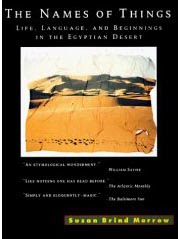
BOOKS | The Names of Things

The Names of Things

From The Names of Things:
Life, Language, and Beginnings in the Egyptian Desert

by Susan Brind Morrow

I'm halfway through the book. We pick up a book with a certain expectation of what we're in for -- but right now the book seems to be taking me in another direction. I'm trying to withhold my prior expectations and allow the book to unfold itself in my mind.

I keep going back to the first page, the page that caught my attention a few years ago and made me rush to buy the book. The stirring rumination on memory and word:

"You could keep some remnant of it, a talisman that would become rare and fine, worn over time into something familiar. It would naturally become more thin and precious the more the air wore it out, like the bones of a saint. After all, it was only an object in the physical world, not something more potent, like something in the mind: memory.

"But the original, the thing itself, would never come back. It had passed away from the world. You could conjure it, though, the emotion that kept it alive inside you, with a trigger: an image, a smell, a combination of sounds that formed it into a picture that stayed in your mind. That was the life of the thing after it died. The only thing that could bring it back.

"This is what a word is worth."

Some of us write to understand. We use language to give form to evanescent thoughts and emotions, the better to explain, either to ourselves or another. In this sense, language performs a process of crystallization, and we use this process for in our the desire to encapsulate experience. I keep a journal. It is my record of the moments that I want to secure for just that little bit longer.

I have been thinking about this desire in us. Memories will forever be about experience that has passed. Why do we write? Why did we create language? Is it nothing more than a means of capturing something lost?

The truth is I am reminded of something I copied down in my earlier journal a long time ago. That was more than ten years ago, but I wrote it down because there was something about it that felt true, and a little threatening to someone who has depended on the written word. The Egyptian god Thoth gave the science of writing to mankind. Thamus warns of the gift:

"This discovery of yours will create forgetfulness in the learners' souls, because they will not use their memories; they will trust to the external written characters and not remember of themselves. The specific which you have discovered is an aid not to memory, but to reminiscence, and you give your disciples not truth, but only the semblance of truth; they will be hearers of many things and will have learned nothing; they will appear to be omniscient and will generally know nothing;"

~ Phaedrus

I thought this will be a book about writing. It is, in an intimate way -- but it seems to me Susan Brind Morrow also shows how we lost something with our acquired literacy. She tells of the illiterate natives she meets on her travels in Egypt and Sudan, and how she learns a greater appreciation for "something any nomad or illiterate pesant knew; the intangible treasure of memory, of memorized words."