Monday, November 13, 2006

Between Eros and Thanatos

From The Guardian, Patrick Süskind explores the elusive connection between Eros and Thanatos.

I'm posting this article because he examines Orpheus and his journey into the realm of death for a love. And yes, as you can tell from the name of this blog, the Orphic myth is one that has intrigued me - but for a different reason.

The life of Orpheus ends not with a well-judged "It is finished", representing the final moment of a grand plan for the salvation of the world, but with a simple lament for the one woman he loved. It began with the same lament. While the coming of Jesus as Messiah was prophesied, while he was born the Messiah and was the Messiah all his life, Orpheus entered myth and history as a man in mourning. He had lost his young wife when she was bitten by a poisonous snake. He is so inconsolable at her loss that he does something which may well appear to us mad, but is easy to understand: he wants to bring his dead beloved back to life. It is not that he questions the power of death in itself or the fact that it has the last word, still less is he concerned with overcoming death on behalf of all mankind or achieving eternal life. He wants only this one woman back, his beloved Eurydice, and he wants her back not forever and ever, just for the length of a normal human life, to be happy with her on earth.

So Orpheus's venture into the underworld is not to be regarded as suicidal - he was no Werther, no Kleist, and certainly no Tristan - but as a bold venture looking towards life, and indeed desperately fighting for it.


Full article.

Sunday, November 12, 2006

New Trailer for Spider-Man 3

See the new trailer for Spider-Man 3. Wicked.

Just a question: where's Gwen Stacy?

Bad Hair Day

Sid Vicious

Bad hair day.

Had my hair cut short yesterday. Not liking it much. Then this morning I saw myself in the mirror and I swear, I look like Sid Vicious.

Last Saturday

I have been listening to Shawn Colvin's new album, These Four Walls for the past week. Shawn Colvin is still worth listening to, one of those artiste that just held on to their music the way they wanted to play it. She's not a one-hit wonders, although she did have ONE HIT with that catchy Sunny Came Home. But I like Shawn Colvin for music that's simple - a beautiful voice, a guitar and some accompanying instruments. Nothing too fanciful between you and the music.

Then suddently I was at HMV on Saturday, and I was gripped by this need to possess Restrospective: The Best of Suzanne Vega. I was in a music nostalgia. Anyone remembers her singles, Luka, Tom's Diner or Caramel?

Thursday, November 09, 2006

BOOKS | Tigers in Red Weather

Michael Dirda reviews Ruth Padel's Tigers in Red Weather.

Ruth Padel is better known as a poet in the UK. Here is the chronicle of her travels to India, Nepal, Bhutan, Russia, Korea, China, Indonesia, and Myanmar in search of tigers. It looks promising. Witness what she writes of the great hunter:

"Tigers naturally hunt secretly. Their technique is all about getting close under cover. It is the art of stillness, geometry, concealment. Tigers have great speed over short distances but are no use in a long chase. Once they get into a race with prey they have lost. . . . Tigers are heavy, and work through long grass, dense bushes, trees. It can take hours. The angle you come from is all. A hunt ends with a burst of explosive power but depends on long preparation. The fifty yards that a jungle-smart man will cover in two minutes, thinking he is quiet, may take a tiger fifteen. The tiger will really be invisible. Rather than risk the faint crackle of a dead leaf, she will slowly crush it to dust."


Totally useless trivia: Did you know Ruth Padel is the great-great-granddaughter of Charles Darwin?

Regrets

The thought of today is regret. Things you have done. Things you have failed to do. And the consequence of it haunting you day after day.

I have loved badly, loved the great
Too soon, withdrawn my words too late;
And eaten in an echoing hall
Alone and from a chipped plate
The words that I withdrew too late.

~ Edna St. Vincent Millay

Wednesday, November 08, 2006

BOOKS | Bound to Please

I had the pleasure of picking up Michael Dirda’s Bound to Please recently. It is an extraordinary collection of his contributions to The Washington Post Book World, as well as a grand testimony to a life-time of reading.

I wish to single out my favourite book essay: Dirda’s review for A.S. Byatt’s Possession. The entire review could be condensed with a single, drool-splattering, "Wow." But it is the little Postscript he added to the version published in Bound to Please that I love. He reveals that the Byatt review has personal significance for him, as it was published the day his youngest son was born. Soon after reading the review, A. S. Byatt invited him out for lunch. They have become friends since.

This is the kind of reviews I like. The sheer humanness in it, that brings you back to why you read in the first place.

Michael Dirda has become a reviewer I seek out. He writes book reviews like a fanboy with a hard-on (I meant this as a compliment). I’ve found his reviews often personal and engaging. Some might argue, the point of the book review is the book itself – not the reviewer. I agree, but Michael Dirda injects his essays with a heartfelt personal engagement that sparkles and brings it to life. Afterall, for many of us, reading is a highly personal experience. Ex Libris, as they say. Out of the book. We read for what the book reveals of ourselves, and we are often the better for it.

I can’t abide reviewers who approach their readings like an autopsy. Clinical, detached, cold. I want biro, I want bile. I want the occasional bitchiness if the book is really bad.

When I pick up books on books like Bound to Please, I always skip ahead to the essays on books I’ve read (or want to read). For me, book reviews is a kind of dialogue with the reviewer (where I am doing most of the listening). We read book reviews, not just to seek out more books to read, but because we want to know what someone think about the book. We want to know how they feels - and do we agree with them?

Watch as I skipped to Page 306 in the Norton edition of Bound to Please. Here Dirda writes about Judith Thurman’s Secrets of the Flesh. Or rather, he writes about Colette and her vibrant, passionate life - full of pleasures and frustrations, contradictions and mysteries. I adore Colette. And I like this man, Michael Dirda, who writes so respectfully of Colette.

Most importantly, Michael Dirda is a true reader after my own heart: A man who reads beyond genres. In this collection alone, you can find reviews on the books of Terry Pratchett, Ben Okri, Philip Pullman as well as Umberto Eco. You can also check out Dirda’s essays on the biographies of a variety of literary figures such as Bruce Chatwin, John Ruskin, Jorge Luis Borges, and Edgar Rice Burroughs. (I recommend his piece on the biography of Samuel Beckett. I came out of it admiring the great-hearted Beckett.)

And if you are really interested, on Page 9 Dirda reads The Bible.

BOOKS | Aubrey-Maturin Reading List


  1. Master and Commander

  2. Post Captain

  3. HMS Surprise

  4. The Mauritius Commander

  5. Desolation Island

  6. The Fortune of War

  7. The Surgeon's Mate

  8. The Ionian Mission

  9. Treason's Harbour

  10. The Far Side of the World

  11. The Reverse of the Medal

  12. The Letter of Marque

  13. The Thirteen-Gun Salute

  14. The Nutmeg of Consolation

  15. Clarissa Oakes

  16. The Wine-Dark Sea

  17. The Commodore

  18. The Yellow Admiral

  19. The Hundred Days

  20. Blue At the Mizzen


Monday, November 06, 2006

LIFE | Fifth Mindfulness Training

The fifth mindfulness training: "Aware that true happiness is rooted in peace, solidity, freedom and compassion, and not in wealth or fame, I am determined not to take as the aim of my life fame, profit, wealth or sensual pleasure, nor to accumulate wealth while millions are hungry and dying. I am committed to living simply and sharing my time, energy and material resources with those in real need."
~ Venerable Thich Nhat Hahn

How often do I lose myself?

Some time back, due to a breakdown in the relationship with my bosses, I was passed over for the promotion. Since then I have learnt to "play nice" and the situation with my superiors have improved.

I was promoted last week; the promotion is an indication of how things can change for the better if we make a sustained attempt toward positive changes.

However, for the past week I have been wondering what this promotion really means to me.

I see the promotion as a tangible acknowledgement of my hardwork and abilities, as such, it is important to me to have my superiors recognise my effort. But I am often reminded of how hardwork often goes unappreciated. It is more important to work hard, and work towards the positive for its own sake.

I ask myself: I am the sort of person that co-workers feel comfort approaching for help? Have I been generous with my time and expertise with my co-workers? And the answer is: not all the time. So I ask myself: then what does it matter, if they promote you or not?

I came to the teachings of Thay Thich Nhat Hahn during a period of emotional upheaval. I was desperate for anything that might be helpful, and I scoffed at what I read initially. But gradually the greater wisdom took root, and he has been an immense spiritual influence in my life since. I came across the quote on the Fifth Mindfulness Training last week, while musing over the promotion. It puts things in perspective for me, and the promotion now seems almost anti-climatic.

But not to the colleagues in my department of course. I was promoted with another colleague in the department. To celebrate our joint promotions, we will be buying dinner. The date has been set for 23rd November.

"What is it for?" my Director asked us, when we invited him to dinner. He checked his organiser. "It’s Thanksgiving. The 23rd is Thanksgiving."

"We’re giving thanks," I quipped. I realised later I wasn’t joking.

I am often frustrated and bitter at the things that failed to come my way. But life is often so much better when I can learn to give thanks for the little things that I actually have.

I know this, and yet it is still a lesson I have to re-learn ever so often.

How often do I lose myself in the pursuit of things that do not matter?

Friday, November 03, 2006

QUOTES | Dumas

"I intend that my last work shall be a cookbook composed of memories and desires ..."

~ Alexandre Dumas, 1869

Thursday, November 02, 2006

WTF | Kitty Vader


There are warped minds out there ...

Tuesday, October 31, 2006

Comic Not Artform

Gene Luen Yang's graphic novel, American Born Chinese has be nominated for a National Book Award in the young people's literature category. Tony Long is a copy editor from Wired and he has this to say about the nomination:

But it's a comic book. And comic books should not be nominated for National Book Awards, in any category. That should be reserved for books that are, well, all words.

This is not about denigrating the comic book, or graphic novel, or whatever you want to call it. This is not to say that illustrated stories don't constitute an art form or that you can't get tremendous satisfaction from them. This is simply to say that, as literature, the comic book does not deserve equal status with real novels, or short stories. It's apples and oranges.

If you've ever tried writing a real novel, you'll know where I'm coming from. To do it, and especially to do it well enough to be nominated for this award, the American equivalent of France's Prix Goncourt or Britain's Booker Prize, is exceedingly difficult.


I'm linking the full statement here. Just so that you can read for yourself what he wrote.

(I have seen the graphic novel in question. In fact, I ordered it for our bookstore. I would not consider a mediocre work, though it's not actually representative of Chinese culture per se; it tells a story and the artwork is good.) Now, personally I LURVE Mr Long's whining about the "Age of Mediocrity". I feel closed-minded opinions like Mr Long's in fact contribute significantly to this dark Age of Mediocrity. Expand your mind, Mr Tony Long, and get an idea. It is the quality of the work, not the medium that matters here.

The cool bit is Neil Gaiman's dignified response to Tony Long. (Neil Gaiman's The Sandman won the World Fantasy Award - and some people they will never allow a comic book to win ever again):

I suppose if he builds a time machine he could do something about Maus's 1992 Pulitzer, or Sandman's 1991 World Fantasy Award for Best Short Story, or Chris Ware's Jimmy Corrigan winning the 2001 Guardian First Book Award, or even Watchmen's appearance on Time's Hundred Best Novels of the 20th Century list. Lacking a Time Machine, it seems a rather silly and antiquated argument, like hearing someone complain that women have the vote or that be-bop music and crooners are turning up in the pop charts.

I like the bit where he says that he hasn't read the comic in question, but he just knows what things like that are like. It's always best to be offended by things you haven't read. That way you keep your mind uncluttered by things that might change it.


Neil Gaiman is my Number One Nice Guy. I sat next to him at a luncheon once. When they served me my vegetarian set, Neil, misunderstanding that the hotel screwed up on my order, offered me his fish. Awww, what a sweet guy ... ;)

Friday, October 27, 2006

YOUTUBE | Funniest Feedback Survey EVER

Some lecturer are the university was conducting a survey for his teaching method during lecture. It turns out to be really funny. Must watch!

Thursday, October 26, 2006

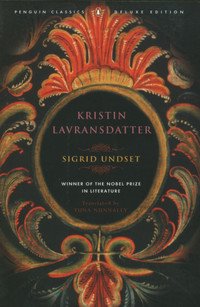
100 Books To Read 2007 | Set In Stone Selection #1

Penguin Deluxe Edition

It's only October 2006, but I'm already planning my 100 Books To Read 2007. It's a bit of a headache, as I'm not even halfway done with the 2006 reading list. I'll probably carry some titles over for 2007.

I'm still shortlisting (and abandoning) titles. But some titles have been Set In Stone as Must Reads. So, here I present:

100 Books To Read 2007
Selection #1: Kristin Lavransdattar by Sigrid Undset

For those who have never heard of Sigrid Undset, you're in good company. I'm ignorant of Norwegian literature. Part of the purpose of my 100 Books To Read list is to set a schedule for myself to read more widely. Thankfully, William T. Vollmann did a recent round-up of Norwegian books to check out for Salon.com. Here is what he wrote about Kristin Lavransdattar and her other masterpiece, The Master of Hestviken:

Kristin Lavransdattar's three novels (1920-1922) follow their eponymous heroine from her early childhood to her death from the Black Plague. It is one of the greatest love stories ever written, because it is one of the truest. For the sake of a man, Kristin sacrifices a great deal that she values, including her purity, her honesty and her obedience to her father, who is one of the most lovingly delineated characters in literature. She finally marries her sweetheart, only to learn that he and she cannot make each other happy. But Undset manages to convince us that if happiness will not be hers, perhaps she has won something similar to the treasure of an Eddic heroine: a destiny, a doom, that simultaneously fulfills and befits her. At the end, one feels that she could not have lived her life in any other way, with any other man.

"The Master of Hestviken" (1925-1927) is also a love story of sorts. The hero of this tetralogy is a friendless orphan named Ølav who cleaves only to his foster sister, Ingunn, a weak-willed, sickly girl to whom he was betrothed by his dying father. When the young couple are parted by violent legal difficulties, Ingunn has a fling with an Icelander and gets pregnant. To save her honor, Ølav kills the seducer, marries Ingunn and gives out that the child is his. All his life he longs to confess the manslaughter and do penance for it, but first Ingunn pleads with him not to, and then later, after she has suffered a long and ghastly death, he feels a mixture of duty to Ingunn's memory and revolted pity for the bastard, who adores him; and so the years go by, until this faithful, loving, bravely steadfast man has been utterly eaten up by his unshrived sin. Every time I reread this book I try to find the place where Olav "went wrong," and I cannot. This work reminds me of Sophocles -- or, better yet, of the old Norse sagas, whose heroes are simply "fated" to do what they do. Indeed, Undset's Norway retains its Eddic dwarfs, elf temptresses and mountain dwellers. Even Odin and the death goddess Hel get mentioned. And both Kristin and Olav are Eddic in their uncomplaining bearing of destiny's burden.

~ From Salon's Literary Guide to Norway


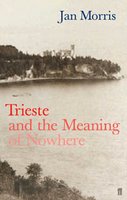
JAN MORRIS | Trieste

Melancholy is Trieste's chief rapture. In almost everything I read about this city, by writers down the centuries, melancholy is evoked. It is not a stabbing sort of disconsolation, the sort that makes you pine for death (Although Trieste's suicide rate, as a matter of fact, is notoriously high.) In my own experience it is more like our Welsh hiraeth, expressing itself in bitter-sweetness and a yearning for we know not what.

Trieste and the Meaning of Nowhere
By Jan Morris
Published by Faber & Faber

When I found out Jan Morris turns 80 this October I decided I have to pick up Trieste before - well, before anything permanent happens to her. Okay, it's a morbid thought. But as soon as I finished the final pages of The Master and Margarita, I picked up Trieste. And that was 3 am in the morning.

I have always wanted to read Jan Morris, but -->insert excuses here<-- Excuses aside, I've since set down Trieste and the Meaning of Nowhere as the first Jan Morris book to read. Really.

Trieste was said to be her last book. Thankfully, that has been proven to be just an unfounded rumour since the publication of Morris' novel, Hav, in 2006.

What do I know about Trieste? Very little. I happen to know James Joyce lived there for a while, and he taught English to a middle-aged Triestino gentleman who will one day be know as Italo Svevo. Otherwise, nothing at all.

Why does Jan Morris come back to this dead seaport that lies in limbo - officially a part of Italy - yet according to a poll in 1999, 70 percent of the Italian people have no idea Trieste actually belongs to Italy.

Jan Morris first came to Trieste as a young man. It was at the end of the Second World War, and James Morris was a soldier in Her Majesty's service. Decades later, after her gender-reassignation surgery, she returns to Trieste, the city that is for her, "an allegory of limbo."

"My acquaintance with the city spans the whole of my adult life," she writes, "but like my life it still gives me a waiting feeling, as if something big but unspecified is always about to happen.”

Trieste is a place sympathetic to Jan Morris's heart. She tells us of listening to Signor Umberto Lupi, a famous Trieste artist who sang in the Trieste dialect. He is of a certain age himself, and his audience elderly. As Signor Lupi sang his sweet songs, in their language, the eyes of his audience were full of tears. Jan Morris wept with them. Because she knows the songs will not last much longer, because she is at an age where you realise the best years of your life is behind you, and what is to come, dark. This is the state of unease, where you have not yet resigned from life, yet aware of the inescapable decline. Like Trieste, Jan Morris faces these questions: where do you belong in the world? Where do you go from here?

I am homesick, I am thinking sad thoughts about age, doubt and disillusion, but I am not unhappy. I feel there are good people around, and an unspecified yearning steals narcotically over me - what the Welsh call hiraeth. Pathos is part of it, but in a lyrical form to which I am sentimentally susceptible, and at the same time I am excited by a suggestion of sensual desire. The allure of lost consequence and faded power is seducing me, the passing of time, the passing of friends, the scrapping of great ships! In sum, I feel that this opaque seaport of my vision, so full of sweet melancholy, illustrates not just my adolescent emotions of the past, but my life-long preoccupations too. The Trieste effect, I call it. It is as though I have been taken, for a brief sententious glimpse, out of time to nowhere.

Tuesday, October 24, 2006

LIFE | Married Women

I'm reading Taslima Nasrin's blog on the Words Without Borders Forum:
I cannot talk for more than fifteen seconds with most married women. Because right from the start, they make you listen to what their husbands like to eat and like to wear and so on. Apart from this, they have no other stories of their own. Telling all these stories, they try to hold on in society because they think there's no other means by which they can hold on.

I find that I face similar problems with my married female friends. They used to be independent-minded swinging singles back when I first knew them. Then they marry, and then it's the husband - and later the children that occupy their conversation. It is their world, and I am interested - up to a certain extent.

What about you? I want to scream. What happens to these intelligent women when they marry that they have come to subjugate their identities to husbands and children?

OBITUARY | Eric Newby

Eric Newby, author of A Short Walk in the Hindu Kush, died on Friday, aged 86. First Wilfred Thesiger, now Eric Newby. Newby's one of the old guards of travel writing. They travelled and lived to write about it in the days before Lonely Planet guidebooks.

Someone go check on Jan Morris, please.

From The Guardian's obituary:

Evelyn Waugh wrote a preface to the book, which is considered a classic of travel literature. In it, Newby describes encountering the legendary traveller Wilfred Thesiger in Afghanistan. Thesiger observed Newby and his companion Hugh Carless inflating their airbeds, and told them: "God, you must be a couple of pansies."

Baba Novelist In Turkey

Orhan Pamuk's winning the Nobel Prize caused a mixture of anger and delight in his home country. In the Guardian, Elif Shafak offers an explanation, on the expected role of the novelist in Turkey.
So the novel - a literary genre which was new, modern and, unlike the old tradition of poetry, utterly western - gained a unique position. No wonder then that a novelist is always more than a novelist in Turkey. He is, first and foremost, a public figure. Novelists are the "babas", the fathers of their readers. They are loved and hated, looked up to and looked down upon. This is a society which is writer-oriented, not writing-oriented.

Full article.

La la lalala la la la la la

The Smurfs turns 48.

Did you know they were an allegory for Communism? I didn't. Must be the blue.

Commie Papa Smurf

POETRY | Mary Oliver Selections

Of course I have always known you
are present in the clouds, and the
black oak I especially adore, and the
wings of birds. But you are present
too in the body, listening to the body,
teaching it to live, instead of all
that touching, with disembodied joy.
We do not do this easily. We have
lived so long in the heaven of touch,
and we maintain our mutability, our
physicality, even as we begin to
apprehend the other world. Slowly we
make our appreciative response.
Slowly appreciation swells to
astonishment. And we enter the dialogue
of our lives that is beyond all under-
standing or conclusion. It is mystery.
It is the love of God. It is obedience.

Excerpt from Six Recognitions of the Lord

Sunday, October 22, 2006

YOUTUBE | SNL Parody of LoTR

SNL parody of Lord of the Rings – stars Jack Black and Sarah Michelle Gellar. It's very funny. ;)

POETRY | A Month of Days and Nights

A Month of Days and Nights

By Jane Hirshfield


Days that could have
been anything,
nights that could have been anything,
turned with the leaves.

Then, someone played
the piano -
halting, unpracticed, and perfect.

I listened to pity
and lowered my head in shame.
Ashamed not at my tears,
or even at what has been wasted,
but to have been dry-eyed so long.

Pink's Birthday

Pink

Pink's birthday is 8th September 1979.

This makes her Virgo. ;)

Friday, October 20, 2006

WTF | Your SESAME STREET Persona Test

WTF?? Guy Smiley? Not even Snuffle??!

Guy Smiley
You scored 45% Organization, 56% abstract, and 32% extroverted!
This test measured 3 variables.

First, this test measured how organized you are. Some muppets like Cookie Monster make big messes, while others like Bert are quite anal about things being clean.

Second, this test measured if you prefer a concrete or an abstract viewpoint. For the purposes of this test, concrete people are considered to gravitate more to mathematical and logical approaches, whereas abstract people are more the dreamers and artistic type.

Third, this test measured if you are more of an introvert or an extrovert. By definition, an introvert concentrates more on herself and an extrovert focuses more on others. In this test an introvert was somebody that either tends to spend more time alone or thinks more about herself.

You are mostly organized, both concrete and abstract, and more introverted.

Here is why are you Guy Smiley.

You are both mostly organized. You have a good idea where you put things and you probably keep your place reasonably clean. You aren't totally obsessed with neatness though. Guy Smiley is your average Joe. He'll dress up and look nice for his game show, but he's not a neat freak.

You are both a concrete and abstract thinker. Guy Smiley uses his imagination to come up with ridiculous game shows. However he's concrete enough to stick by his rules and perform his role as host. You know when to be logical at times, but you also aren't afraid to explore your dreams and desires... within limits of course.

You are both introverted. At first glance Guy Smiley may appear to be an extrovert given he hosts a popular show. But in reality he struggles to relate with other people. His prizes tend to just be Guy Smiley merchandise. For whatever reason you are a bit uncomfortable in social settings. You may have one or two people that you are close with. You'd rather do things by yourself and you dislike working in groups where things are always so inefficient.

The other possible characters are
Oscar the Grouch
Bert
Snuffleupagus
Ernie
Elmo
Kermit the Frog
Grover
Cookie Monster
Big Bird
The Count


My test tracked 3 variables How you compared to other people your age and gender:
free online datingfree online dating
You scored higher than 13% on Organization
free online datingfree online dating
You scored higher than 53% on concrete-abstra
free online datingfree online dating
You scored higher than 2% on intro-extrovert
Link: The Your SESAME STREET Persona Test written by greencowsgomoo on OkCupid Free Online Dating, home of the The Dating Persona Test

Thursday, October 19, 2006

LIFE | General Stuff

I have about three stacks of books reserved at my work desk. Every payday I buy some of the books reserved - spending only within the budget I set for myself.

My boss nags me from time to time on how much I spend on books every month. I always remind her that it's the books that keep me working for the bookstore. Take away my staff purchase privileges and I'll quit immediately for a more lucrative job.

For the past 2~3 years I've noticed my priorities shifting. Yoga and books have come to take an even larger role in my life. But I wonder if, instead of expanding my world as I hoped, I am merely diverting my energies from one narrow focus (JOB) to another (YOGA & BOOKS).

I haven't been spending much time meeting new people of late. I've been meeting the same people at work, at yoga class, or just at home reading. In spite of my preference for solitude, I still believe the social aspects of one's life is important to mental well-being. But then again, I have often been reminded that I'm not quite accepted as "sane". In fact, when I feel most myself, colleagues often ask me, "Are you okay?"

Am I going the right way in my life? Or should I make an attempt to expand my life. Perhaps try new things (salsa, perhaps?) Learn a new language (always wanted to learn Italian).

But I am content right now. Maybe a little complacent too. But I'm comfortable.

Tuesday, October 17, 2006

YouTube | Stupid Girl MTV

Ladies and gentlemen, let us revisit Pink's Stupid Girl MTV

Pink is just so fun! ;)

Dictionary | Definition of Catholic

Here is more proof that I'm not very bright. I didn't know there was an alternative definition of "catholic" - as in broad or wide-ranging in taste.

Does this means I have a catholic reading habit?

cath‧o‧lic 
–adjective

1. broad or wide-ranging in tastes, interests, or the like; having sympathies with all; broad-minded; liberal.
2. universal in extent; involving all; of interest to all.
3. pertaining to the whole Christian body or church.

Monday, October 16, 2006

The Three Musketeers

In The Times Online, Antonia Fraser reviews the new translation of The Three Musketeers positively.

Friday, October 13, 2006

Just One Day

Just one day.

Today, I found out someone I knew just gave birth to a baby boy. It's alway nice to hear news of this nature, even if you don't know them that well.

Later in the evening, I found out a good friend of mine will have problem having a baby. My friend also told me she had been suffering from insomnia these past few weeks. Her doctor placed her on one week's medical leave to rest. I think she's taking the news harder than she allows herself to admit.

We take a lot of things for granted. Things like having children. Some of us put it off, thinking we'll get around to having off-spring soon. Then one day it hits you - you've put it off too long and now the priviledge has been forfeited.

Orhan Pamuk

Orhan Pamuk

Orhan Pamuk wins the Nobel Prize for Literature, although I really believe it's a Nobel Prize for enduring stupid law-suit from your country.

He's not the only Turkish writer who has been sued recently for "anti-Turkishness" - Elif Shafak comes to mind. But I guess he's the most famous.

You can check out:

The New York Times write-up
The Guardian write-up.

FILM | Scoop

Scoop Movie PosterScoop (2006)
Directed by Woody Allen
Starring Woody Allen, Scarlett Johansson & Hugh Jackman

I confess I've never been a fan of Woody Allen's. I know The Brat likes Woody, but I don't get him. He's fidgety, nervous, self-conscious - I don't get it.

So how do I like Scoop - the cinematic latest enterprise from Woody Allen? I like.

My initial motivation for watching the film was Hugh Jackman and Scarlett Johansson. How can I not watch a movie with Hugh (Hugh! Hugh! Hugh!) and Scarlett? I wasn't expecting to like it, but I was entertained.

Woody Allen and Scarlett Johansson work well together as a comedic part. Most of the time it's Woody's nervous lines that set the laughs, but together they are fun. That line about how if they put their heads together "you'll hear a hollow noise" - you can see that. They are both such awkward, bumbling fools trying their legs at detective work they make you root for them.

And On her own, Scarlett Johansson's gawky, be-spectacled reporter character is endearing too. She was enthralling in Lost in Translation with her soulful, waifish blondeness. In Scoop, it's how she's obviously Scarlett Johansson - and yet convincingly unconscious of her own beauty. It warms me to her character.

Unbearable Hugh!

Next reason I like Scoop (or another reason why I love Hugh Jackman)- Hugh Jackman appearing in swimsuit, looking all wet and with a wide, wide smile. "You have great enamel," says Scarlett Johansson. Oh yes, I agree.

Yes, the character's flat and he doesn't do much acting in the movie. But he does the most important bit - striding around looking beautiful in his usual full-blooded stud-muffinness. What is it with Australia that has all these beautiful, heterosexual men that oozes such musculine charm? Just look at Eric Bana, Heath Ledger and even Russell Crowe has his own beefy manliness to him; I offer L.A. Confidential as supporting evidence to the meaty beauty of Crowe. (And in spite of what some people say, I think he pulled off Master and Commander splendidly. If I was the monarch of England, I want Russell Crowe commanding my warships).

Yes, the plot is thin, but it's a nice entertaining movie for a weekend. Woody Allen never meant for this to be a serious movie. That's why he threw in the bit with Death and the souls of the dead. And who can forget dark Ian McShane without his mustache? If you've watched Deadwood, you know how sexy that man can be with his rumbling voice.

Scoop is just fun.

Thursday, October 12, 2006

No Boring Place

From The New York Times:
I find that some business travelers are numb to the portals through which they pass, focusing only on the destination. I think they’re missing a lot. Something as mundane as an airport stopover can be fascinating. On a flight from Bali to Madras, India, I had a seven-hour wait at Changi International Airport in Singapore. Instead of sitting around like many of the other passengers, I made a room in the airport hotel my temporary headquarters and went exploring. Changi has a fabulous bookstore, a health spa, great restaurants and a permanent orchid show. It became a destination unto itself for me.

That’s when it occurred to me that there is no such thing as a boring place. Only boring travelers.


Full story here.

Wednesday, October 11, 2006

My Carebear

A 20th Anniversary Collector's Edition Friend Bear, from the Carebear Collection.

Brat may appreciate this. ;)

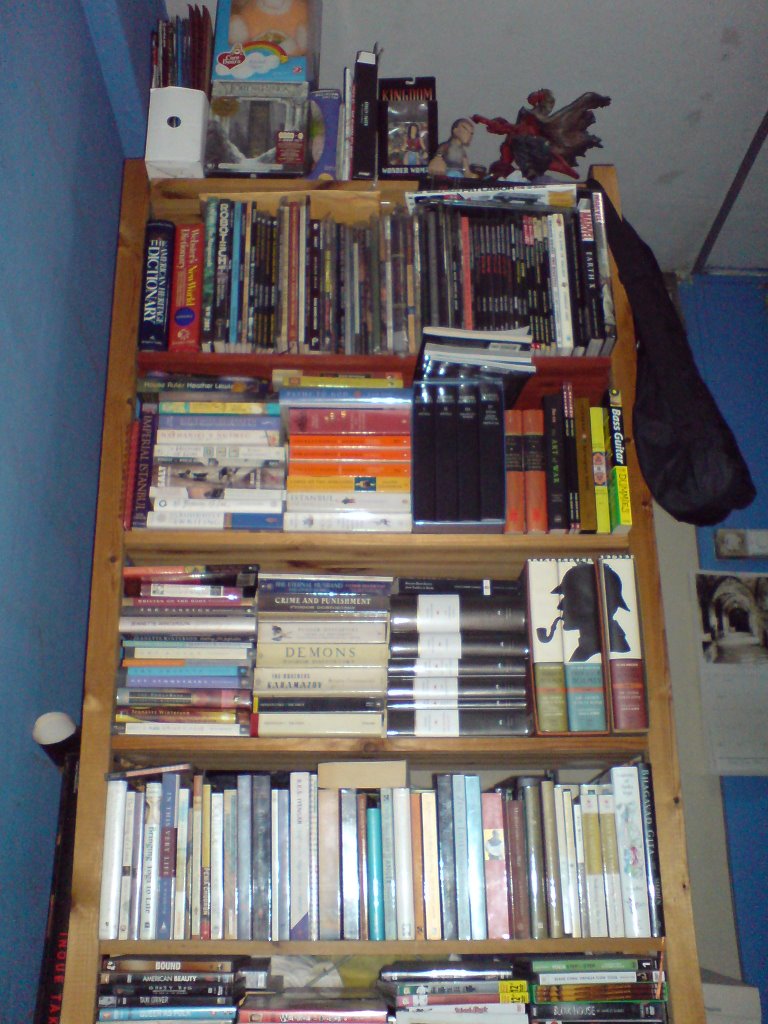
Looming Bookshelves of Death Part 2

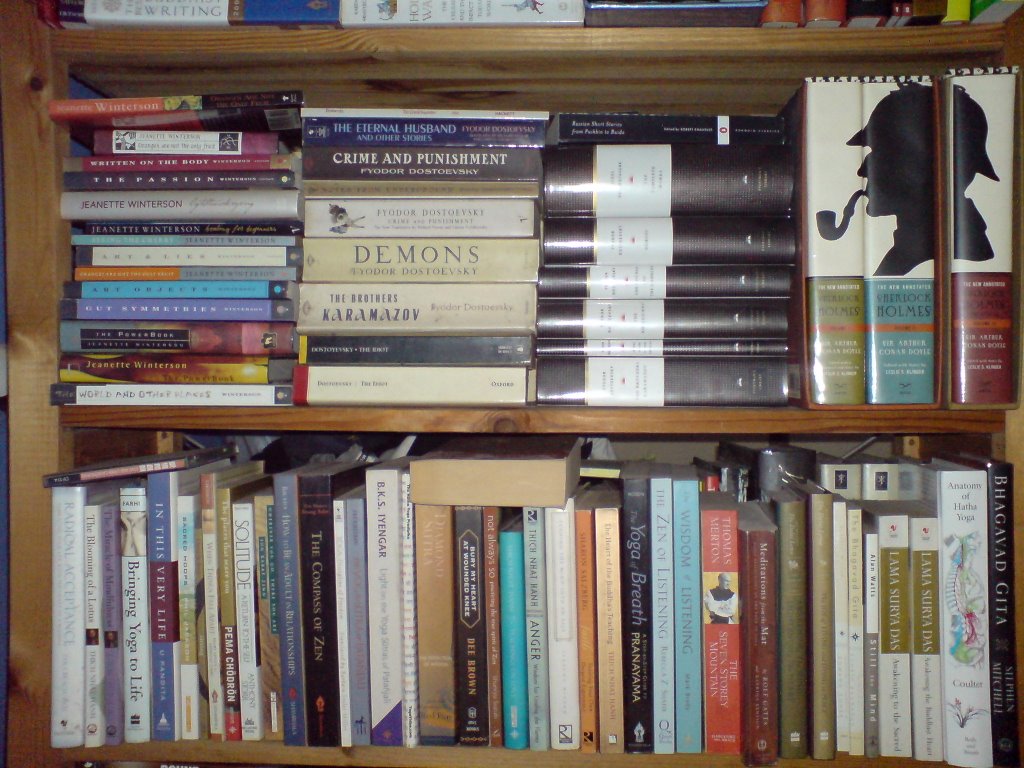
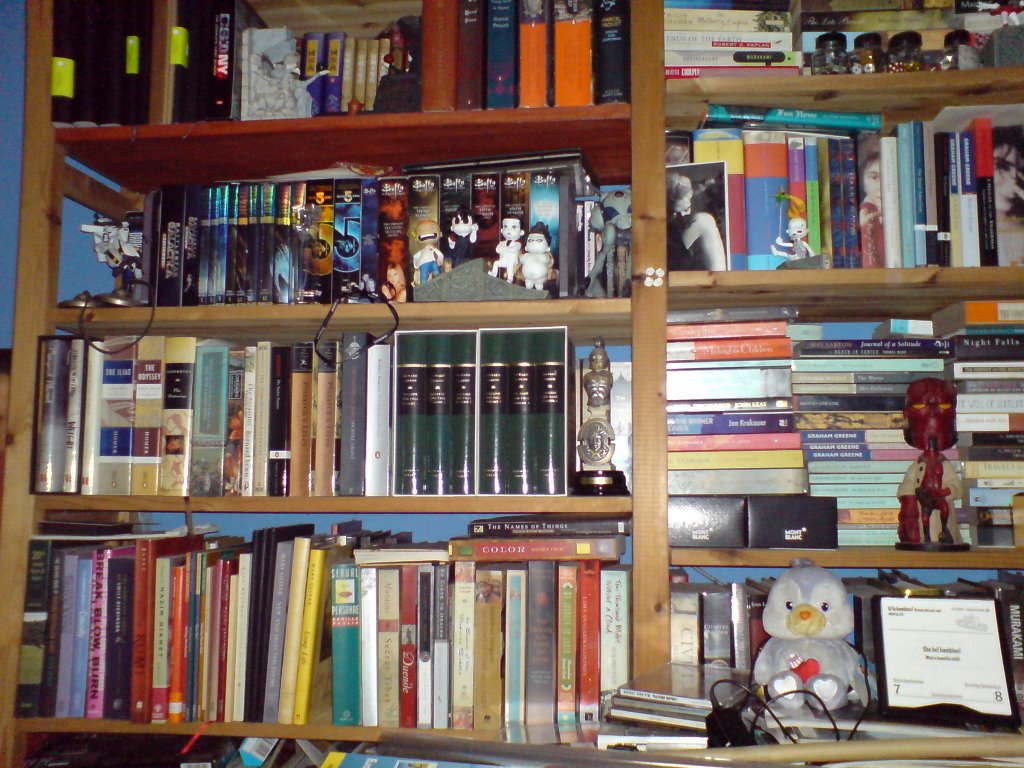
This is the bookshelf that sits facing my bed. It's the one with my favourite authors, as well as books on yoga and related subjects. It's also the bookshelf most likely to crush me to death in case of an earthquake.

[Picture 1 Above: A fuller view of the bookshelf. The long, black thing hanging off the top right hand corner is a yoga bag.]

[Picture 2 Above: Lower rows. Bottom row are the yoga, meditation and spirituality titles. Top row are the Jeanette Winterson titles, Dostoevsky in paperbacks and the Everyman hardcovers. And of course, Sherlock Holmes]

[Picture 3 Above: On the top row are mainly my graphic novels; The Sandman, Hellboy, Strangers in Paradise. Bottom row - standing upright are the collected works of Samuel Beckett, next to the Everyman editions of R. K. Narayan on the right]

That's it for bookshelves. I'll try to find something else to shoot with my camera phone.

BOOKS | What I'm Reading Now

Yes, I'm still playing with my camera phone. These are the books I'm in the midst of reading. The black book with the fountain pen is my journal.

Poetry | Foreign

I've came across discussions about reading poetry recently, and I find myself thinking about my own relationship with poetry. I admit I don't read a lot of poetry, even in school (I always preferred a good story.) As an English Lit major I had to read the important poets: John Donne, William Blake, W. H. Auden, Sylvia Plath and T.S. Eliot to name a few. But really, we read them because we had to; not everybody will come to loves Sylvia Plath (While I appreciate her works, I personally prefer Ted Hughes' earlier works- especially the shamanistic The Crow). Classroom poetry rarely made enough of an impact on our lives for us to carry them with us beyond school.

The irony then, that I discovered the poets I love after graduation.

I'm trying to recall the very first time I really responded to a poem on a deep, personal level. I guess it had to be Carol Ann Duffy.

We were using the anthology 20th Century Poetry & Poetics (edited by Gary Geddes) as a text for a third year module on 20th Century Literature. Carol Ann Duffy was not covered in the during class but some of her poems were in the anthology. I am of the disposition where the only time I do anything with interest is when I don't have to. So naturally, I read the poetry that are not included in the exams. I read Carol Ann Duffy's Foreign.

I cannot understand why this poem touched me. This is not about my situation in life. I should not be able to identify with the poem, but it moves me deeply. It is about me. Is it the universal theme of alien-ness within a cityscape that speaks to me, I asked myself - but this is the conditioned response of an English Lit student. In schools we were taught to approach a poem analytically. Look at rhythm, rhyme, structure, themes and motifs. What does it says? What does it mean? Suddenly, I stumble across a poem that hit me square in the chest. And I am less concern with what it say - but rather, how it makes me feel.

How it makes me feel is that I feel like the man who speaks but his words cannot translate. I try, but I do not understand the strangeness of the world I live in. And sometimes I feel that the world is unreal.

... and now you do not know
why your eyes are watering and what's the word for this.


Foreign
By Carol Ann Duffy


Imagine living in a strange, dark city for twenty years.
There are some dismal dwellings on the east side
and one of them is yours. On the landing, you hear
your foreign accent echo down the stairs. You think
in a language of your own and talk in theirs.

Then you are writing home. The voice in your head
recites the letter in a local dialect; behind that
is the sound of your mother singing to you,
all that time ago, and now you do not know
why your eyes are watering and what's the word for this.

You use the public transport. Work. Sleep. Imagine one night
you saw a name for yourself sprayed in red
against a brick wall. A hate name. Red like blood.
It is snowing on the streets, under the neon lights,
as if this place were coming to bits before your eyes.

And in the delicatessen, from time to time, the coins
in your palm will not translate. Inarticulate,
because this is not home, you point at fruit. Imagine
that one of you says Me not know what these people mean.
It like they only go to bed and dream.
Imagine that.


PS: To be fair, I should mention that whenever Christmas preparations start to drive me crazy, I make it a point to re-read T.S. Eliot's Journey of the Magi. I find that it helps keep the holiday in perspective. Perhaps something from classroom poetry did make a profound impression.

Monday, October 09, 2006

My Bookshelves

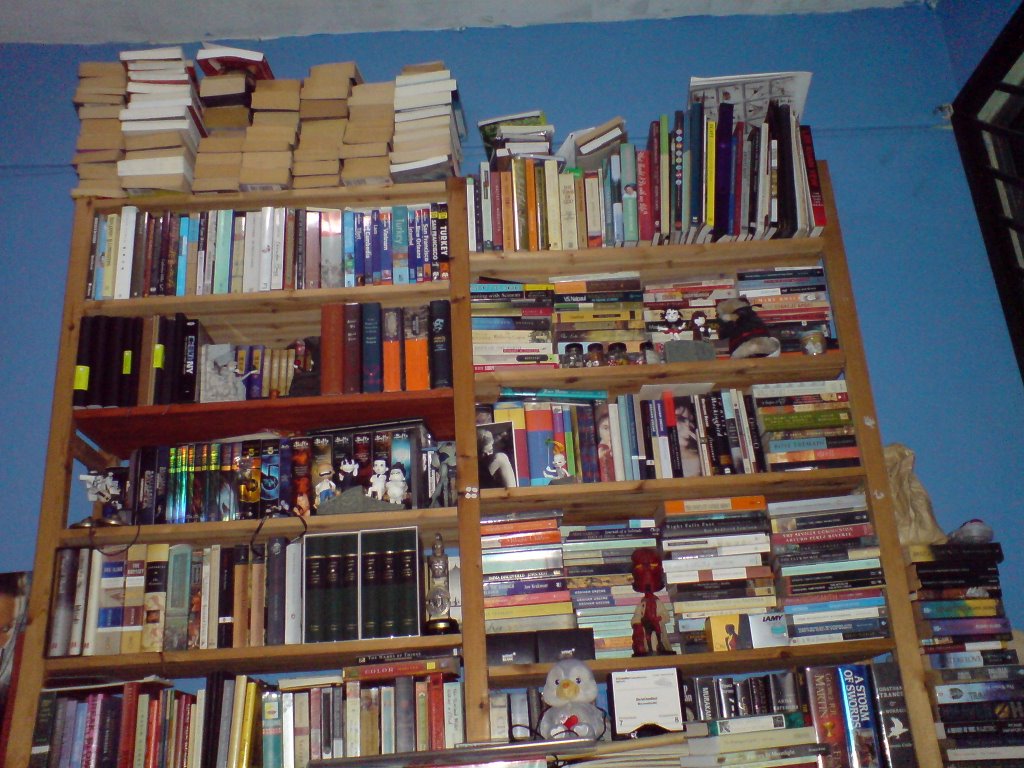
Bought a new camera phone, so I was trying out the camera function. A glimpse at my bookshelves in a gradual 3 parts view from the floor upwards. (Click on the picture for a larger view)


[Picture 1 Above] These are the stacks on the floor. No more shelf-space. The penguin is one of the Carebear Cousins. In the background you can see the bookshelves. My poetry collection (small collection) on the left, the hardcovers on the right.


[Picture 2 Above] Mid-rows of the bookshelves. Besides books, there are the Little Endless figurines, Robotech bookends, Sandman bookends. Next to the little Greek armour statue is Gibbons' Decline and Fall of the Roman Empire and other works on ancient history and mythology (such as Homer, Plutarch, Herodotus and Suetonius).


[Picture 3 Above] Is it just me or is there a "looming bookshelves of death" feel to this picture?

PROUST | Elstir and the Follies of Youth

An excuse to reference Proust, because all things are connected, and everything comes full circle.

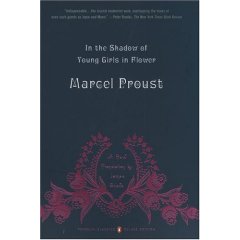
In the Shadow of Young Girls in Flower, the narrator finally meets the artist Elstir in Balbec. And Elstir, with regards to himself, offers the narrator some advice that would hopefully benefit the young man:

"There is no such thing," he said, "as a man, however clever he may be, who has never at some time in his youth uttered words, or even led a life, that he would not prefer to see expunged from memory. He should not find this absolutely a matter for regret, as he cannot be sure he would ever have become as wise as he is, if indeed getting wisdom is a possiblility for any of us, had he not traversed all the silly or detestable incarnations that are bound to precede that final one. I know there are young men, sons and grandsons of distinguised men, whose tutors, since their earliest high-school years, have taught them every nobility of soul and excellent precept of morality. The lives of such men may contain nothing they would wish to abolish; they may be happy to endorse every word they have ever uttered. But they are the poor in spirit, the effete descendants of doctrinarians, whose only wisdoms are negative and sterile. Wisdom cannot be inherited―one must discover it for oneself, but only after following a course that no one can follow in our stead; no one can spare us that experience, for wisdom is only a point of view on things. The lives of men you admire, attitudes you think are noble, haven't been laid down by their fathers or tutors―they were preceded by very different beginnings, and were influenced by whatever surrounded them, whther it was good, bad, or indifferent. Each of them is the outcome of a struggle, each of them is a victory..."

Respect Everything

The ego has a way of tricking us. We think we have matured, evolved to become a better person. Then something happens and we realise: Nope, still same old me. Still have miles to go. I'm still the same person making the same mistakes. And yet - I understand a little bit more now than I did.

I was thinking of something, so I went and dug out an old issue of Shambhala Sun.

There was a piece I recall a long time ago that stuck with me:


Te-shan asked the old tea-cake woman, "Who is your teacher? Where did you learn this?"

She pointed to a monastery a half mile away.

Te-shan visited Lung-t'an and questioned him far into the night. Finally when it was very late, Lung-t'an said, "Why Don't you go and rest now?"

Te-shan thanked him and opened the door. "It's dark outside. I can't see."

Lung-t'an lit a candle for him, but just as Te-shan turned and reached out to take it, Lung-t'an blew it put.

At that moment Te-shan had a great enlightenment. Full of gratitude, he bowed deeply to Lung-t'an.

The next day Lung-t'an praised Te-shan to the assmbly of monks. Te-shan brought his books and commentaries in front of the building and lit them on fire, saying, "These notes are nothing, like placing a hair in vast space."

Then bowing again to his teacher, he left.

Natalie Goldberg elaborated on this parable:

But, oddly enough, Te-shan only had that one meeting with Lung-t'an, and he woke up. Of course, he was a serious scholar of the dharma for a long time. Who is to say scholarly pursuits―studying books intently and writing commentary―don't prepare the mind as well as sweeping bamboo-lined walk-ways, sitting long hours, or preparing monastery meals?

Zen training is physical. But what isn't physical while we have a body on this earth? Sitting bent over books, our eyes following a line of print, is physical too. So that when Te-shan had that single evening in Lung-t'an's room, he was already very ripe. Lung-t'an merely had to push him off the tree, and Te-shan was prepared to fall into the tremendous empty dark with no clinging.

Te-shan was shown true darkness when Lung-t'an blew out the light; he held at last a dharma candle to guide his way, but he still had a lot of maturation ahead of him. Don't forget the next morning he made that grandiose gesture of burning his books in front of the assembly of monks. He was still acting out, choosing this and leaving that. He was not yet able to honor his whole journey, to respect everything that brought him to this moment. Te-shan still envisioned things in dualistic terms: now only direct insight mattered; books needed to be destroyed. He didn't see that all those years of study had created a foundation that supported his awakening with Lung-t'an. Originally he traveled from the north with his sutras on his back to enlighten the southern barbarians. Here he was doing a complete reversal, torching his past and revering his present experience. Someday he would embrace the north and the south, unify all of China in his heart, and attain a peaceful mind. But he was not there yet. We see him engaged in drama, presenting a flaming pageant in front of the other monks.

His life has not yet settled and become calm....

How can anyone survive if the way is so splintered? What we learn is it's all whole, been whole all along. It is our perception that is broken and that creates a shattered world. But each of us has to discover this in our own lives. That is what is so sad.


The excerpt is taken from, "When the Candle Is Blown Out," written by Natalie Goldberg, Shambhala Sun, September 2004 issue. There is a lot more in the article, but it is this particular parable of Te-shan and the burning of the books that I always come to. Like Te-shan in a way, I'd believe I need to burn away my past to move on. Yet time and time again, I am reminded that I am the sum of all my experiences, pleasant or otherwise. To deny any bit of my experience is to deny the whole of myself.

Ms F and I were talking one day. The question came up: "If you could go back in time, what would you change?"

Of course, as Ms F pointed out, it's a trick question. You can only learn from your mistakes after having made them. Without the mistakes you would not want to change anything. A paradox of life - that we need the mistakes and the regrets for change. That our screw-ups can lead to a realisation of something better. We just need to be ready to see.

Another time, another place. After yet another screw-up with her no-good boyfriend, Ms C asked me, "If you were in my place, what would you have done?"

Once again: trick question; if I was in her place, I would not have made the choices that led to her regrets and heartbreaks. Similarly, Ms C would not have made my mistakes; she would have chosen differently.

This is the burden of Free Will. We are no better that anyone else; We just make our own mistakes, each one on our own path. As Goldberg wrote, "But each of us has to discover this in our own lives. That is what is so sad."

This is what is so sad.

Even now, when I see my friends about to make similar mistakes, I try to warn them. I have been there, I tell them. It has costed me much suffering. Do not go there. Here we are - trying to change our past through another. But we never listen. What did I expect? That was how it was for me: advice fell on deaf ears, how I would not listen until I was ready to hear. Finally, it was the tremendous regrets that made me hear.

As the mud nourishes the lotus, yet not cling to the lotus. Respect everything that brought us to to this moment. I have to keep reminding myself of this.

Tuesday, October 03, 2006

Elegance, Audrey Hepburn Style

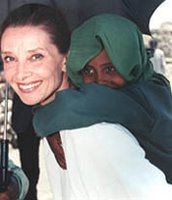
Photo Source: UNICEF/HQ88-0184/John IsaacSome background to this photo: In 1988 in Ethiopia, shaded from the sun by an umbrella, UNICEF Ambassdor Audrey Hepburn carries a girl while reviewing a UNICEF-assisted food supply project in the northern Amhara region of the country.

There was an exhibition for the works of photographer John Isaac, a few months back. Among the works on display were the UNICEF photos of Audrey Hepburn.

John Isaac had a close collaboration with Audrey Hepburn when she was special UN Ambassador for UNICEF: she said that his 1992 portrait of her surrounded by children in Somalia was her all-time favourite. (I can't be certain which photo specifically, so I put up one from John Isaac that I liked.)

When American Photo ran an issue on celebrity photography, they asked Isaac to ask Hepburn if they could airbrush her facial wrinkles.

Audrey Hepburn's replied, "Johnny, tell them not to mess with that picture. I’ve earned every one of those wrinkles."

That made an impression on me. Elegance, Audrey Hepburn style.

Bulgakov and Bakhtin

I finally finished re-reading Mikhail Bulgakov's The Master and Margarita last night. Translators do matter. It seems odd, to re-read the book, and feel like I'm reading it for the first time.

Bulgakov wrote around the same time as Mikhail Bakhtin, a Russian literary theorist. Both writers formulated their philosophy during the Stalin regime. Specifically, Bulgakov's novel made me think in the line of Bakhtin's idea of the carnivalesque. The carnivalesque serves as a strategy for destabilising the status quo which has become rigid and oppressive. It comes from the tension between that which is permitted and that which is forbidden, and is of particular significance to writers under a totalitarianism society.

In The Master and Margarita, Satan visits Moscow and causes much chaos. No one can stop him, because no one believes Satan exists in an atheist Socialist Russia. Society is unarmed by its own rigid worldview.

Will write more. I need to re-read Bahktin.

P/S: I've finally received my order of Colette's Earthly Paradise. It's out of print, but thank you for Abebooks.

Jan Morris

Jan Morris celebrates her 80th birthday on 2nd October, 2006.

The Guardian pays tribute to this extraordinary writer.

You can also check out:
1. The Guardian's Quick Guide to Jan Morris
2. Lonely Planet interview
3. Salon.com's Book Bag

Monday, October 02, 2006

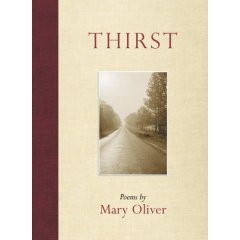
OLIVER | Thirst

Thirst by Mary Oliver

Just bought my copy of Mary Oliver's new poetry collection, Thirst.

The beauty about working in a bookstore is that you can always just walk up to the warehouse people and politely ask - "Are my books in?" If they like you, they will usually tear the cartons to get you the books. Otherwise, you wait - like everyone else. Hee.

I'm reading the collection tonight. Will definitely share any poems that inspires me.

Shteyngart on a Russian Slacker

From The New York Times, Gary Shteyngart writes "the most insightful essay ever written on the subject — a short, funny, but oddly moving meditation" on Ivan Goncharov's Oblomov. It's funny.

Read it here.

Friday, September 29, 2006

FEER Ban

Singapore authority has banned the Far Eastern Economic Review magazine. Somehow, this news depresses me.
In its press release, the government added that it was now also an offense to import or possess copies of the Hong Kong-based magazine, known by its initials FEER, for sale or distribution in the city-state.

Full write-up here.

From "Traveling Light"

The Perils of 'Going Native' by Rolf Potts
In The Songlines, Bruce Chatwin observes that nomadic animal species tend to be less dependent upon hierarchies and shows of dominance, since the hardships of the journey naturally weed out the weak. Now that nomadic life rarely involves natural selection, however, travel culture seems to have utilized fashion (among other things) as a subtle kind of litmus test. Ostensibly, a Shan jacket worn with a Mao hat and cotton pyjama bottoms implies that you had the Darwinian oomph to survive northern Burma, communist China, and the Punjab. (Wearing a fanny pack over a lungi, on the other hand, implies that you have yet to prove your evolutionary jam.)


Full article.

New Look

I got bored with the old layout. But now it's getting more complicated. Will see how I feel about this page.

Thursday, September 28, 2006

Penguin Classics Reading Group Reads

I'm not getting paid for this, but from Penguin Books with Amazon.com:
Penguin proudly announces the launch of the Penguin Classics Reading Group @ Amazon.com, a hosted forum to promote lively conversation about selected classics throughout the year. Our discussion of each title will continue for about six weeks, and selections will run the gamut from well-known favorites to cult classics representing writers from across the centuries and all regions of the globe. Please join us as we read great books together!

The Penguin Classics Reading Group will kick off with Robertson Davies' The Fifth Business.

Discussion will be faciliated by Kathryn Gursky, a librarian who had her 3 minutes of fame when her husband bought her the Penguin Classics Complete Collection to replace her personal library of some 2,300 books lost in a fire (Good husband!).

Go to Penguin Classics Reading Group

Bourdian Goes To Singapore

From The New York Times of all places, Anthony Bourdian eats in Singapore.

Monday, September 25, 2006

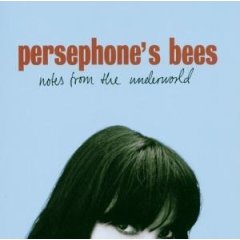
MUSIC | Notes from the Underworld

Notes from the Underworld
Currently Playing: Persephone's Bees: "Notes from the Underworld"

Been playing this album non-stop. It's catchy, in an upbeat, retro-dance-pop savvy kind of way. I can feel my feet and hips moving to the rhythm every time.

My favourite track: "Muzika Dyla Fil'ma," which is performed in Russian by lead singer, Angelina Moysov (who is apparently of Russian descent). Great vocals - she has a breezy, sultry voice that carries the songs confidently.

Thursday, September 21, 2006

Books I Would Like To Read But ...

Are Still In Expensive Hardcovers ...

#1. The Ruby In her Navel by Barry Unsworth
Not shortlisted for the Man Booker Prize, but still looks interesting. Love, and some of it involving a sensuous court dancer - all these taking place at the Sicilian court of King Roger in Palermo.

#2. The Three Musketeers by Alexandre Dumas; translation by Richard Pevear
Always wanted to re-read this classic, with the villainous Milady. And it's a Richard Pevear translation.

#3. Just Kids by Patti Smith
Patti Smith describes her relationship with Robert Mapplethorpe, from their first meeting in the early 1970s through their shared artistic ambitions. Just because I am a Patti Smith fan.

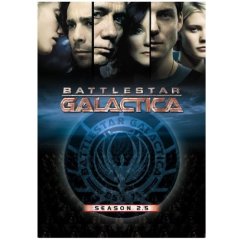
BSG 2.5

Battlestar Galactica
My Amazon order for Battlestar Galactica Season 2.5 has shipped!

Excitement!

Wednesday, September 20, 2006

Wedding Invitation

Came back last night from yoga class and I found the square envelope on top of my laptop. I recognise the roundish handwriting. So, the wedding invitation has arrived.

Some time back, I was at work. There was an old calculator lying around. I picked it up. There was a sticker on the back, with "Unit One" written in a familiar handwriting. It was a distinctive script. Roundish, like something written by the hand of a child. And for a very brief moment there was a tinge of nostalgic heartache.

Has it really been six years?

Of all the people that came and left - it is amazing that you are still my friend.

And now, your wedding.

In case I have to - in case you don't already know I wouldn't miss it unless I'm dead or in a coma:

RSVP - YES. I AM ATTENDING YOUR WEDDING.

Tuesday, September 19, 2006

A Year of Russian Masters

I've just started on the third volume of The Proustian Epic, The Guermantes Way. But barely 20 pages into the book I found myself picking up Mikhail Bulgakov's The Master And Margarita. I first picked up Bulgakov in the university library six year ago. Now, re-reading the Richard Pevear/Larissa Volokhonsky translation, it feels like a new book. The carnivalesque energy is simulating.

If there is a theme to my 100 Books To Read List this year, it's probably a Russian inclination. There is something about the Russian masters that fascinated me - their tragedy, their passions, their despair and their faith. I thought this year will be a good year to finally acquaint myself further with the Russian masters.

I've picked up Dostoevsky's The Idiot twice - but never finished it. Nastasya Filipovna is one of the most compelling femme fatale I've ever encountered in literature. Perhaps, I tell myself, perhaps this year I'll finish The Idiot.

I've not read War and Peace, or Anna Karenina. I loved the short stories of Nikolai Gogol - and desire to read Dead Souls. And Chekhov, the master of human tragedy.

Monday, September 18, 2006

OLIVER | Beans

Beans
By Mary Oliver

They're not like peaches or squash.
Plumpness isn't for them. They like
being lean, as if for the narrow
path. The beans themselves sit qui-
etly inside their green pods. In-
stinctively one picks with care,
never tearing down the fine vine,
never not noticing their crisp bod-
ies, or feeling their willingness for
the pot, for the fire.

I have thought sometimes that
something―I can't name it―
watches as I walk the rows, accept
ing the gift of their lives to assist
mine.

I know what you think: this is fool-
ishness. They're only vegetables.
Even the blossoms with which they
begin are small and pale, hardly sig-
nificant. Our hands, or minds, our
feet hold more intelligence. With
this I have no quarrel.

But, what about virtue?

Saturday, September 16, 2006

De Charlus By Fashion

Montesquiou

I saw that he had changed his clothes: the suit he now wore was even darker than the other one – no doubt true elegance is closer to simplicity than is false elegance, but there was something else about him: at close range, one sensed that the almost complete absence of color from his clothes came not from any indifference to color, but because, for some reason, he deprived himself of it. The sobriety apparent in his clothing gave the impression of deriving from a self-imposed diet, rather than from any lack of appetite. In the fabric of his trousers, a fine stripe of dark green harmonized with a line visible in his socks, the refinement of this touch revealing the intensity of a preference which, though suppressed everywhere else, had been tolerated in that one form as a special concession, whereas a red design in the cravat remained as imperceptible as a liberty not quite taken, a temptation not quite succumbed to.

~ from In the Shadow of Young Girls In Flowers

PROUST | Baron de Charlus

In The Shadow of Young Girls In Flowers

Still reading In the Shadow of Young Girls in Flower.

The narrator is still at Balbec with his grandmother. Saint-Loupe has made his appearance.

And I have finally been introduced to the larger than life Baron de Charlus.

Much have been written about de Charlus - one of Proust's most memorable creations, according to various critics and biographers. I have formed an impression of an aristocratic monomaniac, with an ego as consuming and glorious as the Sun, and everyone else just satellite around him.

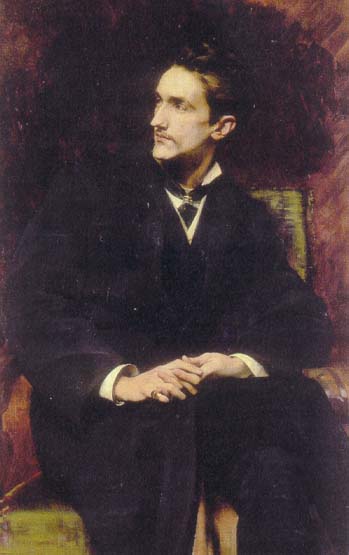
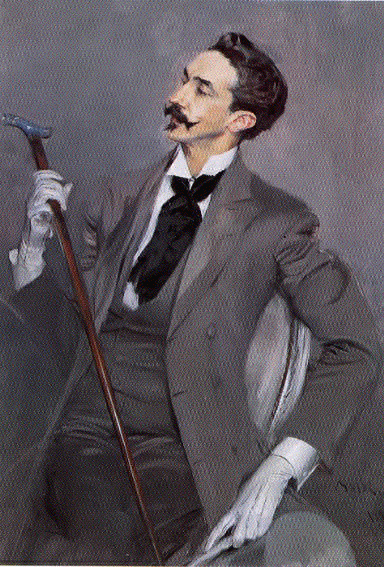
De Charlus is said to be loosely based on Robert de Montesquiou, French Symbolist poet and art collector – and all around snob.

Proust seemed to have fawned on Montesquiou, and it seemed like a calculated relationship for the writer. "Proust was impressed by Montesquiou's combination of reverence for the arts and extraordinary social connections; the young man shared the first and coveted the second," wrote Edmund White.

In fact, White has quite a few things to say about Robert de Montesquiou:


In 1893 Proust met Robert de Montesquiou at the house of the hostess-painter Madeleine Lemarie … Montesquiou – a monster of egotism who needed constant praise as exaggerated as that which Nero had required, and who could be as sadistic as the Roman emperor if it was not forthcoming – was thirty-seven when Proust, just twenty-two years old, met him. In 1909 he gave a hint of his pretensions when he answered a questionnaire (“Who are you?”) by saying: “Related to a large part of the European aristocracy. Ancestors: Field-Marshals: Blaise de Montluc, Jean de Gassion, Pierre de Montesquiou, Anne-Piere de Montesquiou, the conqueror of Savoy, d’Artagnan (the hero of The Three Musketeers), the abbot de Montesquiou, Louis XVIII’s minister, the General Count A. de Montesquiou, Napoleon’s aide-de-camp.” Proust admired his dandy with his leanness (“I look like a greyhound in a greatcoat,” he said of himself), his fabled friendships with legendary poets such as Verlaine and Mallarme, and his cult of the beautiful conducted in his extravagant house, the Rose Pavilion…

Montesquiou was a grand seigneur, distinguished by such overweening pride that a society painter was once overheard saying about him, “There’s one good thing about the French Revolution. If it hadn’t happened, that man would have us beating his ponds to keep the frogs quiet.”

In his high-pitched, grating voice Montesquiou was constantly recited his own poetry from volumes with names like Hydrangeas, The Bats, and The Red Beads, or presiding over literary and musical soirees. No praise was too extravagant, and Proust knew how to lay it on thick. "You are the sovereign not only of transitory, but of eternal things," Proust wrote him. On another occasion Proust (ridiculously) compared him to the seventeenth-century playwright Corneille, the father of Frrench classical theater. But Proust was also the master of the nuanced compliments; after Montesquiou showed him his celebrated Japanese dwarf trees, Proust had the nerve to write him that his soul was "a garden as rare and fastiduous as the one in which you allowed me to walk the other day ..." And Montesquiou heard that Proust kept his friends in stitches imitating his way of speaking, of lauging, and of stamping his foot. Most daring of all, Proust proposed to write an essay to be titled "The Simplicity of Monsieur Montesquiou," who had never been previously accused of such a quality.

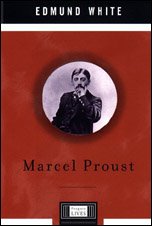
~ pp 59-60 from Marcel Proust: A Penguin Life

Portrait of Robert de Montesquiou, the inspiration for Proust's Baron de Charlus

<--- Portrait of a Snob

Friday, September 15, 2006

Footballers Are Children Too

Too funny not to post:
In Frank Lampard's book, for example, the long-suffering Chelsea dynamo tells us that during the 2004 European Championship the staff took the players out to McDonald's for a bit of a treat. Not much more is revealed, but those who witnessed the scene claim that there were a few tantrums when it emerged that the toy in David Beckham's Happy Meal was one of the surfer dude turtles from Finding Nemo, while the rest of the squad had to make do with a model of that camp Hispanic crab from Little Mermaid II.


Full story here.

Pope Benedict Shoots His Mouth Off

Somebody should just shut-up. And I'm not talking about Bush.

Another good reason why I choose to be irreligious.

Books Unread

I look at the books unread on my list. I am attempting to reconcile myself to the fact I probably will have to go to my grave with Moby Dick unread.

Man Booker Shortlist 2006

Desai, Kiran The Inheritance of Loss - Hamish Hamilton
Grenville, Kate The Secret River - Canongate
Hyland, M.J. Carry Me Down - Canongate
Matar, Hisham In the Country of Men - Viking
St Aubyn, Edward Mother’s Milk - Picador
Waters, Sarah The Night Watch - Virago

My bet is on Sarah Waters, but that's probably because it's the only book on the list I've read.

Thursday, September 14, 2006

Your Life In Boxes

Ms F is leaving for her studies at East Anglia next week. She messaged me this:
It's kinda surreal seeing your life summarised in 2 big boxes.
Only 1 year, girl. Unless they are on strike at East Anglia, then it'll probably be a little longer.

Stingray Mutilations

It seems Steve Irwin fans are on a stingray rampage to avenge the man:
Mr Irwin, a TV personality known as the "Crocodile Hunter", was killed while diving in Queensland when a stingray's barb stabbed him in the chest.

Since then, 10 stingrays have been found mutilated on Queensland beaches.

What a damn waste. You guys could have BBQ-ed the stingrays with lots of sambal chilli.

In honour of Steve Irwin, I propose that all fans go forth and eat a BBQ stingray.

Skeletal Art of Cartoon Characters

An artist has decided to render in art the skeletal system of cartoon characters like Charlie Brown and the Power Puff Girls. It should disturb me, but it doesn't. It's quite cute, actually.
I decided to take a select few of these popular characters and render their skeletal systems as I imagine they might resemble if one truly had eye sockets half the size of its head, or fingerless-hands, or feet comprising 60% of its body mass.
See here.

Link via Bookslut.

Wednesday, September 13, 2006

Matthiessen and Turgenev

I found this in an article on Peter Matthiessen:
"There's a line in Turgenev," he says, "That absolutely haunts me. It's a suicide note, and the entire note is, 'I could not simplify myself.' What an arrow through the heart!"

Tuesday, September 12, 2006

Rereading To Kill A Mockingbird

I re-read To Kill A Mockingbird this year. We outgrow childhood books, but there are the special ones that we can never shake off because it was pivotal in shaping the adult you become.

Like Jeanette Winterson, I am uncomfortable with someone who has no books in their homes – because then the person becomes a blank slate to me.

But more than the books you read, what you focus on in a book reveals something about you.

This is one of my favourite parts of To Kill A Mockingbird. I still find it stirring when I read it earlier this year. This is after the "guilty" verdict has been passed on Tom Robinson. Atticus about to leave the courtroom.

Judge Taylor was saying something. His gravel was in his fist, but he wasn’t using it. Dimly, I saw Atticus pushing papers from the table into his briefcase. He snapped it shut, went to the court reporter and said something, nodded to Mr Gilmer, and then went to Tom Robinson and whispered something to him. Atticus put his head on Tom’s shoulder as he whispered. Atticus took his coat off the back of his chair and pulled it over his shoulder. Then he left the courtroom, but not by his usual exit. He must have wanted to go home the short way, because he walked quickly down the middle aisle toward the south exit. I followed the top of his head as he made his way to the door. He did not look up.

Someone was punching me, but I was reluctant to take my eyes from the people below us, and from the image of Atticus’s lonely walk down the aisle.

"Miss Jean Louise?"

I looked around. They were standing. All around us and in the balcony on the people wall, the Negroes were getting to their feet. Reverend Sykes’s voice was as distant as Judge Taylor’s:

"Miss Jean Louise, stand up. Your father’s passin’."

I have always believed this scene is an affirmation. I was looking through my journal, and to this scene, I wrote:

It alway seems silly to cry at this point. But it’s redemptive, almost, this scene. As though it’s never a complete defeat. That in some little way, fighting to the end is its own victory.

With hindsight, I realise that for me, it is not enough to do what is right, just for the sake of doing the right thing. I want the accolades for my struggles.

Like Atticus, I want to be someone who will stand up for a Tom Robinson even if the world tells me not to. But - I want people to stand when I leave the courtroom.

For all the admiration I have of the character, I am not Atticus.

One is about someone else, the other - is about me.

I am still sorely human. And that - is something to think about.

My entry for 15th March 2006, just after I finished reading To Kill A Mockingbird:

Reread the book you loved from childhood, and remember why you loved it then, and why you cry.

That you still can cry at the parts that used to break your heart – maybe you have not lost as much as you supposed. Maybe the years haven’t hardened you so much. Maybe your experience had not caught up with your instincts.


I wonder. Maybe a part of me has not yet changed.

POETRY | Walking Home from Oak-Head

I was browsing through my September/October 2006 issue of Utne magazine. They have included a Mary Oliver poem from her latest collection, Thirst. The collection is due out this October, published by Beacon Press.

I adore Mary Oliver’s writings. I look to her poetry and essays for that breath of fresh air.


Walking Home from Oak-Head


by Mary Oliver


There is something
    about the snow-laden sky
        in the winter
            in the late afternoon

that brings to the heart elation
    and the lovely meaninglessness
        of time.
            Whenever I get home - whenever -

somebody loves me there.
    Meanwhile
       I stand in the same dark peace
            as any pine tree,

or wander on slowly
    like the still unhurried wind,
        waiting,
            as for a gift,

for the snow to begin
    which it does
        as first casually,
            then, irrepressibly.

Wherever else I live -
    in music, in words
        in the fires of the heart,
            I abide just as deeply

in this nameless, indivisible place,
    this world,
        which is falling apart now,
            which is white and wild,

Which is faithful beyond all our expressions of faith,
    our deepest prayers.
        Don't worry, sooner or later I'll be home.
            Red-cheeked from the roused wind,

I'll stand in the doorway
    stamping my boots and slapping my hands,
        my shoulders
            covered with stars.

Monday, September 11, 2006

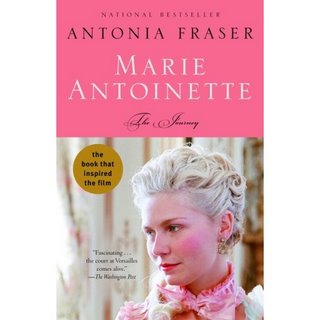
Marie Antoinette Film Tie-In Cover

So Pink!OMG! So PINK!

PENGUIN RED CLASSICS: Notes from Underground

Notes from UndergroundHere's the new jacket treatment for the awful Penguin red Classics. Okay, I would not buy this version, but something about the handsome young man with the dangling cigarette makes me want this as a poster in my room.

Edmund White on Proust

Our friendly local library has only one copy of Edmund White's Marcel Proust, and it's categorized under "Reference Only."

What this means is: for the past few weeks, I've been making weekend trips to the library just to read this book.

Gleanings from Edmund White, his take on why we read Proust:

Proust may have attacked love, but he did know a lot about it. Like us, he took nothing for granted. He was not on smug, cozy terms with his own experience. We read Proust because he knows so much about the links between childhood anguish and adult passion. We read Proust because, despite his intelligence, he holds reasoned evaluations in contempt and knows that only the gnarled knowledge that suffering brings us is of any real use. We read Proust because he knows that in the terminal stage of passion we no longer love the beloved; the object of our love has been overshadowed by love itself.

Edmund White has also praised Jean-Yves Tadié's biography of Proust as one of the best on the subject. It is awfully thick, and of course, the genius at our friendly local library has categorized it under "Reference Only."

*sigh*

SALON Goes Norway

Salon's the Literary Guide to the World goes Norway.

William T. Vollmann selects:

1. The Poetic Edda by Lee M. Hollander
2. Kristin Lavransdatter by Sigrid Undset
3. The Master of Hestviken by Sigrid Undset

Coincidentally, I've scheduled Kristin Lavransdatter for next year's 100 Books To Read. JN gave some positive feedback about it, but I'll probably speak to her about it later - AFTER I've actually read the book.

Friday, September 08, 2006

POEM | Optimism

Optimism

More and more I have come to admire resilience.
Not the simple resistance of a pillow, whose foam returns over and over to the same shape, but the sinuous tenacity of a tree: finding the light newly blocked on one side,
it turns in another.
A blind intelligence, true.
But out of such persistence arose turtles, rivers, mitochondria, figs--all this resinous, unretractable earth.

~ Jane Hirshfield

Wednesday, September 06, 2006

Books Echoing Life

And more on books that I'm reading that are echoing life:

The Black Dahlia, James Ellroy's noirish take on the gruesome murder of Hollywood wannabe - Elizabeth Short - dubbed "The Black Dahlia" after she was found mutilated and her body dumped. Her murderer was never found.

Meanwhile, the whole world is talking about the recent confession of John Mark Karr for the JonBenét murder. There are now doubts due to conflicting DNA evidence. The murder remains unsolved.

On an aside, Ellroy's novel is adapted into a movie starring Josh Hartnett, Scarlett Johansson, Aaron Eckhart and Hilary Swank. Mia Kirshner (most famous for playing the annoying Jenny in The L Word) stars as the dead girl, Elizabeth Short.

Best of Singapore Erotica


Okay, this is too funny not to talk about it.

Some time back, I blogged about a friend who's going to have a story published in the anthology, Best of Singapore Erotica. Wonderful thing is, she kept a copy of the book hidden in her wardrobe. Her high-strung dragon-lady of a mother found the copy while looking through her daughter's wardrobe (apparently Mother does frequent random search in Daughter's room).

That evening Mother insisted on having A TALK with my friend about RELATIONSHIPS.

Friend locked herself in her room the whole night.

Tuesday, September 05, 2006

YOGA | Wheel

H’s a nice Australian yoga teacher who came over to teach. How do I know he’s Aussie? Occasionally he comes to class in a singlet with "Australia" printed straight across the back. No one but an Aussie will wear a shirt like quite so unabashedly; feels like someone stuck a "Kick Me" note on his back.

Now, H. is a nice, funny guy who also happens to be a good yoga teacher. He has a slacker-dude sense of humour that I appreciate. His humour and chatter lifts the mood of his classes – important when your muscles are burning from holding the pose.


Last Saturday was Power Yoga 1 with H. Personally I find Power Yoga more demanding as I lack upper body strength. Last Saturday we were supposed to do Urdhva Dhanurasana (Wheel Pose). As you can see from the picture, it requires strength in the arms, shoulders and thighs: the areas of the body that I have yet to develop. Baron Baptiste calls it "one of the most powerful poses in yoga practice" – and he meant it.


H. understood not everyone is ready for it, and explained we do not have to try it if we are not ready. The first rule of yoga is Awareness. Be aware of yourself. Know your limits – when to surrender, when to push a little further.

I attempted the Wheel Pose that day. H. saw what I was doing, and he told me to stay down; I was not ready to go up.

When the class prepared to do the Wheel Pose for the second time. H. came over. He asked me to hold his ankles, to give me a better leverage in the arm-lifts. He assisted me in a modified version of Wheel Pose. I was grateful.

Later, addressing the class, H. reminded us that not everyone is ready for all the postures. But he will always allow us the choice to surrender or to attempt the asana. We make the choice. At the end of the day, it is our own practice.

I first learnt yoga more than three years ago in a crowded gym studio. I did yoga 3~4 times every week for more than a year. M, the yoga teacher, was a wound-up core of sheer yogic stamina. Her classes were demanding - and her battle-axe personality was intimidating. She pushed her students, sometimes shouting at them from across the room. I persisted, and because of her I grew stronger. We did Wheel Pose every Thursday. Didn’t matter if you can’t, you just try. If for no other reason, you tried because M was so scary. Then one day, I lifted.

I still remember the first time I went up in a Wheel Pose: The thrilling sensation of power as I pushed my body higher. I wanted to stay in the pose for a long time. My body was light, liberated.

In Urdhva Dhanurasana, I felt like I could fly.

Then I quit the gym. Without the regular yoga practice, I lost the muscular strength. And I couldn’t do the Wheel Pose last Saturday.

But in all that time at the gym, I have never felt so supported and safe - as I did last Saturday in H’s class.

I am grateful to H. – that he saw I was not strong enough, yet supported me in my struggling endeavour. I will continue working at my practice. I will continue to try the challenging poses. And I know H. will watch over me as I explore. I am grateful for a teacher that makes me feel safe.

Most of all, I want to fly again.

Monday, September 04, 2006

Salon's Literary Guide On China

I admit Salon.com's Literary Guide to the World starts with good (albeit ambitious) intentions. As Hillary Frey, Books editor at Salon wrote in her introduction:
"From Turkey to Togo, D.C. to L.A., Rio to Russia and beyond, the Guide promises to recommend the best books -- fiction, history, memoir or otherwise -- to take with you on your travels."

It's never an easy task, doing recommendations like this. Lists are often highly personalised choices, and doomed to the limitations of the people doing the selection. You will always be criticised for what you include, as well as your omissions.

But I have to bitch about the selection for China. Any list that does not include Louis Cha (or Jin Yong) in their list of great literature of China, does not understand Chinese Literature.

I happened onto the Chinese newspaper recently. In a study done on the national reading habits of the Chinese, Louis Cha ranked #1 as Best Loved Author. This is followed by Ba Jin and Lu Xun. Qiong Yao comes in at #4, but let's not go there. (My mother almost named me after a character from one of Qiong Yao's novels, so we really should not mention Qiong Yao here)

Louis Cha's novels are mainly in the wuxia (martial art) genre. The wuxia novel is rather unique to Chinese culture and I believe, the main reason why it resists translation into English, and why it's not better known among English-speaking readers. It's a pity, because in the same survey on Chinese reading habits, wuxia is the most read genre of choice amongst the Chinese.

In case you're interested, this is Nell Freudenberger's selection for Salon's Literary Guide to China:

  1. The Search for Modern China by Jonathan Spence
  2. Selected Stories by Lu Hsun
  3. Wild Swans by Jung Chang
  4. Ocean of Words by Ha Jin
  5. Oracle Bones by Peter Hessler

GUARDIAN REVIEW | Unsworth on Claudius

In The Guardian Review, Barry Unsworth writes on Robert Graves' Claudius novels (I, Claudius, Claudius the God) - which I have included in my 100 Books to Read 2006.

BOOKS | Turkish Literature

Salon's Literary Guide to the World goes Turkey

LIFE | SIMS 2, Books, Yoga

It is Monday again, so we due for another extract from Ms Winterson's The Times online column.

In case you're interested, you can read the column here.

I'm behind schedule on my reading of the Proustian epic. But in spite of my distractions, I still find the Proustian search of lost time seeping into my life and the things I read online.

Ms Winterson wrote on reading, and how we experience time:

If reading reclaims time, it realigns time too. Time for us is always slipping away — we talk about losing time, finding time, making time, and taking time. The wellbeing that we feel when we don’t notice time, because we are happy, or engrossed or in love, is the result of those rare moments when time inside us and time outside us are not in conflict. Reading is another way of allowing this to happen and, as it becomes a habit, like all habits, it affects the rest of our behaviour too. No question, reading is good for you.
I'm feeling that mild distress of "having not enough time." Between work, yoga and the rest of life (this includes chores like laundry) - I find less time to read.

For the past month I've stayed on course with my renewed commitment to my yoga practice. I go for yoga class straight after work, which means the earliest I reach home on weekdays is around 9pm. Dinner has become optional - but reading is still a priority after yoga.

I had intended to finish James Ellroy's The Black Dahlia over the weekend. I have not kept to this goal because I installed SIMS 2 on my laptap on Friday. I've been staying up late playing this game of simulated life - and it's addictive. On Sunday morning, I was up until 5 am even when I had a 11:45am Power yoga class later in the morning. Needless to say, it was a strain.

(Okay, I know - why not just skip yoga class and sleep in? Because I don't want to make it a habit of skipping class, that's why.)

Last night (or this morning) I was up until 3 am on the game. I woke up late for work this morning because of this. And I will be missing yoga class tonight. After work today, I'm going straight home to uninstall SIMS 2 - before it becomes a habit.
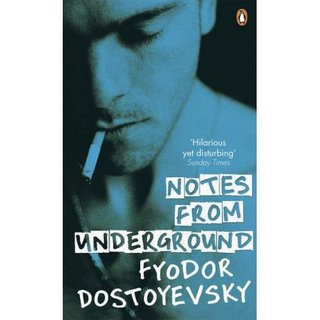
During the final years of university, a classmate neglected her thesis because she was addicted to MUD (Multi-User Dungeon). I have a similarly addictive personality, which is why I know I have to quit this gaming habit cold-turkey before it gets worst.

We are what we eat (and I'm also reading Fast Food Nation, so that's a scary notion) - similarly, the quality of our lives depends on what we spend time on. SIMS 2 allows me to control the lives of game characters. But I've neglected my own life in the process.

What I've absorbed from the Proust's epic is its journey for time lost. I speak of "lost" in the sense of time wasted. Like Charles Swann, after he fell out of love with Odette, I reflect on the time wasted in my life on things (and people) that did not matter. The revelation came only after I lost them. I decided there are things that are important and worth spending time on. I would rather give my time to family, friends, yoga and books.

This said, I'm taking time off yoga this Friday to meet up with Ms Foo and a mutal friend. Ms Foo will be flying on 18th September for her MA at East Anglia. She will be sorely missed for the year she will be gone.